
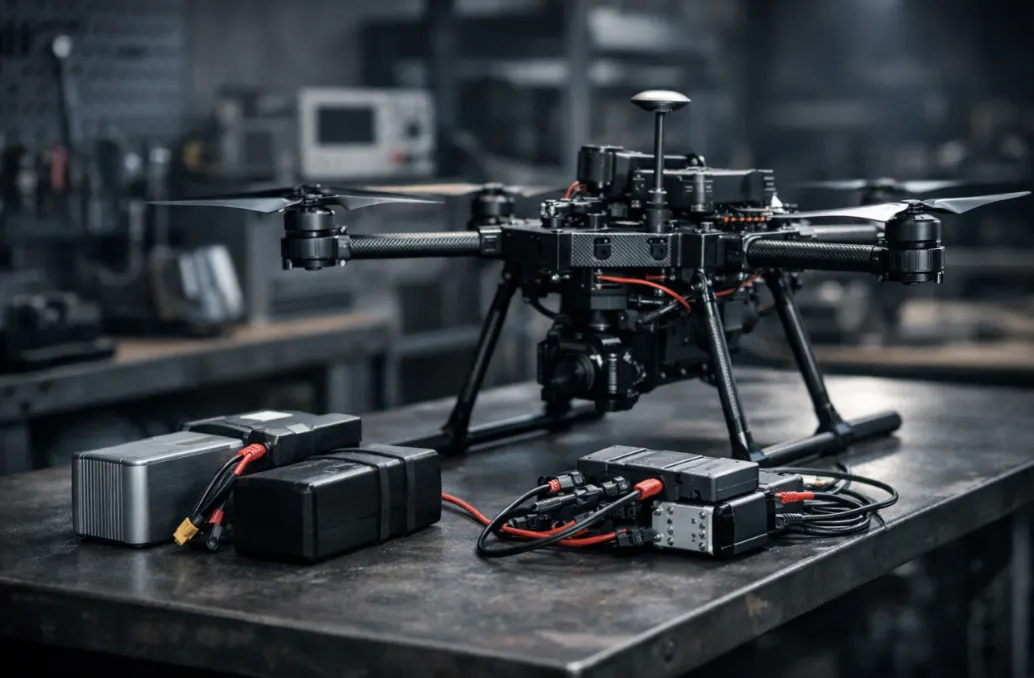
In UAV power discussions, 6S and 12S systems show up everywhere. Yet 7S seems like a logical middle ground: a little more voltage than 6S, without the jump in complexity that often comes with 12S. Many engineers search for a 7s lipo battery expecting an easy off-the-shelf option, then discover that standard 7S products are surprisingly hard to find. This article explains why 7S battery packs are rare in commercial drones and when a custom 7S design is actually worth the effort.
For a broader view of how system voltage choices affect endurance and integration, start with this guide on selecting the right 6S, 7S, and 12S battery pack for long-endurance drones and robotic platforms.
What Is a 7S Battery Pack?
A 7S battery pack is built with seven cells in series. When people ask what is a 7S battery, they usually want more than a definition. They want to know what that series count means for voltage range, current draw, heat, and whether their electronics can tolerate it.
What “7S” Means in Battery Architecture
“7S” sets a higher voltage window than 6S. For the same power, higher voltage reduces current, which can reduce resistive losses in wiring and connectors. Engineers also ask what is a 7S LiPo battery because LiPo is still common in high-power drones, and chemistry plus series count together determine peak-load behavior and heat buildup.
Typical Applications Where 7S Appears
You will most often see 7S in niche or semi-custom projects: prototypes, robotics platforms, or OEM systems where the full powertrain is engineered around a specific voltage window. For mainstream drones, the ecosystem usually steers decisions toward 6S or 12S.
Why 7S Battery Packs Are Rare in Commercial Drones
7S is not “impossible.” It is rare because drones are systems, not batteries. Voltage choice locks you into compatibility, supply-chain availability, and long-term support, and the ecosystem is built around 6S and 12S.
Ecosystem Lock-In Around 6S and 12S
Most UAV components are validated against common voltage standards. ESCs, chargers, regulators, and many accessories are designed with 6S and 12S ranges in mind. Moving to 7S often removes that “known-good” compatibility and increases integration risk.
This is why off-the-shelf options for a 7s lipo battery pack are limited. Even if a component can tolerate the voltage, the project risk comes from the full chain: firmware limits, safety margins, connector ratings, and heat under real mission loads.
Manufacturing and Supply Chain Constraints
Non-standard series counts create inventory and support costs. Low-turn SKUs are harder to stock, rotate, and keep consistent across lots. They can also require different test fixtures or documentation variants. Many suppliers therefore treat 7S as an OEM configuration rather than a standing catalog item.
Certification, Testing, and Support Complexity
Supporting a low-volume voltage variant means extra validation and troubleshooting. If a customer pairs 7S with electronics intended for 6S, failures may look like “battery issues” even when the root cause is system mismatch. That support burden is a major reason 7S rarely becomes a standard product line.
Electrical Trade-Offs: Is 7S Actually Better Than 6S?
7S can reduce current versus 6S and slightly ease thermal stress. The real question is whether the gain is large enough to justify extra sourcing and integration complexity.
Voltage, Current, and Efficiency Comparison
Higher voltage generally means lower current for the same output power, reducing I²R loss in wiring and connectors. However, the efficiency improvement from 6S to 7S is often modest compared with the jump to 12S, and it can be erased if the system is not tuned for that voltage window.
System-Level Impact on ESC and Motors
Voltage choice affects ESC firmware thresholds, transient behavior, and heat margins. A 7S system can sit close to the upper limit of components designed around 6S, leaving less margin for spikes, temperature, and aging. If you are comparing 7S vs 6S battery systems, treat it as drone battery voltage selection across the whole powertrain, not a battery-only swap.
When a Custom 7S Battery Pack Makes Sense
7S can be the right answer when the platform is truly custom and you control system validation. The more your build relies on standard hobby components, the less 7S makes sense.
Custom UAV and Robotics Platforms
If your platform uses proprietary electronics and a defined operating window, 7S can be chosen to match a motor’s efficiency region or reduce current without moving all the way to 12S.
Weight and Form-Factor Constraints
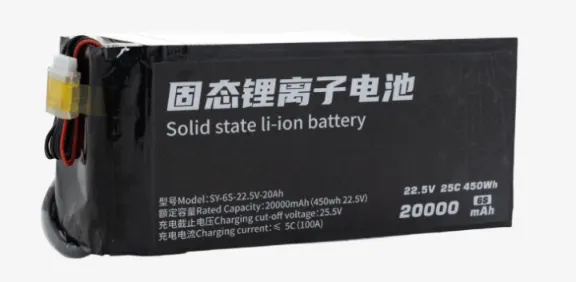
Sometimes 12S is electrically attractive but mechanically impractical. If 12S packaging, insulation, or wiring complexity is too costly, 7S can be a compromise. In practice, a 7s lipo battery pack is almost always a custom design, validated together with ESCs, chargers, and the complete system. This is where a custom battery pack for drones can deliver value: it solves a real constraint without forcing a full architecture change.
Fixed Load or Narrow Operating Windows
7S works best when duty cycles and temperatures are predictable. If your platform must handle highly variable loads and uncontrolled charging behavior, staying with common standards usually lowers risk.
7S vs 6S vs 12S: A Practical Comparison
Table: Series Voltage Comparison for UAV Systems
| Factor | 6S | 7S | 12S |
|---|---|---|---|
| Nominal Voltage | ~22V | ~25.9V | ~44V |
| Component Availability | Very high | Low | High |
| Current for Same Power | Higher | Medium | Lower |
| System Complexity | Low | Medium–High | High |
| Typical Use | Mainstream UAV | Custom OEM | High-end UAV |
Should You Choose 7S for Your Next Project?
If you are considering 7S, treat it as a system decision. For many platforms, the fastest path to reliability is still to pick a standard voltage and optimize pack quality, wiring, and charging discipline.
Questions to Ask Before Specifying 7S
Ask practical questions that reveal hidden risk: Are your ESC and charger validated for the full voltage window with margin? Do you have test resources for peak load and heat? Is volume high enough to justify customization? If not, 7S can add risk without proportional benefit.
Why Many Projects Still Default to 6S or 12S
6S and 12S dominate because they reduce uncertainty: proven ecosystems, easier sourcing, simpler support, and faster troubleshooting. In most operations, those factors beat small efficiency gains.
Conclusion
7S is not inherently a bad choice. It is non-standard in a market optimized around 6S and 12S. For most drones, 6S or 12S remains the safer path. For qualified OEM platforms with controlled requirements and full system validation, a custom 7S design can solve specific packaging, current, or efficiency constraints.
Shengya Electronic: Supporting Custom Voltage Battery Design for OEM Projects
As an experienced UAV battery manufacturer, Shengya Electronic focuses on standardized voltage platforms commonly used in industrial drones while supporting custom voltage battery packs for qualified OEM projects where system-level validation is in place. Shengya emphasizes cell matching, process control, and pack-level engineering so performance stays stable under real UAV loads and frequent cycling.
FAQ
Q1: Is a 7S battery pack a good fit for any drone?
A: Not usually. A 7S battery pack works best in OEM platforms where the ESC, charger, and powertrain are validated for the full 7S voltage window. If your system is built around standard 6S or 12S ecosystems, 7S can increase integration risk.
Q2: Why do people search “7s lipo battery” if standard products are rare?
A: Because it sounds like a practical middle step between 6S and 12S, and it is a common search phrase. In the market, however, most suppliers mass-produce around 6S and 12S, so 7S is typically handled as a custom configuration rather than a stocked SKU.
Q3: What is the real benefit of 7S vs 6S battery systems?
A:For the same power, 7S can reduce current compared to 6S, which may lower wiring and connector losses and reduce heat. The gain is often modest, and it only matters if the full system is tuned and validated for 7S operation.
Q4: When does a 7s lipo battery pack make sense as a custom build?
A: It can make sense when 12S is too bulky or complex for your airframe, but 6S forces high current that creates heat or voltage sag. In practice, a 7s lipo battery pack should be customized and verified with the ESC, charger, and thermal limits as a complete system.
Q5: What is the biggest mistake teams make when ordering a custom battery pack for drones?
A: Focusing only on voltage and capacity. The critical factors are system compatibility and lifecycle consistency: peak current events, transient voltage limits, charging strategy, temperature boundaries, and batch-to-batch matching with a clear test standard.


