
Why Standard Drone Batteries May Not Fit Your UAV Design?
A new UAV platform often requires a battery designed around the airframe’s specific dimensions and electrical requirements. The battery bay may have a taper, a low roof, offset rails, or a connector that must clear a payload. A catalog pack can meet a voltage headline and still fail the fit test. A custom UAV battery project turns those constraints into a defined electrical, mechanical, and software specification.
Before you request a quote, record the bay envelope, mounting points, center-of-gravity window, peak current, continuous current, flight profile, charge method, operating temperatures, and required cycle life. Include drawings in STEP or PDF, connector photos, and the flight controller’s communication specification. This information gives an engineering team a usable starting point.
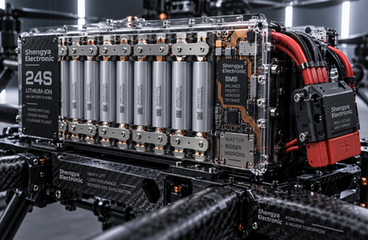
How Should You Select Cylindrical or Pouch Cells?
Cell format affects energy density, cooling, assembly work, and service risk. The mission and available volume determine the choice. Compare these needs with the UAV battery product range.
Cylindrical Cells for Repeatable Assembly
Cylindrical cells use a defined can, diameter, and length. Holders and busbars create a repeatable stack, and automated spot welding suits medium and high production runs. The metal casing provides structural support. Plan for cell spacing, insulation rings, weld access, and a compression frame. Those details consume volume inside a tight bay.
Pouch Cells for Thin or Shaped Bays
Pouch cells use a laminated-film enclosure and can be suitable for thin battery compartments, slim fuselages, and packs with stepped or irregular outlines. The design needs controlled compression, edge protection, strain relief, and a housing that limits swelling. A pouch pack can save height while asking for more discipline in mechanical support and handling.
Ask the cell supplier for discharge curves, internal resistance data, temperature limits, storage guidance, and lot traceability. Test samples at your current and temperature points. A nominal capacity number does not describe voltage sag during a hard climb.
How Do You Set Series and Parallel Counts?
Series count sets voltage; parallel count sets capacity and current sharing. A 24S pack, for example, uses 24 cells or cell groups in series. With a 4.2 V full-charge voltage per lithium-ion cell, a 24S configuration reaches 100.8 V at full charge. Your inverter, motors, charger, insulation system, and safety clearances must all match that value.
Parallel groups raise amp-hour capacity and reduce current per cell. Size the pack from the mission profile: hover, climb, cruise, reserve, and landing. Use measured motor data when available. Define peak current duration, since a 10-second climb demand creates a different thermal load from a 30-minute cruise demand.
Keep parallel cells matched by chemistry, capacity, age, and impedance. Specify fuse links or current-limiting paths for each parallel group when the fault study calls for them. Busbar thickness, weld pattern, and copper PCB traces need a current calculation. Thick-copper PCB designs support higher current and heat spreading, while their line width, etching, hole copper, and lamination rules need early review.
What Mechanical Details Belong in the Battery Drawing?
Send a dimensioned envelope, datum references, mounting loads, and keep-out zones. Mark cable exits, latch travel, vent paths, and the service direction. State the allowed mass and the target center of gravity. A few millimeters at a connector or latch can decide whether the pack installs cleanly.
Account for vibration, shock, moisture, dust, and thermal expansion. Use insulating barriers between live conductors and the case. Add strain relief where repeated insertion can load the terminals. If the battery is removable, define the connector mating cycle and a pre-charge method to limit inrush into large capacitors.
Thermal design starts with the heat source map. Measure cell temperature, busbar temperature, and BMS component temperature during representative flights. Provide a conductive path to a frame or cold plate when the mission requires it. Place sensors close to the hottest cells identified during the thermal test.
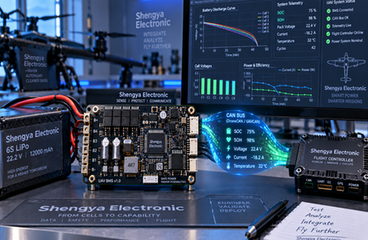
How Does Smart BMS Communication Integrate With the UAV?
Treat the BMS as part of the aircraft control system. Confirm the physical layer, connector pinout, baud rate, message IDs, byte order, scaling, update rate, and fault behavior before hardware release. CAN is common for robust vehicle networks; isolated UART or RS-485 can fit other architectures. Differential signaling improves noise immunity by carrying complementary voltage signals and rejecting common-mode noise.
Create a signal table for state of charge, state of health, pack voltage, current, temperatures, cycle count, alarms, and remaining power. Define what the flight controller does when a frame times out, a sensor crosses its limit, or a contactor opens. Log raw frames during bench tests, then replay them through the integration software.
Set protections for over-voltage, under-voltage, over-current, short circuit, over-temperature, under-temperature, and cell imbalance. Validate thresholds with controlled tests. The BMS should store event records with timestamps and pack identity so a returned unit can be traced to its production lot and test results.
What Should You Ask an OEM Drone Battery Manufacturer?
Evaluate the supplier through engineering evidence. Request a design review checklist, cell approval process, electrical drawings, CAN database or protocol document, sample inspection report, and change-control method. Ask how the supplier handles a cell-lot change, firmware revision, connector substitution, and end-of-line failures.
Pilot builds should include dimensional inspection, insulation resistance, hipot testing where applicable, capacity testing, balancing verification, communication checks, and vibration or thermal cycling matched to your risk plan. Agree on acceptance limits before the first article. A production report with serial numbers and test data supports field service and warranty decisions.
How Can a Design Review Reduce Rework?
Use a gated sequence: requirements, cell samples, electrical architecture, mechanical fit check, BMS protocol test, engineering samples, environmental validation, and pilot production. This sequence turns custom battery packs for drones into controlled engineering releases. Freeze each gate with a signed document. Keep one owner for the interface control document so a late connector or firmware change reaches every team.
Bring the airframe drawing to Shengya Electronic when the pack is still in design. The company can review cell layout, custom busbars, pack housing, wiring, and smart BMS communication as one system. Its PCB experience includes BMS control boards, differential interfaces, thick-copper current paths, connector inspection, and traceable testing.
That combination supports a 24S architecture, a shaped pouch pack, or a cylindrical module through one engineering group. Share the bay envelope, load profile, and protocol early; the review can produce a buildable sample and validation list.
FAQ
Q1: What Information Is Needed for a Custom Drone Battery Pack?
A: Send the bay envelope, mounting drawing, voltage and current profile, flight time target, temperature range, connector details, charger data, BMS protocol, and annual volume estimate.
Q2: Is a 24S pack suitable for every drone?
A: A 24S pack suits an aircraft whose motors, inverter, charger, insulation, and protection system are rated for its full-charge voltage. Confirm those ratings before selecting the series count.
Q3: When should you choose pouch cells?
A: Choose pouch cells when a thin or stepped bay drives the design and you can provide compression, edge protection, and swelling management.
Q4: Which BMS data should reach the flight controller?
A: At minimum, provide pack voltage, current, state of charge, temperatures, alarms, cell imbalance, and contactor or protection status. Define update rates and timeout actions in the interface document.
Q5: How do you start a project with an OEM drone battery manufacturer?
A: Share the drawings and mission profile, schedule a design review, approve cell samples, test the BMS messages on a bench, and release an engineering sample before pilot production.