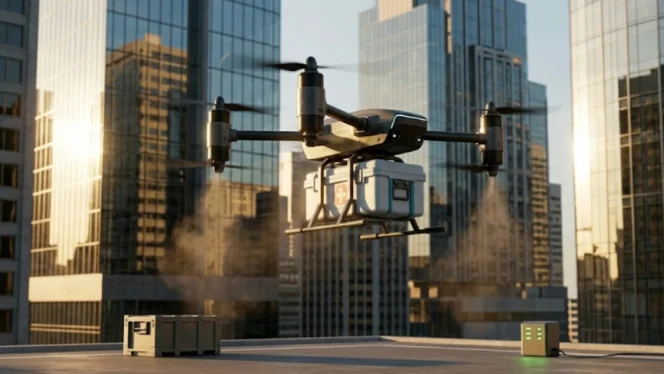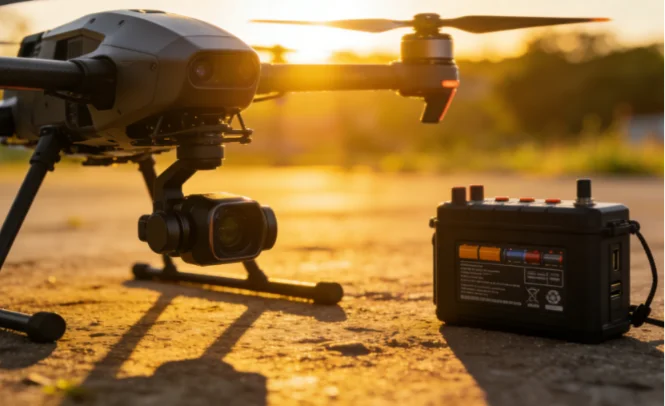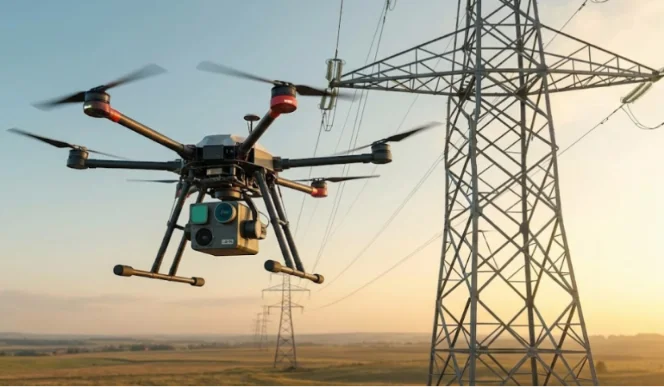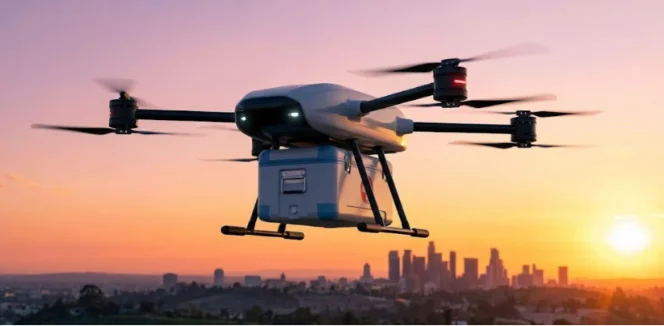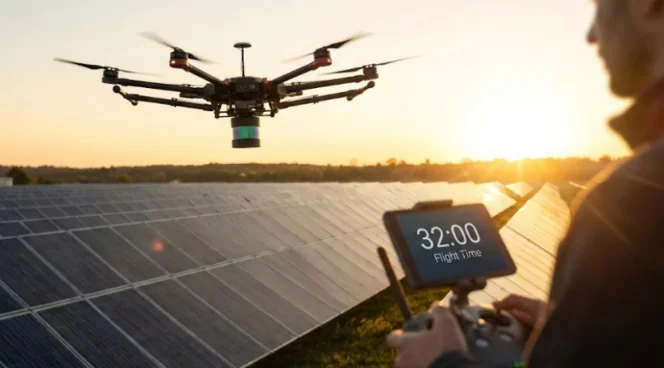
That annoying “low battery” alarm? It always seems to scream right when things get tough. Maybe you are three-quarters of the way through a mapping grid. Or maybe you are inspecting a tall tower, the wind picks up, and your power drains faster than you planned. For pros who fly for a living, time in the air is money. Every single minute you stay up there means more data you can grab. It means less time on the ground swapping packs. It means you make more profit on every job.
Most commercial drones hit a wall around the 22 or 25-minute mark. It is frustrating. You can’t just slap a bigger battery on the frame. Why? Because weight fights against lift. If you add more standard lithium cells, you add mass. More mass needs more thrust. More thrust burns energy faster. Physics is mean about this; it is a cycle that is hard to beat. To break that 30-minute barrier without throwing away your camera or sensors, you have to change the chemistry inside the pack. You don’t need a bigger tank; you need better fuel. This is where the high energy density drone battery changes the whole game.
What Is 270 Wh/kg Energy Density?
Want more air time? You need to look at something called gravimetric energy density. That is a fancy engineering term. It basically asks: for every kilogram of battery weight, how much actual juice is inside?
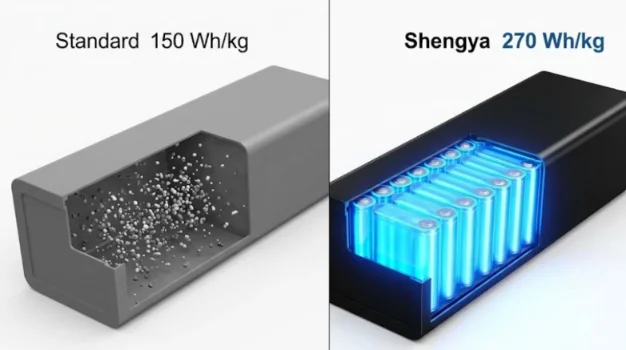
Standard LiPo batteries, the kind you buy at hobby shops, usually sit between 150 to 180 Wh/kg. They work fine, but they are heavy for the power they hold. Think of it like packing a suitcase. If you throw clothes in loosely, you fit a week’s worth of gear. Now, imagine you vacuum-seal those clothes. You fit two weeks’ worth in the same suitcase. That is exactly what a 270 Wh/kg battery does for your drone.
By using smart materials, like semi-solid state tech, you can fit way more milliamp-hours (mAh) into the same weight. If your current rig uses a 16,000 mAh battery that weighs 2 kilograms, switching to a high-density 270 Wh/kg pack could bump you up to 22,000 mAh or more. The best part? You don’t add a single gram to your takeoff weight. That extra capacity is basically “free” weight-wise. It goes straight into keeping your props spinning longer.
The 4.35V High Voltage Advantage
But capacity isn’t everything. You also have to look at voltage. Standard lithium cells charge to 4.2V. They are usually considered empty around 3.5V or 3.7V when under a load.
The new generation of long-lasting batteries are often High Voltage (LiHV). These charge up to 4.35V per cell. It sounds like a tiny difference. Just 0.15V per cell. But over a big 6S or 12S pack, that adds up to a huge jump in total voltage.
Why does this matter for flight time? Think of voltage as the “push” behind the electricity. As a battery drains, that push gets weaker. When it drops too low, your drone’s computer panics. It triggers a return-to-home (RTH) command to stop a crash, even if there is still some juice left in the cells. A 4.35V LiHV cell keeps a higher voltage “platform” for longer. Your motors get the punch they need to stay steady in the wind without draining all the juice. This delays that RTH trigger. It squeezes out those precious final minutes of work.
Real World Scenario: The Payload Calculus
Let’s do some quick math for a heavy lifting job. Say you are flying a quadcopter for an industrial inspection.
Your drone frame, motors, and electronics have a fixed weight. Your payload—maybe a LiDAR scanner or a thermal camera—also has a fixed weight. The only thing you can change? The battery. If you use standard packs, you have a tough choice. You can carry a small battery to keep the drone light, but you have to land every 15 minutes. Or, you can carry a huge brick of a battery. This makes the drone slow and barely gets you 5 extra minutes because the motors work so hard to lift it.
Switching to a 270 Wh/kg solution gives you a fresh choice. You keep the battery weight the same as your lighter setup. But, you increase your energy tank by 30% to 40%.
For a mapping mission, this is huge. It is the difference between needing three flights to cover a site versus doing it in two. That is one less landing. One less battery swap. One less break in your data stream. Over a year of daily work, these small wins add up. You aren’t changing the drone. You are just giving it a better fuel tank.
Does High Density Mean Less Safety?
People used to think “high energy” meant “dangerous.” In the early days of RC flying, pushing limits often led to puffy packs or heat issues. However, the tech has grown up, especially for work jobs.
Modern high-energy density cells are different. They often use semi-solid materials or special separators inside. These are much more stable than the liquid stuff found in cheap packs. They are built to handle the heat of a long flight. Of course, you still need to treat them right. Use a proper charger that can hit that 4.35V mark accurately. Never store them fully charged for weeks. But the old trade-off between being safe and flying long isn’t really a problem for pros anymore.
Actually, having a battery with more room can sometimes be safer. Why? Because you aren’t pushing the pack to its absolute 0% limit just to finish a job. You land with a healthy buffer. This puts less stress on the cells over time.
Why Source Matters: The Shengya Electronic Approach
If you fly a $20,000 camera, you don’t buy batteries from a random online shop. You need a maker who understands the chemistry, not just someone who puts stickers on boxes. This is where Shengya Electronic fits into your day.
Shengya doesn’t just ship boxes. They actually make the cells specifically for this high-density, high-voltage world we are talking about. Their High Energy Density Series is built for the commercial work we discussed. We are talking about a company that can change the pack shape or the BMS (Battery Management System). They can even change the connectors to fit your specific drone, whether it’s a fixed-wing VTOL or a multi-rotor.
They offer discharge rates that actually match what they say on the label. This means when your heavy drone fights a gust of wind, the voltage doesn’t collapse. Their 4.35V tech is solid. It offers that sweet spot of max flight time without killing the battery life. If you are building a fleet or fixing up old units, getting your power straight from a maker like Shengya gives you a leg up. You know the power system matches the job.
Dealing With Temperature And Environment
Another thing that kills flight time? The weather. Cold air is thick, which props love. But cold slows down the chemical reaction inside a lithium battery. It effectively shrinks your tank size.
Good quality commercial drone power solutions often have lower internal resistance. This means they waste less energy as heat during normal use. But they also hold voltage better when it gets cold outside. No battery loves freezing temps. But a high-density cell that starts with 30% more capacity gives you a much bigger safety net. You might lose 10% of your power to the cold. But because you started with a 270 Wh/kg pack, you are still flying longer than you would with a warm standard pack.
Upgrading Your Fleet Without Replacing Drones
The beauty of battery tech is that it is the cheapest way to upgrade a UAV. Buying a new drone with better aerodynamics costs thousands. Changing motors or props only gives small gains. But swapping the power source gives you immediate results you can see.
Are your current flight times limiting what you can sell? Maybe you can’t bid on large mapping jobs. Maybe you can’t do long pipeline checks because your drone has to come home every 20 minutes. Look at your battery label. If it doesn’t say 4.35V or show high energy density specs, you are carrying dead weight.
You need to check your connector types and battery bay size. High-density cells can sometimes be a slightly different shape. So measuring your bay is the first step. Once you know it fits, the switch is usually easy. You update your flight controller settings to see the new voltage limits (telling the drone that 100% is now 4.35V per cell, not 4.2V), and you are ready to fly.
The Bottom Line on Endurance
Breaking 30 minutes is in your head as much as it is in the physics. Once you break it, your work gets easier. You can hover longer to get that perfect shot. You can finish the survey line without panic. You can take on clients that need long-distance flights.
The tech to do this is here right now. It isn’t some future dream. It is available in the form of 270 Wh/kg 4.35V packs. Your drone can do more; it is just waiting for the right fuel.
FAQ
Q1: Can I charge a 4.35V battery with a standard charger?
A: Better not. While a standard charger won’t blow up, it will only fill the battery to 4.2V. This means you lose out on the extra power and voltage benefits you paid for. You need a charger that supports “LiHV” or lets you set the voltage yourself.
Q2: Will the higher voltage burn out my drone motors or ESCs?
A: Generally, no. Most modern ESCs (Electronic Speed Controllers) and motors can handle a range of voltages (like 6S to 12S). The jump from 4.2V to 4.35V per cell is usually fine for commercial gear. But always check your drone’s manual just to be safe.
Q3: How many cycles can I expect from a 270 Wh/kg battery?
A: High-performance batteries might have a slightly shorter life than heavy, low-power ones if you push them hard. But with Shengya’s tech, if you treat them well—storage charge them when not flying and don’t drain them to 0%—you can expect a solid service life that pays for itself in work done.
Q4: Is a 270 Wh/kg battery heavier than my current battery?
A: Nope, that’s the best part. “Wh/kg” is a ratio of energy to weight. A 270 Wh/kg battery will either be lighter than your current one for the same power, or the same weight with way more power. You get more juice without the weight penalty.
Q5: Does Shengya Electronic make custom battery packs for unique drones?
A: Yes. Because they make the cells and build the packs, they can create custom setups for VTOLs, odd shapes, or specific voltage needs that regular stores can’t match.