You charge the battery to 100%, and head outside. The drone lifts off, and everything looks fine—until the percentage starts falling faster than you expected. 92%. 85%. 78%. You barely got a few smooth shots, and the warning pops up: low battery.
That moment is why people search how long does a drone battery last. You want a number you can trust. Not a perfect lab number. A real number that matches wind, cold air, and the way you actually fly.
This guide breaks it down in plain words. You will see typical flight time ranges, what cuts time the most, and how to tell when a battery is aging, even before it looks damaged.
Quick Answer: Typical Drone Battery Flight Time
For many consumer camera drones, real flight time is often 15–30 minutes per charge. This range reflects typical drone battery life in everyday flying conditions, rather than ideal lab tests or perfect weather.
FPV drones are different. They often fly for only a few minutes, because they pull a lot of power when you punch the throttle.
Use the ranges below as a “normal” starting point. Then think about how you fly and where you fly.
Typical Flight Time by Drone Type
| Drone type | Typical flight time per charge (real-world range) | Why it differs |
|---|---|---|
| Toy / mini drones | 5–10 min | small batteries, low efficiency |
| Consumer camera drones | 15–30 min | balanced weight + stabilized flight |
| FPV racing / freestyle | 3–5 min (sometimes 8–10) | high throttle, high current draw |
| Industrial / mapping setups | 30–60+ min (varies) | larger packs, endurance-focused platforms |
Why Your Drone Battery Lasts Less Than the Advertised Time
If you never hit the advertised number, you are not alone. That “best case” time is often measured in calm air, with slow moves, and no stress on the drone.
Real flying is not like that. You turn, climb, stop, and fight wind. Each move costs power.
Here are the most common reasons your battery drains faster than you expect:
Wind and constant correction
Wind makes your drone work all the time, even when you think you are just hovering. The motors keep pushing to hold position.
Cold temperatures
Cold can make the battery feel weaker. You may see earlier warnings. You may also see the percentage drop faster under load.
Payload and extra parts
Extra weight matters. Guards, mounts, lights, and heavy camera setups all add load. More load means more current draw.
Fast flying and hard moves
Quick climbs, sharp turns, and sudden stops can spike power use. FPV freestyle is the clearest example.
Battery age
As the battery gets older, it may not hold the same energy. It can also drop voltage faster near the end.
How Long Does a Drone Battery Last Over Its Lifetime?
People often mix up two ideas:
- Flight time (minutes per charge)
- Battery lifespan (how long the pack stays healthy)
A battery can still work, yet give less time than it used to. That is normal aging.
Battery life is not only about how many minutes you get today. It is also about how the battery behaves after weeks or months of use.
One common way to talk about lifespan is charge cycles. A cycle is roughly one full use of the battery. Over many cycles, the pack slowly loses capacity and may become less stable under load.
Over time, drone battery performance becomes just as important as raw flight time, especially when you start noticing earlier warnings or shorter usable ranges under the same flying conditions.
In real life, lifespan depends a lot on stress:
- Heat stress (hot flights and hot charging)
- Very deep discharge (pushing to the last percent often)
- Long storage at full charge
- Rough handling and vibration
If you treat the pack gently, it stays steady longer. If you stress it often, it ages faster. Simple habits can make a big difference over a season.
Battery Health Signals You Should Not Ignore During Flight
Numbers are helpful, but “feel” is helpful too. Many pilots can sense a weak battery by how the drone acts near the end of a flight.
A healthy battery often delivers smooth power for most of the flight. A tired battery may act strange even when the screen still shows a decent percent.
Watch for these signs:
Early low-voltage warnings in normal flight
If you get return-to-home prompts earlier than before, under the same load and weather, the battery may be losing real capacity.
A fast drop near landing
Some batteries look fine at the start, then fall quickly near the end. That can be a sign of weaker voltage under load.
Cold-weather problems getting worse
Cold affects all batteries. But old batteries show the weakness more. You may notice weaker climb power or less stable hover.
These signs can show up before you see swelling or other obvious damage. If you notice the pattern, take it seriously. It is about safety as much as time.
A Simple Runtime Estimate You Can Understand
You do not need advanced math here. The idea is simple:
- A bigger battery can give more time.
- But if the drone uses more power, time goes down.
Think of it like this: if you add weight, fight wind, or fly hard, the drone “drinks” energy faster.
So two drones with similar battery size can still have very different flight time. The airframe, motors, props, flight style, and load all change how fast power is used.
This is also why your own flight logs are useful. Your real flights tell you more than a perfect test.
How to Make a Drone Battery Last Longer Per Charge
If you want more minutes today, you do not always need new gear. Often, you just need less waste.
Here are easy changes that help:
- Fly smooth, not sharp
Soft moves use less power. Fast punch-outs look cool, but they burn minutes fast. - Pick calmer conditions when you can
Wind is a hidden battery killer. If you can fly earlier or later in the day, do it. - Keep the battery warm in cold seasons
Do not let it sit in freezing air for a long time before takeoff. A warm pack performs better. - Remove extra weight
If you do not need guards or heavy mounts for this flight, take them off. - Land with a margin
Chasing the last few percent is not worth it. You will also reduce stress on the pack.
These tips sound basic, but together they can add real time. Even one extra minute can feel huge when you are trying to get “one more shot.”
How to Make the Battery Last Longer Across Months
For long-term health, the big word is stress. Batteries do not like heat, deep drain, or long storage at full charge.
Here are habits that are simple and easy to follow:
- Do not store fully charged for a long time
If you will not fly soon, do not keep it topped up for weeks. - Avoid deep discharge as a habit
Try not to run it down to the edge every time. A small buffer is safer. - Let it cool before charging
After a hard flight, the battery can be warm. Give it time to cool down first. - Pay attention to swelling and unusual heat
If the pack looks puffy, or gets too hot in a strange way, stop using it. Safety comes first.
These habits do not make the battery “last forever,” but they can keep it consistent longer. And consistency is what most pilots really want.
How Many Batteries Do You Actually Need?
Some people try to solve battery problems by buying one bigger pack. In many cases, it is smarter to carry more packs instead.
Here is a simple baseline:
- Casual photo flight: 2–3 batteries
- Travel or content day: 3–5 batteries
- FPV session: more than you think, because 3–5 minutes goes fast
Having enough batteries also changes how you fly. You feel less rushed. You make fewer bad choices. That can help both safety and battery health.
Engineering Support Behind Real-World Drone Power Needs
In real drone work, battery performance is not only about minutes in the air. It also affects route planning, charging cycles, safety margins, and long-term cost.
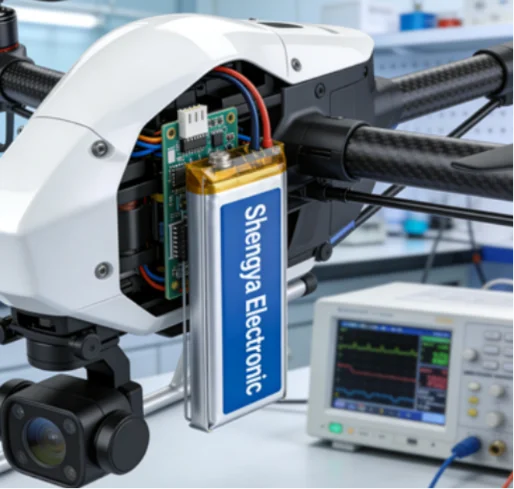
Shengya Electronic supports drone manufacturers, system integrators, and solution providers with practical power-related considerations, especially when real conditions like temperature changes and duty cycles matter. When a project moves from testing to repeat use, small power choices can reduce rework and improve day-to-day reliability.
FAQ
Q1: How long does a drone battery life last on one charge?
A: Many consumer camera drones give 15–30 minutes in real use. FPV drones are often 3–5 minutes, depending on how hard you fly.
Q2: Why does my drone battery life drain so fast?
A: Wind, cold weather, extra weight, and aggressive flying are the top reasons. Any of them can cut flight time quickly.
Q3: How many charge cycles does a drone battery last?
A: It depends on the battery and how you treat it. Heat, deep discharge, and poor storage habits often shorten lifespan. Gentler use usually helps it last longer.
Q4: Can a drone battery last longer than 30 minutes?
A: Some endurance-focused setups can. But for many consumer drones, 30+ minutes happens mainly in calm, ideal conditions.
Q5: How long should you wait before charging a drone battery after flying?
A: Let it cool first. Charging while it is still hot can add stress and may speed up wear.