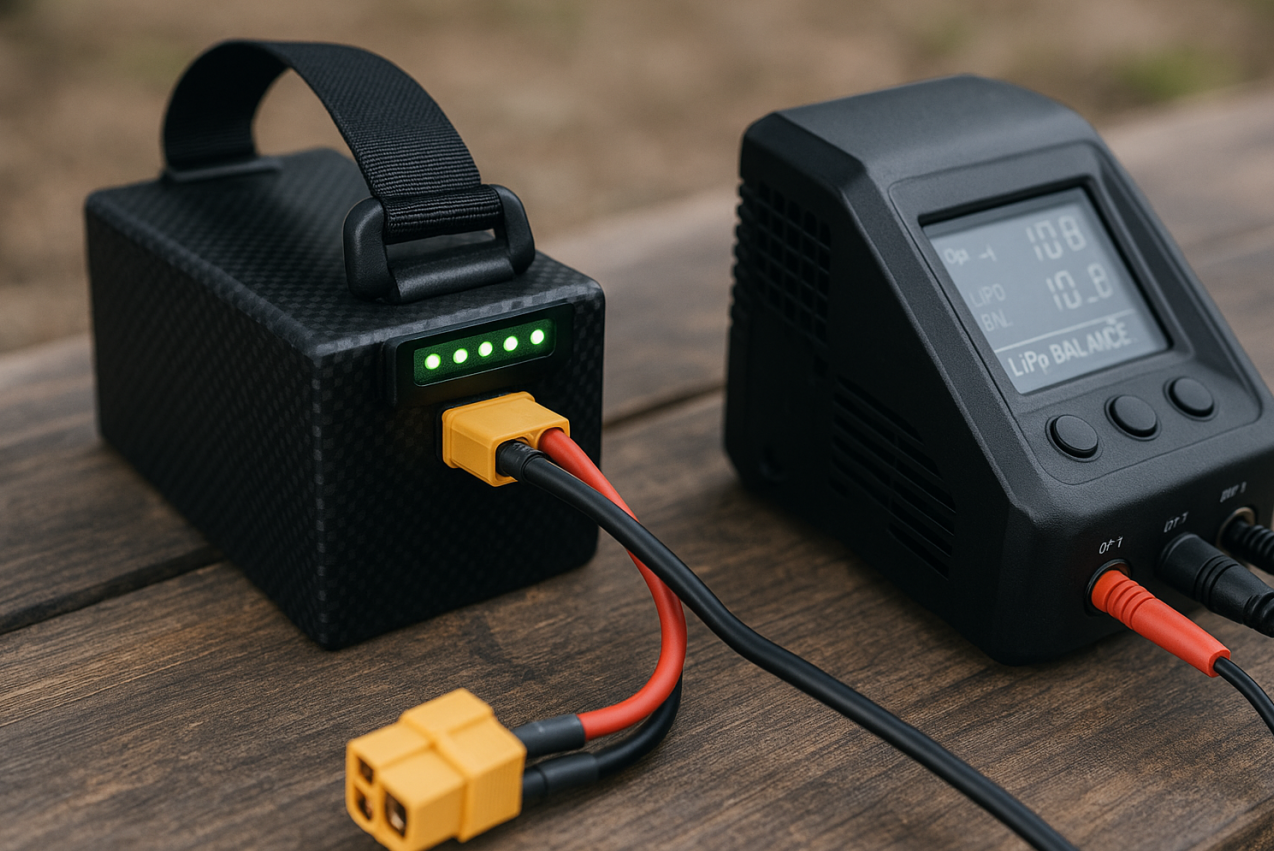
If you’ve flown drones on the job, you know the wait for batteries can drag on and mess with your whole schedule.Charging time is not just a number, it shapes how many flights you can finish in a day and how you plan each mission. Many pilots type how long to charge drone battery into a search box and only get vague answers. This guide walks through the main things that decide charging time for big packs and gives you some simple rules you can actually use on site.
What Determines Drone Battery Charging Time?
Charging time is never one fixed figure. It comes from the size of the pack, the charger, the voltage and even the weather. If you want a clear idea of drone battery charge time, you need to look at all of these together, not just the label on the case.
Battery Capacity (Ah)
Capacity is the easy part. A 5 Ah pack fills much faster than a 25 Ah pack at the same charge rate. Think in C-rate. At 1C, a battery charges in about one hour. At 0.5C, it is closer to two hours. A high-capacity UAV pack in the 20–30 Ah range will always take longer, simply because there is more energy to put back in.
Charger Output (Current)
The charger controls how much current flows. A higher current, as long as it stays inside the rated C value, cuts time. Many lithium packs are rated for 0.5C as a gentle daily setting and 1C as a common upper limit. If you charge at 0.2C, it is safe but slow. If you push past the spec, heat and stress go up and cycle life goes down.
Voltage And Pack Design
High voltage packs such as 12S, 13S or 14S need chargers that can handle the higher total pack voltage. Voltage alone does not make charging slow. It just affects the charger type and total power. Many industrial UAV batteries are built in these higher S counts so they can run big motors and heavy loads in a stable way.
State Of Charge And Temperature
Starting point matters. Going from 20% to 100% will always take longer than topping up from 60%. Lithium chargers also slow down near full, so the last part of the bar always feels slow. Temperature adds another layer. Cells charge best in a moderate range. Very cold or very hot packs may charge slowly or trigger protection in the BMS.
Typical Charging Time For High-Capacity Drone Batteries
Once you know the basic rules, you can start putting rough numbers on the table for real packs that go on mapping drones, farm drones or inspection platforms.
Example Charging Times For a 25 Ah Pack
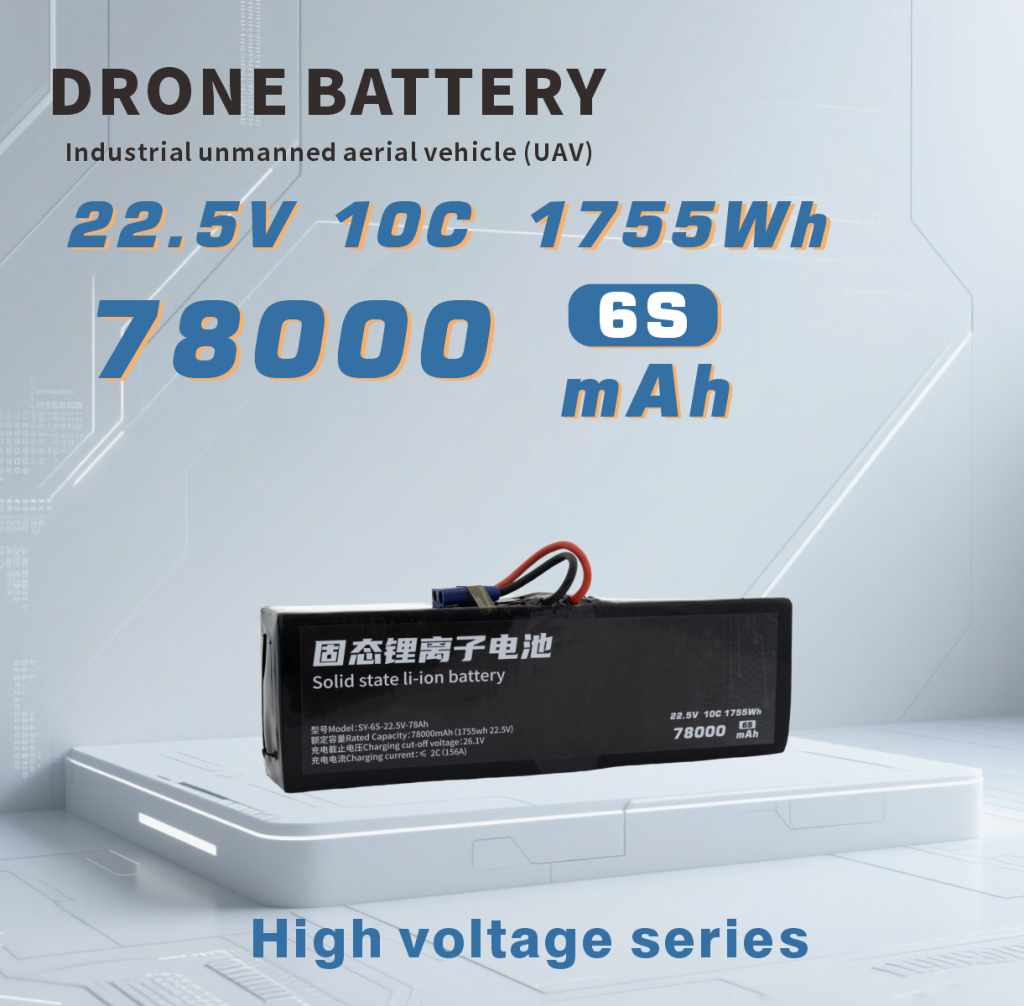
Take a 25 Ah industrial pack. At 0.5C, which is about 12.5 A, the main charge phase sits around two hours. Add the slower tail at the top, and you often see roughly 2 to 2.5 hours from low to near full. At 1C, around 25 A, the main phase drops towards one hour. In practice it is often 1 to 1.5 hours, because the charger reduces current as voltage reaches the set point. For most large UAV packs, normal figures land between 1.5 and 3 hours on a proper charger.
Why Large UAV Packs Take Longer
Big drone batteries are designed for safety and long life, not just speed. Cells often have high energy density and are meant to survive many cycles. The BMS inside will limit current if things get too warm or if any cell group drifts. So even if a very high current looks tempting, the pack will often slow you down on purpose to stay healthy.
How To Charge High-Capacity Drone Batteries Safely?
It is easy to focus only on speed when you are busy. Still, your charging habits decide how long packs last and how safe they are in the field. A few simple checks before charging a drone battery can save money and trouble later.
Choose A Suitable Charger Current
Always read the rated charge C-rate in the spec sheet. If a pack is rated for 1C, staying between 0.5C and 1C is a good daily choice. Below that, you mainly lose time. Above that, you add heat and wear. It is a bit like driving a car. You can go at top speed all the time, but the engine will not like it.
Watch Temperature And Ventilation
Charge in a spot with some air flow. Avoid closed boxes, hot vans in summer and direct sun on the chargers. If a pack comes back warm from a hard flight, let it cool closer to room temperature before you start a new cycle. Heat during charge is one of the quiet ways batteries age faster.
Use Smart BMS-Compatible Chargers
High-capacity packs often include a built-in BMS with balancing and protection. Use chargers that talk to this system and are made for that voltage and pack type. Smart chargers can watch total voltage and sometimes cell groups, which is much safer than a simple power supply with no feedback.
How To Reduce Charging Time Without Damaging The Battery?
Many users try to cut drone battery charge time without buying a full second fleet of packs. There are a few ideas that help, as long as you stay inside the spec.
Use Higher Current Within Limits
If your usual setting is 0.5C and the pack allows 1C, you can raise current step by step and see how warm the pack gets. For a 25 Ah pack, moving from 10 A to 20 A makes a clear change in time. Just keep it at or below the rated C value and watch how the pack behaves after a few weeks of use.
Parallel Solutions For Fleets
For teams that fly many drones, the better path is often more channels, not more current per pack. Multi-channel charging cabinets or parallel charging boards let you fill several packs at once at normal C-rates. Total turn around for the fleet improves, even though each individual pack is still charged in a gentle way.
When Should You Consider Upgrading To A High-Capacity Pack?
At some point, shaving ten minutes off a charge is less helpful than carrying more energy in the air at once.
Longer Missions And Heavier Payloads
If you often hit low voltage warnings before the job is done, or if cameras, tanks or sensors have become heavier, moving to a higher capacity battery can give your drone more useful flight time. Many high energy packs are built for this kind of upgrade path.
Fewer Swaps And Better Uptime
More capacity per pack means fewer landings just to swap batteries. That cuts handling time and reduces the chance of drops or bad connections. Charging still takes planning, but you may need fewer full cycles to finish a day’s work.
A Quick Look at Shengya Electronic Electronic’s Work in UAV Battery Technology
Taixing Shengya Electronic Electronic Electronic Technology Co., Ltd( Shengya Electronic Electronic), focuses on semi solid and solid state lithium ion soft pack cells and finished battery packs. The company, set up in 2017 in Taixing City, Jiangsu Province, aims at high energy density ranges around 190to 350 Wh per kilogram, long cycle life and strong safety for real field use.
Pack groups cover 6S, 7S, 12S, 13S, 24S and 28S layouts, which makes them fit many drones for mapping, farming, firefighting and other special tasks. Shengya Electronic Electronic can also build custom packs, where you can adjust the way cells are combined, the outlet position, the plug and the outer look. In simple words, you can match the battery to the airframe instead of forcing the airframe to live with a random pack.
FAQ
Q1: How long does it usually take to charge a big drone battery?
A: For large UAV packs around 20–30 Ah, many users see about 1.5 to 3 hours on a proper charger. The exact time comes from current, start level and temperature.
Q2: Is fast charging at 1C always safe for drone packs?
A: It can be safe if the spec allows 1C. You still need to check the data sheet. Many operators stay between 0.5C and 1C in daily work to keep a balance between speed and life.
Q3: Why does the last bit of charging feel so slow?
A: The first part uses constant current. Near the top, the charger holds voltage and lets current fall. That constant voltage stage fills the last part but takes more time per percent.
Q4: Should you start charging right after landing?
A: It is better to let the battery cool down first. Charging a very hot pack adds stress and may cause the BMS or charger to cut or limit current.
Q5: How can you plan around charging in daily missions?
A: Note real charge times in your own setup, choose a safe C-rate and keep some spare packs in rotation. With that, you can build a simple schedule where flights, rest and charging fit together instead of fighting each other.