A minute in the air beats a minute on paper. When pilots ask about drone battery life , they’re really asking for numbers that match the field: with this payload, in this wind, on this route—how long will it actually stay up? The fastest way to get close is simple: measure real power, do the watt-hour math, apply a few pragmatic factors, and then run a short validation flight. Below is a repeatable workflow you can hand to any teammate and expect similar results.
Who This Guide Helps
- Mapping, inspection, and agriculture teams planning route time and swap points
- Builders tweaking props, motors, and pack size for longer missions
- Ops managers who want one method that works across 6S/7S/12S fleets
Quick take: Flight time ≈ usable energy (Wh) ÷ real average power (W). Everything else—temperature, altitude, throttle style—nudges that result up or down.
Tools and Info to Gather First
- A wattmeter/power module or reliable flight-controller logs (current & voltage)
- Airframe weight (all-up), prop/motor specs, payload weight
- Ambient temperature and a quick wind estimate
- A balance drone battery charger that supports your pack series (6S–12S)
Step 1 — Measure Real Power Draw
Hover and Route Samples
- Hover test: Hold 60–90 seconds at working height (5–10 m AGL). Record stabilized power.
- Route sample: Fly a 2–3 minute segment that mirrors the job (grid legs, a climb, a loiter).
- Smoothing: Discard takeoff/landing spikes. Average the middle ~70% of samples.
- Payload delta: Run the same profile once without payload and once with it. The current gap is your payload tax.
A small aside: pilots often guess “about 500 W.” Measure it. The truth is rarely round.
Step 2 — Convert Capacity to Usable Energy
Wh = (mAh ÷ 1000) × nominal voltage (V).
Most operations keep a landing reserve, so plan on ~85% usable.
Examples (16,000 mAh):
- 6S (22.2 V): 16 × 22.2 = 355 Wh → usable ≈ 303 Wh
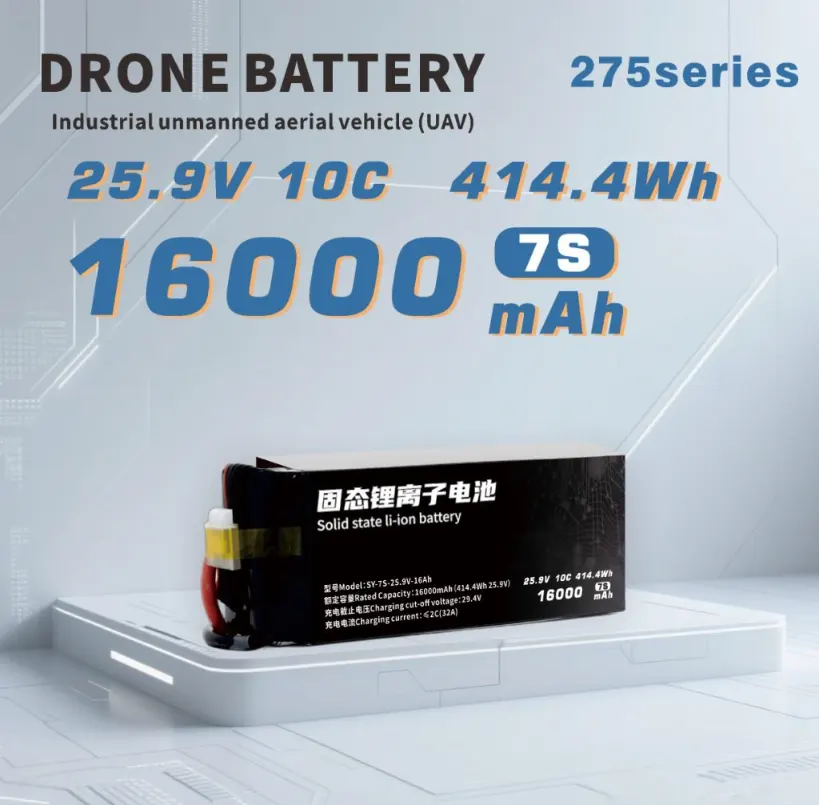
- 7S (25.9 V): 16 × 25.9 = 414 Wh → usable ≈ 352 Wh
- 12S (44.4 V): 16 × 44.4 = 710 Wh → usable ≈ 604 Wh
Temperature Factor (illustrative)
| Ambient | Capacity Factor |
|---|---|
| 25 °C | 1.00 |
| 10 °C | 0.92 |
| 0 °C | 0.80 |
| −10 °C | 0.60 |
Cold reduces effective capacity and voltage stability. If you’ve watched cells sag at freezing temps, you know the feeling—add buffer.
Step 3 — Estimate Drone Battery Life with One Line
Flight Time (hours) = Usable Wh × Temp Factor ÷ Avg Power (W)
Example: 6S pack (≈303 Wh usable), average power 500 W, 10 °C (0.92):
Time ≈ 303 × 0.92 ÷ 500 = 0.56 h ≈ 34 min.
Quick Reference (edit later with your data)
| Pack | Usable Wh | Avg Power | Temp Factor | Est. Time |
|---|---|---|---|---|
| 6S 16 Ah | 303 | 500 W | 1.00 | ~36 min |
| 7S 16 Ah | 352 | 500 W | 1.00 | ~42 min |
| 12S 16 Ah | 604 | 800 W | 1.00 | ~45 min |
Reality check: higher-S airframes often carry more mass and larger props, so power climbs too. Treat the table as planning ballast, not gospel.
Step 4 — Adjust for Real-World Penalties
- Weight creep: Gimbal plates, quick-releases, even long cables add up in amps.
- Prop/motor match: Slightly larger, slower props can drop current for the same thrust.
- Wind & altitude: Headwinds and thin air raise watts; bump your landing reserve.
- Throttle style: Smooth stick inputs are free flight time.
- Deep discharges: Repeated dips below ~3.0 V/cell shorten pack life quickly.
Most “mystery losses” end up being weight and prop efficiency. Log both and you’ll see it.
Step 5 — Validate with a Short Test Flight
Micro-Protocol (about 15 minutes)
- Balance-charge to full; note pack temperature.
- Take off, climb to working height, fly your route segment.
- Land with ~20–25% remaining (under low load ≈ 3.6–3.7 V/cell).
- Export logs; confirm average power and check minimum voltage during peak load.
Mini Log Template
| Date | AUW | Payload | Avg Power (W) | Temp | Time | Land V/cell |
|---|
Two or three runs like this beat a dozen forum threads. It’s your airframe, your numbers.
Step 6 — Charging & Turnaround Planning
Balance charging isn’t optional. It’s how multi-cell packs keep voltages aligned so the weakest cell doesn’t drag the pack. Good charging habits also stabilize UAV battery life across seasons.
- Mode: Li-ion/Li-poly balance mode for 6S/7S/12S.
- Current: 0.5–1C is a practical band (cooler at 0.5C if time allows).
- Voltage limits: Stop at 4.2 V/cell. Don’t sit at full for days if you won’t fly.
- Leads: Keep them short and thick; warm plugs = wasted watts.
Rough charge time:
Time (h) ≈ Capacity (Ah) ÷ Current (A) × 1.2
Examples
| Pack | Current | Time (approx) |
|---|---|---|
| 16 Ah | 8 A | ~2.4 h |
| 16 Ah | 16 A | ~1.2 h |
| 10 Ah | 5 A | ~2.4 h |
If one cell lags every session, retire the pack from mission work. Brownouts over water are memorable for the wrong reason.
Step 7 — Voltage Choice and Wire Losses (6S vs 7S vs 12S)
Higher voltage means lower current for the same power, which cuts I²R losses (heat in wires and ESCs). But voltage must match motor KV, prop size, and ESC limits.
| Series | Nominal V | Typical Use Case | Notes |
|---|---|---|---|
| 6S | 22.2 | Prosumer & light-lift | Broad charger support |
| 7S | 25.9 | Mapping/inspection | Slight efficiency bump at similar thrust |
| 12S | 44.4 | Heavy-lift, industrial | Lower current for same power; systems are heavier |
Don’t throw a 12S pack on a 6S rig and expect magic. The whole drive train has to be in tune.
Step 8 — When High Energy Density Changes the Math
High-density cells around 275 Wh/kg change route math fast: same mass, more Wh; same minutes, more payload. On repeat-route work—orchards, towers, pipelines—those extra 3–7 minutes often finish the grid without a mid-mission swap. Less downtime, steadier data. If you’re comparing on paper, normalize by weight to see the true gain
Step 9 — Build a Simple Calculator Sheet (Reusable)
Columns: Capacity (mAh) | Series (S) | Nominal V | Usable Wh (×0.85) | Temp Factor | Avg Power (W) | Est. Time (min)
Formula: =((mAh/1000)*V*0.85*TempFactor)/Power * 60
Add a voltage dropdown for 6S/7S/12S and prefill common values (e.g., 16,000 mAh). Toss the sheet into your mission folder so everyone uses the same math.
Common Mistakes That Shorten Flight Time
- Guessing power instead of measuring it
- Storing packs full, in heat
- Treating balance charging as “optional”
- Over-tight props or bent adapters driving vibration (and amps)
- Ignoring logs—trend lines will tell you when a pack is aging out
Conclusion
Predictable drone battery life comes from three things: measuring watts, doing the watt-hour math, and validating with a short flight. Control the easy variables—weight, prop efficiency, charging habits—and you’ll get reliable minutes without beating up the pack. If your missions demand longer legs, higher energy density and a sensible voltage choice are the straight paths to more UAV battery life.
About Taixing Shengya Electronic Technology Co., Ltd
Shengya focuses on high-energy-density Li-ion power solutions for UAV applications, with tightly matched cells and practical pack layouts across 6S/7S/12S. Project support typically covers connector selection, balance-lead layout, carton specs for shipping, and charger pairing—so the pack that looks good on paper also flies well on your airframe. If you’re planning a new route or payload, share your average power and AUW; the team can help translate that into a clean spec.
FAQs
Q1: How accurate is this method compared to vendor specs?
A: Usually closer, because it uses your real average power and local conditions. Run one 15-minute validation flight and tune the temperature and reserve factors—your estimate will tighten up quickly.
Q2: What’s a safe landing reserve to protect drone battery life?
A: Many teams plan ~15% on mild days and 20–25% in cold or windy conditions. That buffer protects voltage stability and keeps UAV battery life from shrinking over the season.
Q3: Do I need a special drone battery charger for 7S or 12S packs?
A: Yes. Use a charger that supports balance charging for your exact series count. Stick to 0.5–1C most of the time; cooler charges tend to age packs more gently.
Q4: Will higher voltage always extend flight time?
A: Higher voltage reduces current (and wire losses) for the same power, but only if motors, props, and ESCs are matched. A mismatched 12S setup can pull more power, not less.
Q5: How do I store packs to keep a long-lasting drone battery healthy?
A: Park around 3.75–3.85 V/cell, store cool and dry, and top up every couple of months. Avoid sitting at full charge unless you’re flying that day.