Imagine the worst-case scenario. You are flying a heavy-lift drone carrying a $50,000 LiDAR sensor. Suddenly, smoke trails from the battery compartment. Seconds later, the machine is a fireball, plummeting to the ground. You haven’t just lost a drone; you have faced a catastrophic payload loss and a potential liability nightmare.
This is thermal runaway in lithium-ion batteries. It is a chain reaction that feeds itself. Once it starts, a pilot cannot stop it. A computer cannot stop it either.
Many pilots think they are safe if they don’t crash. This is a wrong idea. The fire risk is often inside, and you cannot see it. You need to protect your stuff. So, you must understand the system conditions that start this failure. Using standard industrial-grade power units is not always enough. The chemistry must be right.
The Three Pillars of Failure: A System Analysis
Thermal runaway is not just bad luck. It happens when certain physical things line up. We can split these into three clear causes: Mechanical, Electrical, and Thermal.
1. Mechanical Trigger (The Puncture)
Inside a standard LiPo battery, there is a separator. It sits between the positive side and the negative side. It is just a thin plastic film. If a drone hits the ground hard, this film can tear. Liquid flows through the hole. This makes an easy path for power to jump across. The result is a huge internal short circuit. It lets out all the stored energy at one time.
2. Electrical Trigger (The Dendrite)
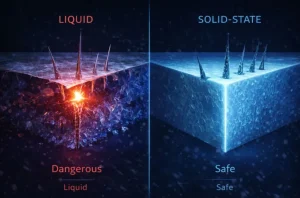
This is the hidden enemy. Lithium dendrite growth can ruin a battery from the inside, even without a crash. Over hundreds of charges, tiny lithium spikes grow on the anode. Eventually, they act like needles. They poke through the separator quietly. This explains why drones sometimes catch fire. It can happen while charging. It can even happen while sitting on a shelf.
3. Thermal Trigger (The Feedback Loop)
Heat kills batteries. Every type has a limit called the lithium ion thermal runaway temperature. For standard liquid kinds, this limit is very low. It is often around 130°C to 150°C. If the cell gets this hot, the separator melts. This can happen from hard work or hot weather. The chemical reaction speeds up. It makes more heat. That causes even more reaction. It is like a runaway train.
The Architecture Flaw: Propagation
The real danger in an industrial pack is not just one cell failing. It is thermal propagation.
In high-voltage liquid systems, cells are packed tight. If one cell starts thermal runaway, it gets very hot. The heat goes over 600°C. This cooks the cells next to it right away. Then, they explode too.
This is a failure of safety criticality. The system lacks fault tolerance. Unlike solid-state architectures with higher thermal thresholds which can stop this spread, liquid systems act like fuel. One small failure destroys the whole drone. The design cannot keep the problem alone.
Why BMS Is Not Enough
We often trust the Battery Management System (BMS) for safety. But there are BMS limitations.
A “smart” BMS is great at stopping outside threats. It stops overcharging or outside shorts. But it cannot stop physics. A BMS cannot stop an internal short circuit caused by a dendrite. It cannot stop a chemical reaction once the thermal runaway temperature lithium ion limit is passed inside the cell.
Relying only on a BMS is like using a smoke detector to put out a fire. It can warn you. But it cannot save the payload.
The Solid-State Solution: Cutting the Fire Triangle
To stop the fire, you must take away the fuel. That is why the industry is moving to non-flammable solid-state battery tech.
Shengya uses a solid or semi-solid material instead of liquid. This changes safety in a big way:
- Physical Blocker: The solid stuff is too hard for dendrites to poke through.
- Higher Thresholds: The lithium ion thermal runaway temperature for these materials is much higher. It is harder to start a reaction.
- No Leaks: Even if there is a hole, no liquid leaks out to burn.
By switching to solid-state tech, you are buying an insurance policy. It is built right into the chemistry.
Case Study: The Nail Penetration Test
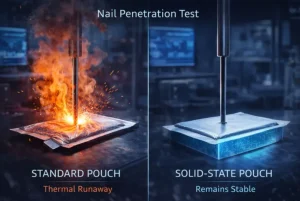
The industry standard for testing safety-critical battery systems is the Nail Penetration Test. Engineers drive a steel nail through a full cell. This copies a bad internal short.
- Standard LiPo: The cell gets big fast. It makes thick smoke. It bursts into flames.
- Shengya Solid-State: The cell gets warmer. But there is no fire. There is no explosion.
This difference is key. Operators with expensive gear are moving to Shengya’s high-voltage safety-certified systems. The safety is built-in. It stops one failure from causing a total loss.
Conclusion
Thermal runaway is a risk found in liquid battery chemistry. Software cannot stop it fully. Pilot skill cannot stop it either. The only way to truly protect your valuable assets is to change the system conditions. You must use safer materials.
Do not wait for an accident to prove this. You can consult on thermal safety specifications to see how solid-state tech fits your needs.
The Manufacturer Behind the Technology: Shengya Electronic
Shengya Electronic makes high-end energy storage. They focus on industrial unmanned aerial vehicles. The company is unique. They manage the whole production chain. They do everything from mixing cell materials to building the final packs. They work in a 26,000-square-meter facility. Shengya Electronic makes about 300,000 Ah every day.
The company is strong in semi-solid and solid-state lithium tech. These products fix real problems for flights: high energy density (up to 340Wh/kg) and long life (800-1000 cycles). With ISO9001, ISO14001, and UL papers, Shengya Electronic is a trusted OEM partner. They help clients who need reliable power for mapping, watching, and carrying cargo.
FAQ
Q1: Can thermal runaway happen while the drone is turned off?
A: Yes. If lithium dendrite growth has damaged the internal separator, a short circuit can occur on its own, even when the battery is sitting in storage. This can lead to a fire without any load applied.
Q2: Are solid-state batteries fireproof?
A: No battery is 100% unbreakable. However, solid-state batteries are puncture-resistant and are generally considered non-flammable. They do not contain the volatile liquid solvents found in standard LiPo batteries, which can cause violent explosions.
Q3: What is the critical lithium-ion thermal runaway temperature?
A: For standard liquid LiPo batteries, the lithium-ion thermal runaway temperature is usually around 130°C to 150°C. Solid-state electrolytes can handle temperatures above 200°C, which gives them a much wider safety margin, especially in industrial environments.
Q4: Does a BMS prevent thermal propagation?
A: A Battery Management System (BMS) cannot stop thermal propagation once it begins. It can only disconnect the battery from the drone, preventing electrical damage. However, it cannot stop the heat from one cell triggering the next. Only the physical chemistry of the cells can prevent this.