
A battery invoice shows only the purchase price. Your operating records reveal the larger figure: packs, charging labor, flight delays, early replacements, disposal, and the risk attached to a weak cell during a full-tank takeoff. A useful total cost of ownership for agricultural drones converts those items into cost per completed flight. That makes a 1,200-cycle pack and a 600-cycle pack comparable on the same basis.
What Belongs in an Agricultural Drone Battery TCO Model?
Start with costs your team can record. Use completed missions as the output because a charging cycle that ends in an aborted spray run still consumes labor and battery life. Keep aircraft repairs in a separate risk line so one incident does not hide normal operating costs.
Direct Battery Cost
Use this working formula:
Battery TCO = purchase price + charging energy + inspection labor + downtime + replacement logistics + disposal + expected failure cost
Then calculate cost per flight = battery TCO ÷ completed flights. For a simple example, assume a pack costs $1,800 and delivers 1,000 completed flights. Purchase cost is $1.80 per flight. If a $1,200 pack reaches 550 completed flights, its purchase cost is $2.18 per flight before labor or downtime enters the calculation. These figures are an example, so replace them with your invoices and flight logs.
Downtime and Risk Cost
During spraying season, a grounded aircraft can miss a short weather window. Record the crew hours, rescheduling, transport, and lost field capacity tied to each pack failure. Expected failure cost can be calculated as incident probability multiplied by the repair, payload, and recovery cost. This line gives voltage stability a financial value.
Which Battery Factors Change Cost per Flight?
Cycle count matters, though usable cycles matter more. A pack has reached its economic limit when heat, voltage sag, or reduced capacity prevents the assigned mission. Your heavy-lift agricultural drone battery should be judged at the payload, route, temperature, and discharge rate used on the farm.
Cycle Life and Usable Capacity
A battery qualification target may be 1,200 cycles with at least 80% capacity retention, depending on the application and test conditions. Treat that figure as a qualification target and request the test conditions. Depth of discharge, temperature, C-rate, end-of-life threshold, and rest time can change the result. Your drone battery cycle life record should include completed flights, delivered amp-hours, maximum temperature, and remaining capacity.
Internal Resistance and Cell Balance
Battery internal resistance turns part of the stored energy into heat. As resistance rises, voltage sag becomes sharper during takeoff, climbing, or a fast turn with a full tank. Track resistance by cell under the same temperature and state of charge. Trend data is more useful than one isolated reading.
A cell-to-cell voltage delta of 0.05 V or less is a practical screening benchmark cited for industrial packs. Cell voltage imbalance makes the weakest cell reach the low-voltage cutoff first, leaving energy unused in the other cells. Quarantine a pack when its delta or heat pattern moves outside your approved limit.
Energy Density and Pack Fit
More capacity can add enough mass to raise motor current and heat. The result can be a smaller gain than the label suggests. Compare watt-hours, pack mass, payload, hover power, and reserve state of charge together. This battery weight guide explains the same sizing issue in flight-time terms. Available UAV battery ranges span roughly 190 to 350 Wh/kg, with configurations from 6S through 18S, so pack selection can follow the aircraft voltage and mission profile.
How Can You Extend Drone Battery Cycle Life?
Most life extension comes from repeatable field habits. A written routine also makes warranty discussions easier because your logs show how each pack was charged, stored, and flown.
Control Heat During Work
Check pack temperature after landing and allow cooling before recharge. Clean vents, keep packs out of direct sun, and avoid charging inside a hot vehicle. Repeated heavy-payload overheating calls for a review of propellers, takeoff weight, discharge rate, connectors, and pack resistance. The heavy-payload heat checklist provides a useful inspection sequence. A dusty landing pad seems minor, yet blocked airflow and grit around connectors show up often during busy field days.
Set Charge and Storage Rules
For storage, use the pack maker’s approved setting. A common lithium guidance range is 3.80 to 3.90 V per cell in a dry 15°C to 25°C space. Log packs by serial number and rotate inventory by use count. Drone battery maintenance should also cover connector wear, swelling, case damage, balance time, and charger calibration.
Use Retirement Thresholds
Define limits before the season starts. Useful triggers include capacity retention, resistance growth, cell delta, physical damage, abnormal heat, and repeated early landing. A retired flight pack may enter a lower-demand role only after a documented safety review and compatible use case.
How Should You Qualify a Battery Supplier?
Ask for data that matches your aircraft. A polished specification sheet has limited value when its test uses a light load, mild temperature, or a different cutoff voltage.
Build a Mission-Based Test
Give the agricultural drone battery supplier your voltage, peak and continuous current, target flight time, payload, connector, charger, ambient range, and reserve requirement. Request cycle-test conditions, cell matching limits, discharge curves, temperature rise, batch traceability, and transport documents. Test a pilot batch through repeated full-payload routes before fleet rollout.
Turning Battery Data into Lower Lifetime Cost
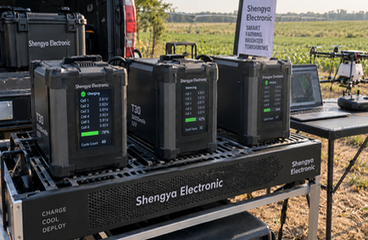
Once your TCO sheet identifies heat, pack mass, or cell drift as the main cost driver, component selection becomes specific. Shengya Electronic provides customizable UAV battery packs with different capacities, voltage configurations, and discharge requirements, subject to project specifications. That range supports a mission-based comparison of voltage, energy, mass, and discharge demand.
The useful supplier conversation starts with your load profile and retirement rules. Shengya Electronic can map those inputs to a pack configuration and provide samples for aircraft-level testing. Your acceptance plan should still set the final gate: stable voltage under peak load, controlled temperature rise, consistent cell balance, and repeatable completed flights.
FAQ
Q1: What is the best TCO metric for a drone battery?
A: Use total battery-related cost divided by completed flights. Add purchase, energy, labor, downtime, logistics, disposal, and expected failure cost.
Q2: Is 1,200 cycles a guaranteed service life?
A: It is a procurement target. Actual life depends on payload, discharge rate, temperature, charge settings, storage, and the test’s end-of-life threshold.
Q3: How often should cell voltage be checked?
A: Check it during charging and review logged cell delta before high-load missions. Set the exact interval from the aircraft manual, pack guidance, and fleet risk level.
Q4: Why does a larger battery sometimes give little extra flight time?
A: Extra battery mass raises lift demand and motor current. Compare usable watt-hours and complete aircraft weight through a controlled flight test.
Q5: When should a flight pack be retired?
A: Retire it when it crosses your approved limit for capacity, resistance, cell delta, temperature, physical condition, or early landings.