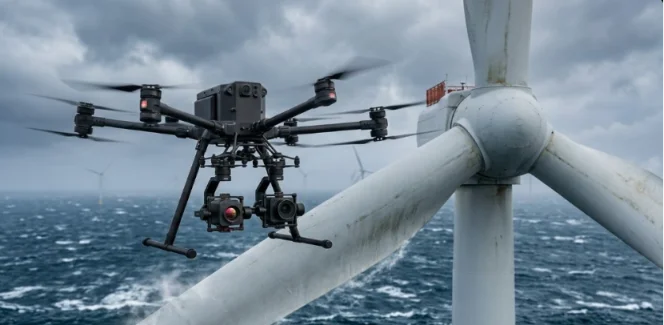
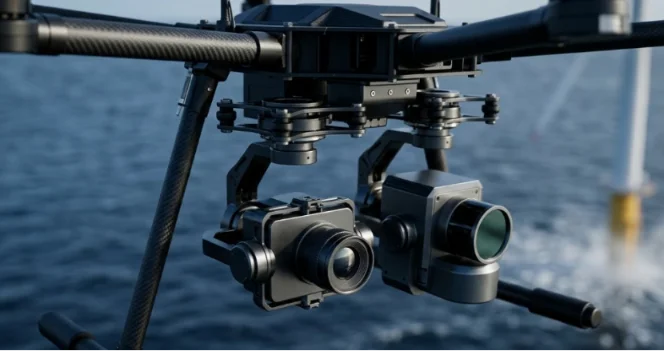
Picture this. You are standing on a swaying boat miles away from the coast. The ocean breeze is pushing fifteen knots. You send your big hexacopter up to look at a massive wind turbine blade. The camera is rolling and picking up tiny cracks in the fiberglass. But just ten minutes into the flight, the telemetry screen flashes a low battery warning. You have to bring the expensive rig back right away. Doing a proper wind turbine drone inspection over open water is incredibly stressful. Regular batteries just die way too fast out there. If you want to finish a full offshore drone inspection without swapping packs every five minutes, you really need to look at what powers your motors. Let us talk about the real challenges of flying over the sea and what kind of power you actually need to survive it.
The Brutal Reality of Offshore Drone Inspection: Why Standard Batteries Fail
Flying over the ocean is totally different from flying over a quiet cornfield. The air is heavy, the gusts are sudden, and there is nowhere safe to land if things go wrong. Standard lithium polymer packs simply cannot handle this kind of constant abuse.
The Hovering Tax: Fighting Unpredictable Ocean Winds
When the wind hits your frame, your flight controller works overtime. To maintain proper drone wind resistance, the motors constantly speed up and slow down. This creates massive current spikes. Think of it like driving a heavy truck in stop and go traffic on a steep hill. It burns through your energy reserves incredibly fast. You might get forty minutes of hover time inside a quiet warehouse, but out on the ocean, that time easily drops to fifteen minutes. It is a brutal reality that catches a lot of new pilots totally off guard.
The Heavy Payload Dilemma
You are rarely just flying a bare frame. You are carrying heavy thermal cameras, big lenses, and maybe even a bulky LiDAR setup. Trying to keep all that expensive gear stable in high winds requires serious thrust. If you are not using a proper heavy lift drone battery, your motors will just suck the cells dry. Flying heavy means you burn power exponentially faster.
Voltage Sag and the Fear of Water Landings
This is the absolute nightmare scenario for any pilot. When you push the throttle hard to fight a sudden gust, the voltage in a cheap battery drops off a cliff. This is called voltage sag in drones. The flight controller thinks the battery is dead and tries to force an emergency landing. But you are over salt water. If it lands, you lose twenty thousand dollars of equipment in two seconds. You need cells that hold their voltage steady even under extreme stress.
What Makes a Drone Battery Truly Ready for Offshore Wind Turbines?
You cannot just buy a physically bigger battery to fix the problem. A heavier battery just makes the motors work harder, which ruins the whole point. You have to find a better power to weight ratio. This means looking at cell chemistry instead of just size.
High Energy Density: The 270 Wh/kg Benchmark
This is the magic number you want to look for right now. Energy density tells you how much juice is packed into every kilogram of weight. A high energy density drone battery completely changes the game. When you use a 270 Wh/kg battery, you are keeping the takeoff weight low while drastically extending your flight time. It allows you to actually finish scanning all three turbine blades before you have to fly back to the boat.
Higher Voltage Output: 4.35V vs 4.2V
Most normal battery packs charge up to 4.2 volts per cell. That is fine for taking wedding photos in a park. But for marine industrial work, a high voltage UAV battery pushing 4.35 volts gives your motors a much stronger torque response. When a twenty knot gust hits the frame, the motors have the extra punch needed to hold the position without dipping into dangerous voltage sag territory.
Massive Capacity for One Flight per Turbine
The ultimate goal is to launch the rig, scan the entire turbine, and come back. You do not want to stop halfway through to change packs. That is why the industry is moving toward setups like the 30000mAh 6S/12S drone battery. Having that massive pool of thirty thousand milliamp hours gives you the safety buffer you desperately need when the winds pick up during the flight home.
Powering Marine Inspections: The Shengya Electronic Solution
Finding the right power supply for these harsh marine jobs usually takes a lot of trial and error. This is exactly where an experienced manufacturer steps into the picture to solve the headache. As a top tier expert in industrial power systems, Shengya Electronic focuses heavily on fixing the exact problems offshore pilots face every day. They build high end batteries specifically for heavy duty multirotors. Instead of offering generic hobby packs, they engineer their cells to handle crazy wind loads and heavy payloads without breaking a sweat.
If you look closely at their lineup, they produce a highly specialized 270 Wh/kg 30000mAh 6S/12S battery built on that crucial 4.35V high voltage architecture. Choosing their products means you get that massive energy density right out of the box. The weight stays low, but the flight time jumps up significantly. Whether you wire them up as a 6S pair or use a massive 12S block, these packs give your rig the raw sustained power to fight ocean winds, scan the whole turbine, and make it back to the deck safely.
FAQ
Q1: How much wind can a drone handle during an offshore inspection?
A: Most commercial rigs can handle gusts around twenty to twenty five knots. But flying in those conditions drains the power extremely fast because the motors work overtime to stay level.
Q2: Why do drone batteries drain faster in windy conditions?
A: The flight controller constantly commands the motors to speed up and slow down to fight the moving air. These rapid changes in motor speed create huge electrical current spikes that drain the cells quickly.
Q3: What does 270 Wh/kg mean for drone flight time?
A: It means the battery holds 270 watt hours of energy for every kilogram it weighs. A higher number gives you more flight minutes without adding extra dead weight to your aircraft.
Q4: Is a 12S battery setup better than 6S for heavy lift drones?
A: Yes. Running a 12S system is much better for heavy lifting. It doubles the voltage, which cuts the electrical current in half. This keeps the wires cooler and makes the motors much more efficient.
Q5: How long does a complete offshore wind turbine drone inspection take?
A: Scanning all three blades and the main tower usually takes about thirty to forty minutes. You really need high capacity packs to finish the entire job in a single trip.