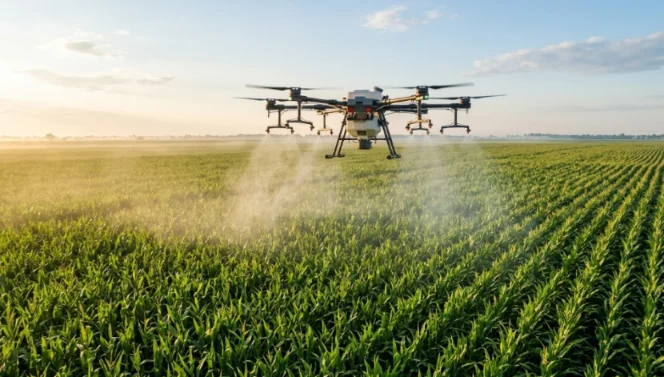
Imagine standing at the edge of a 500-acre cornfield in mid-July. The heat is already building up by eight in the morning. You have a very narrow window to get the pesticide down before the wind picks up and ruins your drift control. But the rig keeps coming back every eight or nine minutes. Swapping power packs constantly just kills your momentum. It takes a massive toll on daily acreage coverage and wastes a lot of expensive labor hours.
Getting a firm handle on agricultural spraying drone battery life completely changes the math for a large-scale farming operation. It is often the difference between wrapping up a field before noon or paying a crew to sit around while generators scream trying to catch up with the charging queue. Let’s look at what actually drains power out there in the dirt and how to fix it without burning through your equipment budget.
What Makes Large-Scale Crop Spraying So Power Hungry?
Throwing a heavy tank of liquid or solid granules into the air takes an absurd amount of raw energy. The sheer physics of lifting that weight requires huge bursts of electrical current from the motors just to get off the ground.
When you shift from standard liquid spraying to heavy payload seeding, the power draw spikes even higher. Spreading solid granules like fertilizer or cover crop seeds means the rig stays heavy for a much longer portion of the flight compared to a liquid tank that constantly gets lighter as it sprays out. This sustained heavy load pulls the voltage down fast. Anyone who has done solid fertilizer spreading knows the low-voltage warning always beeps way earlier than expected. The motors are constantly fighting gravity at near maximum thrust, which strips the cells of their stored energy at a highly accelerated rate.
What Factors Drain Your Power Faster in the Field?
It is rarely just one single thing that kills your flight time. It is usually a messy combination of heavy payloads, bad weather, and inefficient flight routing combining to stress the power system.
Payload weight is the obvious factor. A tank filled to the brim forces the propulsion system to work extremely hard. But the weather is the silent killer on a farm. Summer heat forces the internal temperatures of the lithium cells to dangerous levels quickly. Once those cells get too hot, the internal electrical resistance jumps up, and you lose a significant amount of usable capacity.
Wind plays a massive part too. If the machine is fighting a fifteen-mile-per-hour crosswind across a soybean field, the flight controller has to constantly adjust motor speeds just to keep the frame level. That constant throttling eats up amps much faster than a calm, straight run. Then you have to deal with the actual shape of the field. Irregularly shaped plots with lots of obstacles force the rig to slow down, turn, and accelerate over and over. This stop-and-go flying destroys your efficiency in minutes.
How Can You Extend Your Flight Time and Efficiency?
Fixing a short flight time issue requires looking at both your physical gear and your daily operational workflow. Good drone fleet battery management is all about keeping the machine in the air doing work, rather than sitting on a tailgate waiting for a green light on a charger.
Plan Better Flight Routes and Spray Settings
Straight lines are your best friend. Whenever you possibly can, align your automated flight paths with the longest straight edge of the field to cut down on the sheer number of turns. You also need to match your pump flow rate with the flight speed perfectly. Running out of liquid while you still have thirty percent power left means you are flying dead weight back to the landing zone.
Set Up a Smart Rotation System
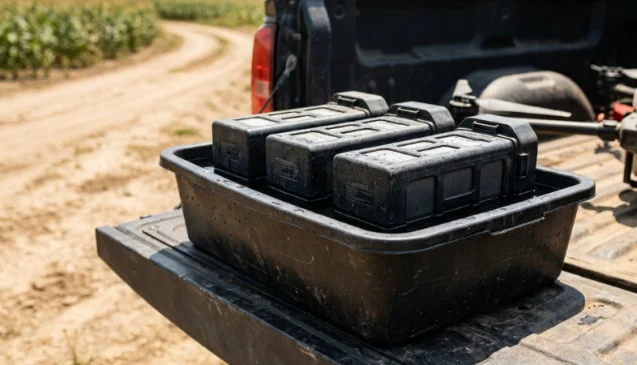
You need a solid rhythm on the ground. The standard rule for continuous commercial flying is having at least three to four packs in a tight rotation. One is in the air working, one is resting to cool down, and the others are actively on the charger. Never pull a hot pack straight out of the machine and slap it directly onto a high-speed charger. That trapped heat needs to dissipate first, usually in a water cooling tub, or you will completely ruin the internal cells in a matter of weeks.
Upgrade to High Energy Density Drone Batteries
Sometimes, flying smarter is just not enough to overcome the physical limits of standard power packs. If you are constantly hitting a wall with coverage, stepping up to high energy density drone batteries changes the game. This is where the actual chemistry of the cell works in your favor. Instead of just adding heavier packs that ruin your payload capacity, advanced tech puts more energy into the exact same footprint.
Take a look at Shengya Electronic. As a manufacturer heavily focused on high-performance aerial power solutions, they build packs that deliver a incredibly stable voltage curve even under extreme farm loads. Their gear keeps water pumps and spreading discs running at perfectly consistent speeds, so your chemical application stays uniform from the start of the flight to the end. By upgrading to Shengya drone power products, you get a noticeable bump in single-flight coverage without making the rig dangerously heavy. It is a direct, practical swap that just works better in the dirt and heat of real agricultural operations.
Are You Following Best Practices for Charging and Maintenance?
Charging out of the back of a dusty pickup truck on a dirt road is tough on sensitive electronics. The conditions are almost always hot, dirty, and incredibly rushed.
When you rely on fast charging drone batteries to keep up with a tight workflow, you have to be extra careful about internal temperatures. Forcing a massive amount of electrical current into a hot pack severely degrades the chemical structure inside. Always let them cool down to a reasonable temperature before hitting them with a high-amp charge.
Off-season storage is where most operators actually destroy their expensive equipment. Tossing fully charged packs onto a garage shelf in November and totally ignoring them until the spring spraying season guarantees swelling and permanent capacity loss. To actively protect your agricultural drone battery lifespan, you need to discharge them down to about forty to fifty percent capacity for winter storage. Keep them in a cool, dry place and make it a habit to cycle them at least once a month.
The Real ROI of Better Power Management
Think about what a single landing actually costs your operation. You have the time spent flying back to the truck, physically swapping the heavy pack, refilling the chemical tank, and flying all the way back out to the exact break point in the field. It takes minutes, and those idle minutes add up to hours over a busy week.
By actively increasing your agricultural spraying drone battery life through better ground habits or upgraded power cells, you drastically cut down those wasted landings. Fewer landings mean less generator fuel burned idling on the ground and far less downtime for the ground crew. The upfront cost of premium packs or better cooling equipment pays for itself incredibly fast when you can easily cover an extra fifty acres a day with the exact same crew. You get the job done faster, and you move on to the next client or the next field before the weather turns.
FAQ
Q1: How long do these packs typically last per flight?
A: Usually between eight to fifteen minutes. It depends heavily on the payload weight and the energy density of the specific cells you are flying with.
Q2: How can you cool down the packs quickly during summer spraying?
A: Water cooling tubs are the most effective and popular method in the field, though high-powered industrial fans also work fairly well if a water setup is not an option.
Q3: Why do the packs lose capacity after just one season?
A: It almost always comes down to poor storage habits during the off-season or constantly charging them while they are still way too hot during the peak summer months.
Q4: Is it safe to leave them fully charged overnight?
A: Doing it once in a while during the busy season will not cause immediate failure, but making it a regular habit will significantly degrade the internal chemistry over time.
Q5: Does a higher capacity pack always mean longer flight times?
A: Not necessarily. If the higher capacity pack is significantly heavier, the motors have to work much harder to lift it, which often cancels out the extra stored energy.