
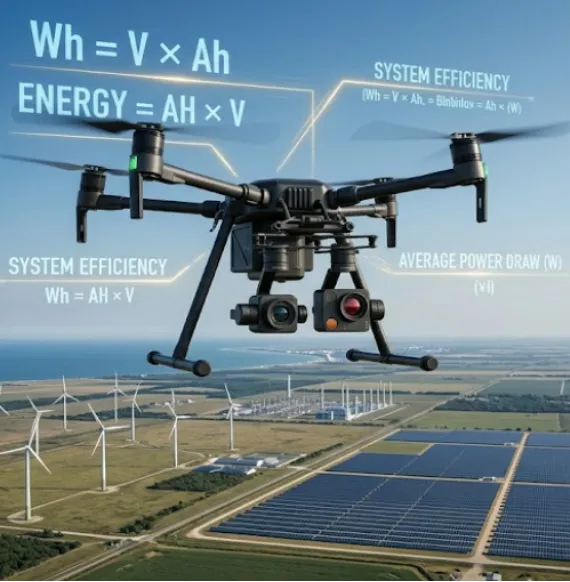
Many buyers still treat drone battery flight time calculation like a simple mAh question. That is where the trouble starts. If you want to know how to calculate drone flight time in a way that matches field use, you need battery capacity, voltage, payload, usable energy, and average power draw. That is the only way to get close to real drone flight time instead of a nice-looking number that falls apart after takeoff. If you are comparing battery options for UAV work, it helps to look at suppliers that publish broad voltage and energy-density ranges, such as Shengya Electronic, because that gives you a better base for real mission planning.
Why Drone Battery Flight Time Calculation Is More Than Just mAh?
A lot of customers ask one question first: “How many mAh?” It sounds reasonable, but mAh alone cannot tell you how long a drone will stay in the air. Two packs can show the same mAh and still give very different flight times if their voltage is different. That catches people off guard more often than it should.
mAh Is Only Part of the Story
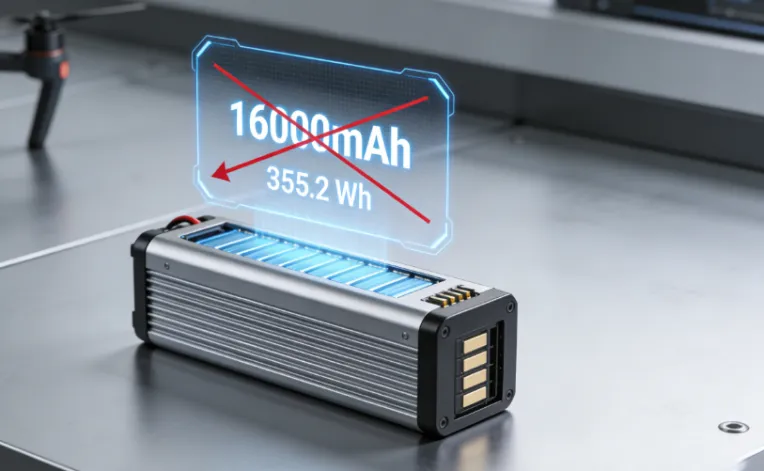
The clean way to look at drone battery capacity vs flight time is this: mAh tells you charge, but Wh tells you usable energy. The basic conversion is Wh = V × Ah. So a 16000mAh pack is 16Ah. If that pack is 22.2V, total energy is 355.2Wh. The reference method for drone flight time calculation then applies usable capacity and divides by average power draw, instead of guessing from mAh alone.
The Formula You Actually Need
For practical work, use this formula: Flight Time = Battery Energy (Wh) × Usable Capacity × System Efficiency ÷ Average Power Draw (W). In plain language, your battery may look big on the label, but you never use every last bit of it. A reserve for landing, return, and voltage sag matters. The reference page recommends calculating from usable energy, safety reserve, and mission power, not from label capacity by itself.
How to Calculate Drone Flight Time by Battery Capacity, Voltage, and Payload?
Once you move from battery label to mission data, the math gets much more honest. This section answers how to calculate drone flight time by battery capacity, voltage, and payload without making it sound harder than it is.
Step 1 Convert Capacity Into Energy
Start with the battery label. Convert mAh to Ah, then calculate Wh. For example, 16000mAh becomes 16Ah. At 22.2V, that gives 355.2Wh. This is why mAh vs Wh for drone battery is not a small detail. Wh lets you compare packs across different voltages in a fair way.
Step 2 Apply Usable Capacity
Next, cut that total energy down to a realistic usable amount. A common planning range is 80% to 90%. If you use 85%, then 355.2Wh becomes 301.9Wh. That number is already closer to what you can really use in the air. It is not flashy, but it is safer.
Step 3 Add Payload and Average Power
Now bring in the mission. If average power draw is 650W, flight time is 301.9 ÷ 650 × 60, or about 27.9 minutes. If the same pack flies a heavier mission at 900W, flight time drops to about 20.1 minutes. Same battery, different result. That is the part many buyers miss. Payload, maneuvering, and wind change the number fast. The reference article uses this same energy based logic and shows why payload conditions should be part of every estimate.
How Battery Voltage Affects Drone Flight Time?
This part matters when buyers compare packs that look similar on paper. Drone battery voltage and flight time are tied together because voltage changes total energy, and total energy is what feeds the aircraft.
Why Wh Beats mAh for Comparison
If two batteries both say 10000mAh, but one is 22.2V and the other is 44.4V, they do not store the same energy. The higher-voltage pack stores much more Wh. That is the short answer to how battery voltage affects drone flight time. Voltage also matters because some pack families are built for weight-sensitive or long-endurance use. On its official pages, Shengya Electronic says it was founded in 2017 in Taixing, Jiangsu, and focuses on solid-state and semi-solid lithium-ion soft-pack cells and packs. It lists energy-density classes around 270, 320, 330, and 340Wh/kg, cycle life around 800 to 1000 cycles, and pack combinations such as 6S, 7S, 12S, 13S, and 14S. That kind of range is useful because longer flight time usually comes from the right mix of voltage, energy density, and pack design, not from one oversized capacity figure.
A Real Product Range Gives Better Clues
The company’s 275Wh/kg series lists UAV pack options from 16000mAh to 30000mAh in 6S, 7S, 12S, and some 14S versions, while other series on the site go higher in energy density. On individual product pages, it also describes semi-solid lithium packs for drones with high safety, long cycle life, customization options, and support for common certificates such as UN38.3 and MSDS. That sort of information matters because battery capacity and drone flight time only make sense when the pack format actually fits the aircraft and task.
How Payload Affects Drone Flight Time in Real Applications?
This is where paper estimates meet the real world. It is also where people finally see how payload affects drone flight time. A camera, sensor, delivery box, or mapping rig does not just add weight. It changes average power draw through the whole mission.
The Same Battery Can Behave Very Differently
A light-hover mission may look fine at nearly 28 minutes. Add payload, stronger climb demand, or headwind, and that same battery can drop near 20 minutes. Not pretty, but normal. Takeoff, hover, cruise, and landing do not draw power in the same way either, so a single flat estimate can be misleading. The reference page specifically points to variable mission phases, payload conditions, and real flight log validation as the better path.
How to Estimate Real Drone Flight Time Before You Buy
If you need how to estimate real drone flight time, ask for four numbers first: voltage, capacity, expected payload, and average mission power. If you need how to choose drone battery for longer flight time, compare Wh, usable capacity, pack weight, and the aircraft’s actual power demand. Big mAh numbers look good in a quote. In the field, Wh and watts decide everything. A quick gut check helps too. If the claimed time looks far better than the aircraft’s usual power class suggests, it probably is.
FAQ
Q1: How to calculate drone flight time by battery capacity?
A: Convert mAh to Ah, multiply by voltage to get Wh, apply usable capacity, then divide by average power draw.
Q2: What is the difference between drone battery capacity vs flight time?
A: Capacity is only one input. Flight time depends on voltage, usable energy, payload, and power consumption during the mission.
Q3: How battery voltage affects drone flight time?
A: Higher voltage changes total Wh, so two batteries with the same mAh can deliver very different endurance.
Q4: How payload affects drone flight time?
A: More payload usually raises average power draw, which shortens flight time even if the battery stays the same.
Q5: Is mAh vs Wh for drone battery important when estimating flight time?
A: Yes. Wh is the better number for comparing real stored energy, especially across different voltage platforms.


