
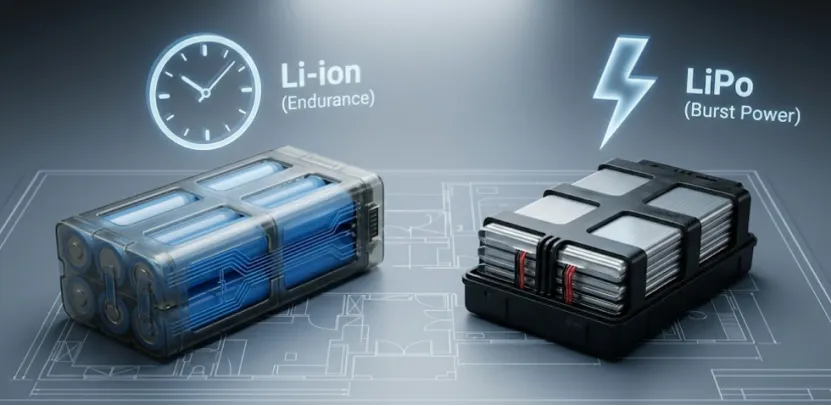
Comparing a li-ion vs lipo drone battery? The true issue isn’t about glossy spec sheets. It’s about the actual work. Your drone might map or patrol all day. It might inspect towers. Here, flight time is crucial. Every added minute counts. Conversely, it might haul heavy payloads. It could spray crops or climb aggressively after launch. In those specific cases, raw peak power becomes the top priority. That is where many buyers get stuck. They are not buying a battery. They are buying mission time, stable lift, and fewer headaches later.
Li-ion vs LiPo Drone Battery: What Matters Most First?
Before you look at capacity, voltage, or price, it helps to sort your own needs. A long-range inspection drone and a heavy-lift agricultural drone can use very different logic when choosing an industrial drone battery. On paper, both are “drone batteries.” In the field, they live very different lives.
Which Pack Fits Long Routes Better?
If endurance is the priority, a li-ion battery for drones typically wins. These packs offer greater energy density. Thus, they store more power at the exact same weight. This matters. Extra battery mass is never truly free. It limits your climb and total range. Plus, it restricts your usable payload. Returning just two minutes early seems minor. Yet, on extensive inspection routes, it hurts. It might mean missing one tower or pipeline piece before sunset.
Which Pack Handles Sudden Power Demand Better?
A lipo battery for drones usually performs better when the aircraft needs strong current output right now. LiPo packs hold voltage better under high amp draw, so they tend to feel stronger in punch, burst climb, and aggressive throttle changes. For a buyer, that usually points to heavy payload work, spraying, or other missions where the aircraft does not just cruise calmly from point A to point B.
Which Battery Gives You Better Endurance?
Endurance is often the first filter in B2B buying, because flight time affects labor cost, route planning, and how many packs you need in rotation. You can recover from a battery that costs a bit more. You cannot recover much from a battery that keeps cutting the mission short.
Why Energy Density Changes Flight Time
A high energy density UAV battery is usually the better answer when you need a UAV battery for long endurance. This is why drone battery energy density matters more than mAh alone. Two packs can both look large on paper, but the lighter one with higher Wh/kg can stretch mission time without pushing takeoff weight too far. That is why Li-ion is widely preferred for mapping, patrol, remote monitoring, and industrial inspection.
Where Shengya Electronic Fits This Conversation
Shengya Electronic is a useful example here because its public product range is built around high-energy-density lithium-ion packs rather than hobby-style power packs. The company says it was founded in 2017 in Taixing, Jiangsu, and makes high-energy-density soft-pack lithium-ion cells and packs for drones, robots, and special-use applications. Its 275Wh/kg series includes 16000mAh, 18000mAh, 22000mAh, 27000mAh, and 30000mAh options, with common combinations such as 6S, 7S, 12S, and 14S. The company also states that battery packs can be customized for connector type, cable position, logo, and pack configuration, with a stated cycle life of about 800 to 1000 charge and discharge cycles. That kind of range matters when you are trying to match one platform to very different jobs.
Which Battery Carries Payload and Keeps Voltage Stable?
Payload is where many comparisons get messy. A pack can be lighter and still be the wrong choice if the aircraft needs hard current bursts all day. So you have to look at weight and discharge behavior together, not one at a time.
Why LiPo Still Matters for Heavy Lift Work
When buyers compare li-ion vs lipo for payload, LiPo still has a strong case in heavy-lift work. It holds voltage better under high draw and tends to run cooler during high discharge. That makes it a familiar choice for aircraft that spray, haul, or climb with authority from takeoff. If your drone spends more time fighting load than cruising efficiently, LiPo may simply feel more stable in the air. Not elegant, maybe, but very practical.
When Li-ion Is Still the Smarter Choice
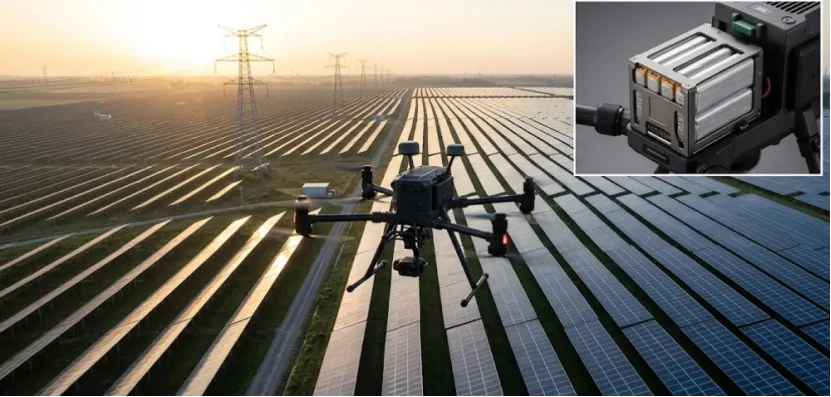
Li-ion can still be the best battery for industrial drones when payload is moderate and endurance is the real profit driver. This is common in logistics delivery, industrial inspection, urban air mobility research, firefighting support, and remote monitoring tasks, all application areas highlighted on the company site. In those cases, a long flight time drone battery can do more for your operation than raw burst power.
Which Option Costs Less Over Time?
A purchase order shows one price. Actual operating cost shows another. That gap is where many battery decisions go wrong, especially when fleet planning starts with unit price and ends there.
Why Upfront Price Is Not the Whole Story
A proper li-ion vs lipo battery cost comparison should include replacement frequency, pack count per shift, and drone battery cycle life. The reference comparison notes that LiPo batteries provide around half the life cycles of Li-ion. That does not mean LiPo is a bad choice. It means short-term cost and long-term cost are not the same thing. If you run a fleet, cycle life can change your spare inventory, charging schedule, and maintenance rhythm more than people expect.
What Should You Ask a Supplier?
Ask simple questions first. Do you need a drone battery for heavy lift applications or a drone battery for payload that is still endurance focused? What voltage combinations are available? What cycle range is stated? Which missions is the pack built for? On the company side, the published application pages point to logistics delivery, crop protection, industrial inspection, urban air mobility, and firefighting and rescue, while the 275Wh/kg product line covers several capacities and pack combinations that suit different aircraft classes. That makes it easier to compare battery chemistry against actual mission demand instead of buying by habit.
FAQ
Q1: Is Li-ion better than LiPo for drones?
A: It is better for many endurance-focused missions, especially when lower weight and longer flight time matter more than burst power.
Q2: How does li-ion vs lipo for drone flight time compare?
A: In most industrial cases, Li-ion wins on flight time because higher energy density gives you more usable energy for the same pack weight.
Q3: How does li-ion vs lipo for payload compare in industrial use?
A: LiPo is often better for high-current, heavy-lift work. Li-ion is often better when payload is moderate and mission time matters more.
Q4: What is the difference in li-ion vs lipo battery cost over time?
A: LiPo may fit some jobs well, but Li-ion often costs less over time because cycle life is usually longer and replacement frequency is lower.
Q5: Which battery is safer for industrial drones?
A: In general, Li-ion is often seen as the safer option, while LiPo is more prone to thermal runaway if punctured or damaged. Pack design and battery management still matter a lot.


