
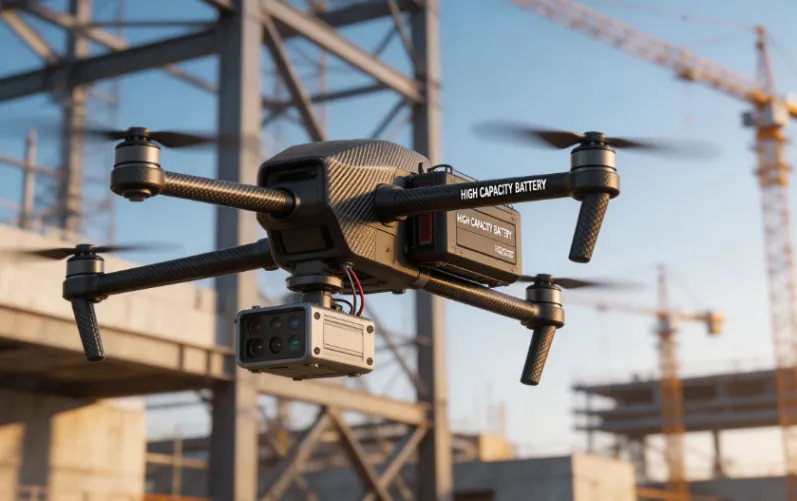
Right off the bat, a lot of commercial operators mistakenly believe that a bigger power pack automatically equals longer flight times. They completely ignore the impact of drone battery dead weight on the motors’ physical limits. You buy a massive new unit, strap it onto the frame, and suddenly the aircraft wobbles like crazy or your voltage alarms start screaming within three minutes.
It happens all the time in the field. Before buying a new power source, you must check that the added mass does not push your equipment beyond its safe maximum takeoff weight MTOW. If you skip this step, you are setting yourself up for an expensive hardware failure.
Why Does Your Drone Become Unstable After Adding a Larger Battery?
It all comes down to simple physics and diminishing returns. Every single extra gram you add requires more thrust just to keep the machine hovering in place. Once you pass the sweet spot of the motor’s efficiency curve, the battery stops being a fuel tank. It turns into dead weight.
The motors start pulling significantly more amps, generating excess heat instead of producing lift. Sometimes they even sound like a cheap coffee grinder struggling with hard beans. That rough sound is a serious mechanical warning.
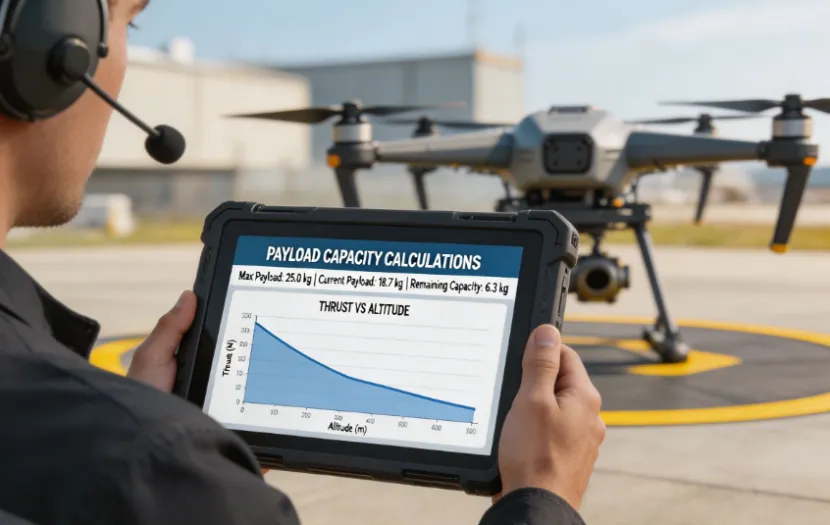
Relying on guesswork rather than hard numbers often leads to melted speed controllers or unexpected crashes mid-mission. To keep commercial operations safe and profitable, mastering the precise drone payload capacity calculation is an absolute necessity.
The Professional Drone Payload Capacity Formula
Let’s look at the actual math used in industrial setups. When you are trying to calculate battery capacity for drone operations, always subtract the empty weight of your frame from the total thrust divided by your target hover ratio.
$$Payload = \frac{Total\ Thrust}{Hover\ Ratio} – (Empty\ Weight + Battery\ Weight)$$
Total Thrust is the combined pulling force of all your motors running at 100% throttle. The Hover Ratio acts as your safety margin. For serious B2B industrial gigs, you want this number sitting right around 2.0 so the aircraft can handle sudden wind gusts safely.
Empty Weight is just the dry weight of the carbon frame, motors, and flight controller. If your hover ratio drops closer to 1.5 because you mounted a heavy brick of a battery, you are flying dangerously close to a stall threshold.
How a 275 Wh/kg Battery Reshapes Your Load Limits
This is exactly where cell chemistry changes the whole game. Upgrading to a modern 275 Wh/kg drone battery allows you to shed approximately 586g of unnecessary weight while maintaining the exact same total energy output. That exact 586g difference can directly translate into carrying a better LiDAR sensor or an industrial inspection camera without having to modify the physical frame.
Finding these specific power-to-weight ratios in reliable commercial formats used to be a major headache for procurement teams. Most brands focus on consumer toys rather than industrial reliability. Shengya Electronic actually solved this specific bottleneck nicely. They focus entirely on high-end B2B power solutions for heavy-lift platforms.
By producing a dedicated high energy density 275Wh/kg series, Shengya Electronic gives commercial operators the exact mathematical margin needed to mount heavy industrial sensors without frying their components. They handle the internal resistance and heat dissipation issues that usually plague high-density cells, making them a highly practical standard for professional fleets. You just swap the pack and gain immediate payload headroom.
Top 5 Best Practices for Heavy-Lift Drone Upgrades
Successfully executing a heavy-lift drone battery upgrade requires a lot more than just soldering new connectors. It demands a complete recalibration of your entire setup.
1.Match your electronic speed controllers (ESC) accurately. The continuous current rating of your ESC needs to handle the high C-rating discharge of the new pack. If the ESC falls short, you will hit a massive voltage sag the second you push the throttle up.
2.Recalibrate the physical center of gravity. A lighter and denser battery shifts the balance. You need to physically adjust the mounting plate so one set of motors isn’t constantly working overtime to keep the nose level.
3.Tune your PID settings from scratch. The flight controller’s factory loop was tuned for the old weight. Drop the mass or change the payload, and you might get high-frequency vibrations. Lower your proportional gains slightly to smooth it out.
4.Watch your storage habits closely. This step makes or breaks the lifespan of the cells. Operators must discharge the cell voltage to around 3.8V for storage after flight to effectively prevent an irreversible increase in internal resistance. Never leave them sitting fully charged on a shelf for days.
5.Check the local aviation weight limits. Staying under specific weight categories often saves you from massive paperwork headaches. Keep your new setup below the heavy registration limits if possible.
FAQ
Q1: What happens if I ignore the target hover ratio?
A: Your motors will run at near maximum capacity just to stay in the air. This causes massive heat buildup, drastically shortens your flight time, and practically guarantees a crash if a strong gust of wind hits the drone.
Q2: Can I use standard chargers for high-density 275 Wh/kg batteries?
A: Yes, mostly. But you need a smart balance charger that can accurately monitor individual cells. Always set the correct chemistry type and charge at a conservative 1C rate to keep the internal layers from degrading.
Q3: Why did my flight time actually decrease with a larger battery?
A: You hit the dead weight threshold. The extra energy contained in the larger pack was completely consumed by the motors working overtime just to lift the added mass.
Q4: Does changing the battery affect my PID tuning?
A: Almost always. The change in mass and weight distribution alters how the drone reacts to stick inputs. If it shakes or oscillates after a battery swap, you need to lower your P gains in the software.
Q5: Is it safe to fly in cold weather with high-capacity packs?
A: Cold weather slows down the chemical reactions inside the cells, causing sudden voltage drops under heavy load. Keep the packs warm inside your car or an insulated bag right up until the moment of takeoff.


