
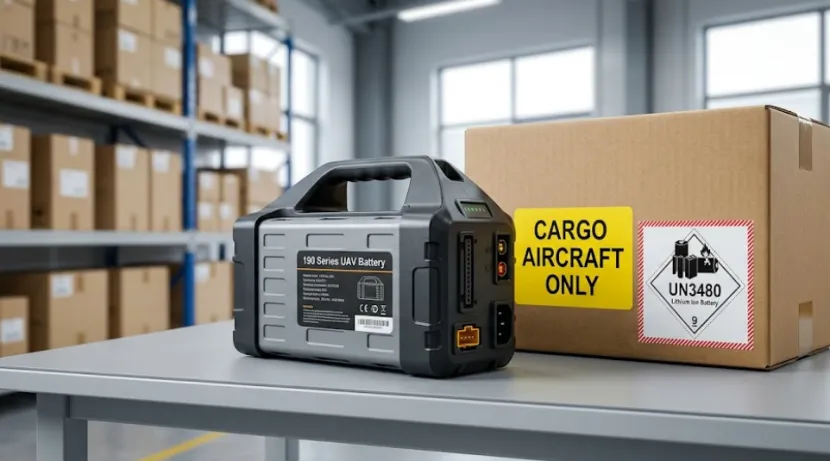
If you sell or source industrial UAV packs, you already know the problem is not just making the battery work. Passing booking checks, airport drop-offs, and customs is actually the toughest part. A single hold-up easily wastes three to seven days. Today in 2026, lithium battery shipping works fine. However, inspectors absolutely hate bad paperwork. This rings especially true when you ship large drone packs rather than basic gadgets.Current air cargo guidance keeps a close eye on classification, state of charge, labels, and battery test records.
A good example of the kind of supplier buyers look for here is Shengya Electronic. Based in Taixing and founded in 2017, it focuses on high-energy soft-pack lithium battery cells and packs for drones, robots, and related fields. On its site, the company lists product lines from about 270 Wh/kg to 340 Wh/kg on the company page, plus multiple 6S, 7S, 12S, 13S, and 14S combinations with custom output layout and plug options. Its featured 190 Series UAV Battery 6S/12S/14S 30000mAh highlights 25C high-rate output, long cycle life of at least 800 cycles, and a safety-first design. That matters because when you ship internationally, technical strength helps, but clear product identity helps almost as much. A battery that is easy to classify is easier to move.
Why do Drone Battery Shipments Get Delayed in 2026?
Most delays start long before the carton reaches customs. They begin when your battery is described too loosely, booked under the wrong category, or sent with a document set that looks incomplete. That is why customs delay often has less to do with the battery itself and more to do with whether the shipment file makes sense in one quick review.
Classify the Battery as UN3480 or UN3481
For air cargo, one basic split changes almost everything. A UN3480 drone battery is a lithium-ion battery shipped by itself. A UN3481 drone battery is a lithium-ion battery packed with equipment or contained in equipment. If you call a loose spare pack “with equipment” just because the charger is in the box, that can trigger a rejection fast. Current guidance also notes that if a package contains only accessories plus batteries, it may still fall under UN 3480, not UN 3481. That little detail catches people more often than it should.
Missing or Weak Documents Create Customs Delay
A second common trigger is weak paperwork. If the invoice says “battery pack” but the test summary, label, and packing details point to something else, your customs delay risk goes up. The same goes for watt-hour figures that do not match, model names that change across documents, or a missing contact person on the SDS. This is where drone battery shipping compliance becomes very practical, not theoretical. One wrong line can hold the whole lot.
What Documents Should You Prepare Before Booking Air Freight?
Before you ask for a freight quote, you want a clean file ready to send. That saves time with the forwarder, and frankly it makes you look easier to work with. Buyers care about price, sure, but when the shipment is urgent, what they really want is fewer surprises.
Keep the UN38.3 Test Summary Ready
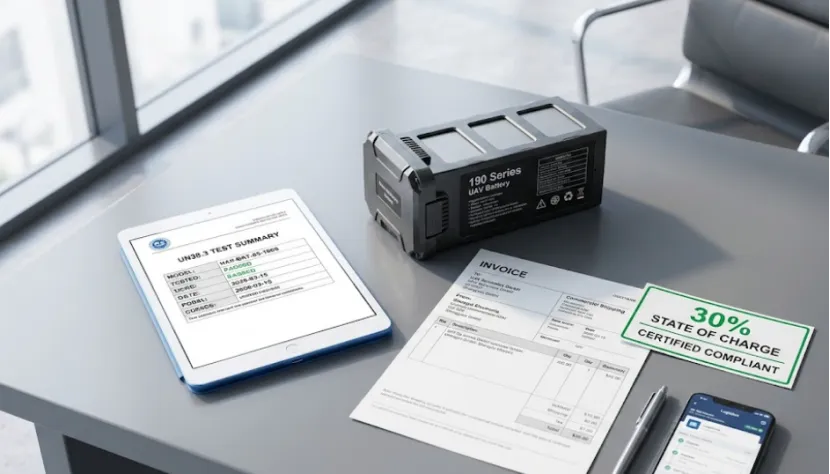
For any UN38.3 drone battery shipment, the test summary should be available on request. Current air guidance says manufacturers and distributors must make the test summary available, and it can be provided by paper copy, website, QR code, or URL. It also says the summary does not need to travel with every shipment by default, but you should be able to send it quickly when asked. In real trade, that speed matters. If someone asks for the UN38.3 test summary for drone battery models and you need two days to find it, the booking may already be gone.
Prepare an MSDS Drone Battery File, but Name It Correctly
The term MSDS drone battery still gets searched a lot, and many buyers still say MSDS out of habit. Formally, the current term is SDS. Official safety sheet guidance states that SDS replaced the older MSDS format and uses a standard 16-section structure with product identification, hazards, handling, and emergency details. At the same time, current air rules also say an SDS is not itself a transport document for battery articles. So yes, an MSDS for drone battery shipping still helps in real business, but no, it does not replace the classification and dangerous goods paperwork.
Match the Commercial Invoice, Packing List, and Labels
Your drone battery shipping documents should describe the same product in the same way. Model name, battery chemistry, Wh rating, quantity, and shipment form all need to line up. Air carriers and service centers also check packaging, labels, and any required dangerous goods declaration. If those pieces disagree, lithium battery shipping delays become much more likely.
What Air Freight Restrictions Matter Most in 2026?
This is the part buyers worry about most, and fair enough. A shipment can be fully legal and still miss the flight you wanted. That is why drone battery air freight planning should happen before production finishes, not after.
Watch the 30% State-of-Charge Rule
For standalone lithium-ion cells and batteries, current 2026 air guidance says they must be offered at no more than 30% of rated capacity. It also states that lithium-ion batteries packed with equipment under PI 966 face the same 30% rule from 1 January 2026. That means air freight restrictions for drone batteries are now tighter in cases that some shippers used to treat more casually. A battery at higher charge may need authority approval, which is not the kind of extra step you want on a Friday afternoon.
Know What a UN3480 Drone Battery Can and Cannot Do by Air
A UN3480 drone battery shipped by itself is forbidden as cargo on passenger aircraft, and packages under the relevant air instructions must carry a Cargo Aircraft Only label. That is one reason drone battery air freight often costs more and routes less freely than buyers expect. A UN3481 drone battery can be easier in some setups, but only when the shipment really meets that classification. The rules are picky here. Honestly, they are supposed to be.
How can You Reduce Customs Delay and Keep Shipments Moving?
Once the battery is correctly classified and documented, the last job is making the package easy to inspect and easy to trust. This is boring work, maybe, but boring is good in logistics.
Pack the Battery So It Cannot Short, Shift, or Look Suspicious
Current shipping guidance calls for terminal protection, non-conductive separation, sturdy outer packaging, and enough inner support to stop movement. For loose packs, each unit should be isolated so handlers do not see exposed terminals or a carton full of movement. That is basic, but it is also where a lot of customs delay starts. A neat box tells a better story than a rushed one.
Build Your Internal Link and Buyer Education Path
Inside your own site, this topic should link naturally to high-energy battery product lines, the product page for the relevant pack, and your company profile. That way, buyers reading about compliance can move straight into technical specs, capacity options, and custom pack capability without leaving the site. It is a simple internal path, but it works because the reader is already halfway through the buying process. On Shengya Electronic’s site, that path is easy to build because the company already separates product families by energy density and battery series.
FAQ
Q1: Is UN38.3 drone battery testing required for international shipping?
A: Yes. Every model must clear UN 38.3 tests. Also, keep the test summary ready. Anyone in the supply chain might ask for it.
Q2: Do you need an MSDS drone battery file before export?
A: Usually, yes. It smooths things out. The correct term is actually SDS now. It isn’t an official transport paper. Still, buyers, forwarders, and customs agents demand it constantly.
Q3: What is the difference between UN3480 drone battery and UN3481 drone battery shipments?
A: UN3480 means you ship the lithium-ion battery completely alone. UN3481 means it travels packed with a device or inside one. This detail completely changes your labels. It also alters your packing rules and available flight choices.
Q4: Can drone battery air freight be delayed because of state of charge?
A: Yes. In 2026, standalone lithium-ion batteries must be offered at no more than 30% state of charge, and some packed-with-equipment cases also follow that threshold.
Q5: How do you avoid customs delay when shipping lithium batteries?
A: Use the right UN number, keep the UN38.3 drone battery record ready, prepare a clean MSDS drone battery file, match every document to the exact model, and pack the battery so it cannot short or shift. That is the cleanest way to cut lithium battery shipping trouble before it starts.


