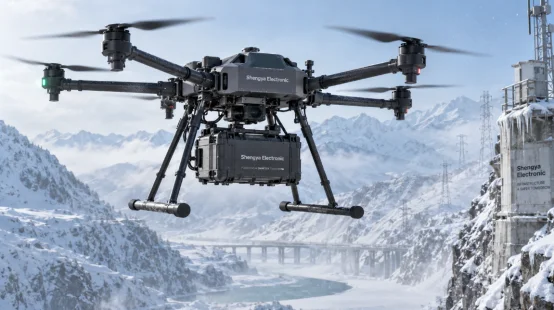
A mapping drone can miss the last two hectares when a headwind raises power draw. A delivery aircraft may reach its weight limit before the parcel bay is full. These operational challenges are driving interest in advanced battery technologies, including solid-state batteries for commercial drones. The decision concerns air time, return reserve, safe charging, and pack inventory.
Why Are Fleet Operators Rethinking Drone Battery Technology?
Commercial schedules ask a lot from current drone battery technology. Agriculture crews want wider coverage per launch. Inspection teams need sensors running throughout a long route. Delivery operators need predictable range with a useful payload. A commercial drone battery must handle heat, wind, repeated fast charging, and daily use.
More Useful Work per Flight
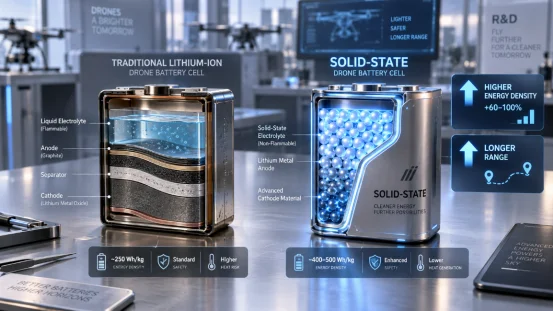
Solid-state drone batteries use a solid ion-conducting material in place of a flammable liquid electrolyte. That structure can support more active material within a given mass and volume. Higher energy density can produce longer drone flight times or leave weight for a camera, sprayer, sensor, or parcel.
An industry review of solid-state drone batteries cites a 410 Wh/kg lithium-metal cell and reports twice the flight duration plus 70% more distance in one development case. Those figures describe one test setup, so your aircraft needs its own measured result. Energy-efficient drones can complete more route segments before reaching the reserve threshold.
Lower Ground Time and Fewer Pack Changes
One development program in the review reported charging from 10% to 80% in three minutes and projected 10,000 to 100,000 cycles at 25°C. However, these figures must be evaluated against the underlying test data, including charge rate, temperature, depth of discharge, and the criteria used to define end of life.
Better drone fleet battery management also cuts handling. Six fewer daily swaps mean fewer connector cycles, state-of-charge checks, and trips to the charging cabinet. Mundane, yes, but it shows up in labor records.
How Do Solid-State Battery Architectures Change Fleet Economics?
A fleet earns from completed hectares, inspected towers, delivered parcels, or usable survey data. Battery price, mass, cycle life, charging time, and cancellations all enter the cost per job.
Energy Density Changes Route Planning
A high energy density UAV battery can extend an inspection, support heavier optics, or preserve a larger return reserve. Gravimetric energy density affects drone payload capacity directly. Adding capacity also adds mass, and rotor power rises with takeoff weight. Aircraft-level tests show the useful result; watt-hours cover only stored energy.
Measure hover power at working payload, peak current during climb, energy per kilometer, landing reserve, and pack temperature. Repeat the route in still air and permitted wind. A published eVTOL flight test reported 48 minutes and 10 seconds of continuous flight using a solid-state battery. This demonstrates the potential of the technology in that specific aircraft, but it does not establish the expected endurance of other UAV platforms.
Safety and Service Life Affect Total Cost
Removing volatile liquid electrolyte can reduce fire exposure and thermal runaway risk, supporting UAV battery safety near warehouses, utility sites, crops, and people. Your pack still needs overcurrent protection, temperature sensing, cell balancing, a suitable enclosure, and a tested damage response.
Longer battery cycle life can reduce battery replacement cost and inventory. Calculate cost per usable cycle with the permitted depth of discharge and retirement limit. A cheap pack that retires early can cost more per flight.
What Could Slow Commercial Adoption?
Solid-state chemistry brings engineering work with its laboratory numbers. Track cell supply, pack consistency, output under load, repair policy, and certification evidence.
Interfaces, Vibration, and Heat Still Matter
Ions must cross solid-to-solid interfaces. Poor contact raises resistance, limits power, and creates heat. Ceramic electrolytes can crack under mechanical stress; polymer electrolytes make better contact but may conduct ions more slowly at room temperature. Sulfide electrolytes offer high conductivity and require moisture-controlled production. Lithium dendrites can also form and cause a short circuit.
Drones add vibration, landing shock, high discharge current, and rapid altitude changes. Solid-state battery testing should reproduce that UAV power demand at cell, module, and pack level. Ask for discharge curves at your actual current, temperature rise near mission end, vibration results, and retained capacity after repeated cycles.
A Pilot Program Needs Clear Gates
Battery manufacturing scale remains a practical constraint. Solid electrolyte layers need tight thickness control and reliable electrode contact. Early production may carry higher cost or wider lot variation.
Set commercial drone battery qualification criteria before fleet pilot testing. Useful gates include delivered energy, voltage sag, cell spread, connector temperature, recharge time, and capacity after a defined cycle count. Test more than one lot. One very good sample tells you surprisingly little about a fleet.
How Should You Plan the Transition?
A controlled transition starts with operating records and ends with an aircraft-qualified pack. It ties the chemistry to your routes, payloads, chargers, maintenance, and local approval process.
Start with Mission Data
Export flight time, current, voltage, payload, wind, temperature, and landing state of charge. Separate normal routes from high-load jobs. Define the duty cycle, reserve energy, peak current, charge window, and daily flight count.
Use those figures to compare usable pack energy across candidates. Record nameplate capacity as one input. Include the battery management system limits and cold-weather derating. Drone fleet battery management works best when dispatch software, charger logs, and pack serial numbers share the same record.
Qualify the Complete Pack
Cell performance is one layer. Battery pack integration adds busbars, wiring, connectors, fuses, sensors, insulation, the BMS, and the enclosure. Confirm cell matching, balance behavior, ingress protection, electromagnetic compatibility, and traceability. Review what happens after an overtemperature event or a hard landing, including quarantine and disposal steps.
Start with a small route group, compare the packs, and expand after the data meets your gates. Operations, maintenance, and purchasing then share the same evidence.
Turning Cell Potential into a Fleet-Ready Power System
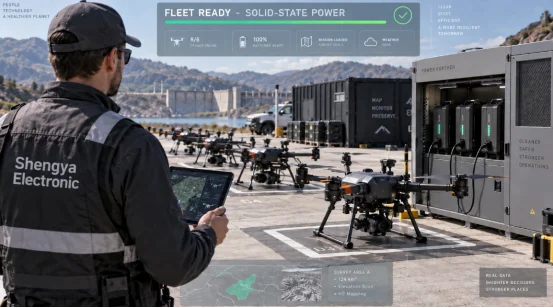
Once your mission data defines the electrical and mechanical limits, supplier capability becomes part of risk control. Shengya Electronic offers UAV battery configurations across 6S, 7S, 12S, and 14S formats with listed capacities from 16,000 to 33,000 mAh. Its catalog also includes a 320 Wh/kg high energy density UAV battery series, which gives engineering teams a concrete starting point for endurance and payload studies.
For a custom UAV battery pack, the useful conversation covers voltage under peak load, cell matching, connector choice, BMS thresholds, enclosure fit, and the evidence needed for lot acceptance. Matching these details to your aircraft can turn cell-level energy density into repeatable dispatch performance. Request test conditions beside every headline value, then validate the pack on your own duty cycle.
FAQ
Q1: Are solid-state drone batteries already ready for every commercial fleet?
A: Readiness depends on cell availability, aircraft integration, certification, cost, and test evidence. A limited route pilot gives you usable data before a fleet-wide purchase.
Q2: Will a higher energy-density pack always extend flight time?
A: Flight time also depends on pack mass, payload, wind, rotor efficiency, discharge rate, and reserve policy. Compare complete packs in the aircraft under matched conditions.
Q3: Are solid-state batteries immune to fire or short circuits?
A: Some solid-state designs may reduce hazards associated with flammable liquid electrolytes, but electrical faults, mechanical damage, interfacial problems, and lithium dendrite formation can still present risks. Appropriate protection and testing remain essential.
Q4: Which metrics matter most in a commercial drone battery trial?
A: Track usable energy, voltage sag, peak current, cell spread, pack temperature, recharge time, landing reserve, and retained capacity by serial number.
Q5: How can commercial drone fleets control transition cost?
A: Begin with high-value routes where extra endurance removes a battery stop or completes an additional task. Calculate cost per completed mission and expand when the operating data supports the purchase.