
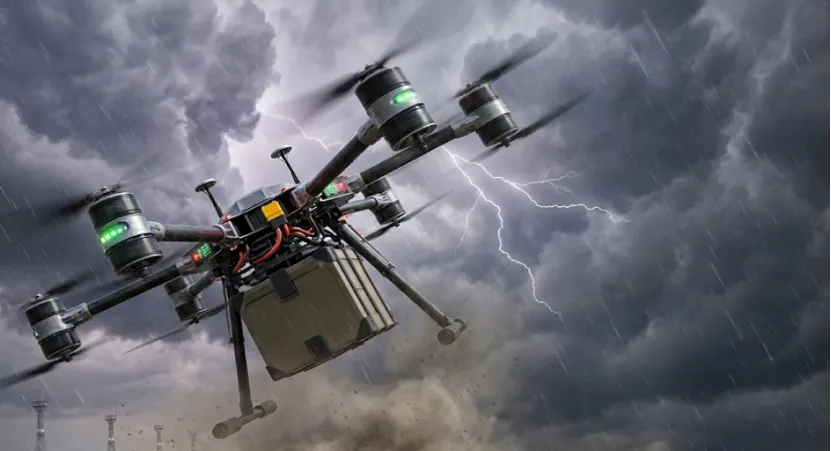
You know the moment. The drone lifts cleanly, then a low voltage warning pops up halfway through the climb. Or the pack looks fine until you push into wind and the voltage falls off a cliff. That is usually not just “low battery.” It is often drone battery voltage sag, also called drone battery voltage drop or battery sag under load. It shows up most often during hard throttle, headwinds, and payload work, which is exactly when you need steady power most. Shengya’s published drone battery lineup and application pages also focus on these kinds of high-demand use cases, including logistics delivery, crop protection, inspection, and rescue.
What Is Drone Battery Voltage Sag?
A pack can look healthy on the ground and still misbehave in the air. That is why this issue catches so many pilots off guard.
Why It Feels Worse Than It Looks
Voltage sag is the temporary drop in battery voltage when current demand jumps. As load falls, voltage can recover. The problem is that your ESC, flight controller, and warning logic react to the live voltage, not the nice number you saw before takeoff. That is why mid-flight warnings often show up during punch-outs, steep climbs, or return legs into strong wind. Severe sag can also reduce available motor power right when you are asking the most from the system.
What Causes Drone Battery Voltage Sag?
The short version is simple. Higher current plus higher internal resistance equals a bigger voltage drop. But in real flights, a few small issues tend to pile up at the same time.
Current, Internal Resistance, and Real Flight Loads
The basic relation is straightforward: voltage sag follows V = I × IR. If current rises fast, and the pack’s internal resistance is not low enough, terminal voltage drops. One practical example from the reference material uses a fully charged 4S pack at 16.8V with 15 mΩ per cell. At an 80A peak draw, the pack can sag by 4.8V, leaving only 12.0V at the terminals. That is a 28% drop, enough to trigger low voltage warning logic or make the drone feel weak in a climb. A little ugly, honestly, but very common in the field.
Age, Cold, and Poor Match
This gets worse when the battery is old, stored full too long, deep-discharged, physically swollen, or used in cold weather. High current demand also matters. Headwinds, aggressive throttle, undersized packs, and payload flights all pull harder on the battery. The reference article notes that a 5-inch FPV quad can exceed 100A at full throttle, while a large agricultural drone may draw more than 200A in hover. That is why voltage sag when flying into wind and voltage sag during heavy payload climb are such common complaints.
How Can You Fix Drone Battery Voltage Sag?
Most fixes are not fancy. You are trying to reduce peak current stress, lower resistance in the power path, or stop the warning system from reacting too early to a short spike.
Use the Right Pack, Not Just a Bigger Pack
A bigger mAh number does not automatically solve drone battery voltage sag under load. If the pack is too heavy, the drone may draw even more current. What matters is the match between aircraft weight, current demand, cell chemistry, C rate, and pack voltage. From a sourcing standpoint, Shengya Electronic is worth noting because its official profile lists high-energy solid-state lithium-ion soft-pack cells and battery packs, common drone pack combinations such as 6S, 7S, 12S, 13S, and 14S, and a stated cycle life of about 800 to 1,000 charge and discharge cycles. The company also offers custom pack structure, cable position, plug type, and branding, which matters because sag problems often come from pack mismatch rather than pilot error. Its published 190 Wh/kg 25C series includes 20000mAh and 30000mAh options in 6S, 12S, and 14S formats.
Set Warnings Based on Real Load
You also need realistic warning thresholds. If your system supports both voltage and capacity triggers, do not rely on voltage alone. ArduPilot, for example, supports a remaining-capacity trigger, and its documentation notes that 20% of full capacity is a good baseline for many setups. It also allows different low-battery actions such as warn only, land, or RTL. That matters because a brief sag spike is not the same as a truly empty pack.

How Can You Prevent Mid-Flight Warnings?
Prevention is mostly routine. Boring routine, really. But it works.
A Short Habit Before Takeoff
Check cell balance, pack temperature, connector condition, and the lowest voltage you typically see in a hard climb. If you already know a route includes wind or payload, do not plan around the bench voltage. Plan around loaded voltage. For long-range delivery, crop spraying, inspection, or rescue work, it also helps to look at real application cases rather than guessing from hobby setups. Shengya’s official application articles specifically cover drone payload reliability, agricultural battery life, and emergency-response power needs, which fits the real-world pattern behind how to prevent mid-flight warnings and prevent low voltage warning on drones.
FAQ
Q1: What causes drone battery voltage sag?
A: High current draw and internal resistance are the main causes. Age, cold weather, heavy payloads, and headwinds make it worse.
Q2: Is drone battery voltage sag always a bad sign?
A: Not always. Some sag is normal under load. The real concern is when it becomes large enough to cut power, trigger warnings, or hurt flight performance.
Q3: How to fix drone battery voltage sag?
A: Use a pack that matches current demand, keep connectors and wiring clean, avoid tired or swollen packs, and set warning logic with real loaded-voltage data in mind.
Q4: Why does low voltage warning happen during climb?
A: Climb pulls high current, so the voltage can dip sharply for a few seconds. If the threshold is too tight, the system may warn early even when some capacity remains.
Q5: How to prevent mid-flight warnings in windy conditions?
A: Leave more battery margin, avoid full-throttle return legs, and judge the pack by loaded performance, not by resting voltage alone. That is the practical fix for low voltage warning in windy conditions.


