

Why Is Commercial UAV Battery Procurement Changing?
Commercial UAV battery procurement used to start with one simple question: how many mAh does the pack have? That is no longer enough. If you buy batteries for mapping, inspection, agriculture, or delivery drones, you are not just buying capacity. You are buying flight minutes, payload room, safer current delivery, and fewer battery swaps during a long workday.
Buyers Now Look at Real Mission Value
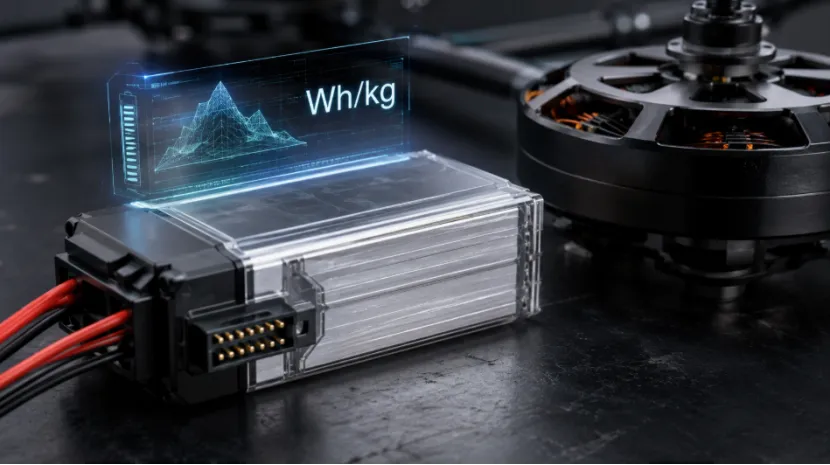
A mAh drone battery label can look impressive, but it does not tell you how much usable energy the aircraft can carry. A better starting point is drone battery Wh, because energy is calculated as Wh = V × Ah. A Wh/kg drone battery then tells you how much energy you get per kilogram, which matters when every gram affects lift, route length, and payload. Battery selection guides also point out that voltage, capacity, discharge capability, and energy density are the four key points that decide whether a pack is suitable.
Why Do Buyers Compare Wh/kg Before mAh?
You compare Wh/kg before mAh because commercial drones have limited space and limited lift. A larger capacity pack can help, yes, but it also adds battery weight. At some point, more capacity may not bring much longer flight time because the drone spends more energy carrying the battery itself. That is the awkward part many buyers meet after sample testing.
Wh/kg Shows Energy per Kilogram
A high energy density drone battery gives you more energy per kilogram. That is useful for a mapping drone battery that needs route coverage, a delivery drone battery that needs payload efficiency, or an inspection drone battery that must stay stable during field work. A lightweight UAV battery can make the aircraft feel less “loaded,” especially during takeoff, hover, and windy turns.
For example, if two packs have similar mAh but different UAV battery voltage, their total Wh can be very different. If two packs have similar Wh but one is lighter, the lighter pack often gives better mission value.
Why Does Battery Weight Matter So Much?
Battery weight is now a core part of the drone battery purchasing decision. For multirotor platforms, heavier batteries increase motor load and heat. They can also reduce useful payload. A tidy spec sheet may say “long endurance,” but the real flight log tells the truth.
More Capacity Can Bring Diminishing Returns
Professional buying advice warns that adding capacity adds weight, and extra weight can reduce efficiency in many multirotor systems. Buyers are advised to define mission time, convert it into Wh, then choose a pack that meets the Wh target with acceptable weight and thermal behavior.
That is why B2B drone battery procurement now includes battery weight, payload efficiency, temperature rise, and fewer battery swaps. For agricultural drone battery projects, a high capacity UAV battery may be right. For surveying drone battery projects, a lightweight high energy density battery may be better.
How Does Voltage Platform Affect UAV Battery Selection?
Before choosing a S-count drone battery, you need to confirm the drone battery voltage platform. The motor, ESC, flight controller, wiring, connector, and payload all matter. A higher voltage UAV battery may support larger platforms, but it should not be chosen casually.
S-Count Must Match the Powertrain
Battery buying guidance makes this point clearly: lock the S-count to what the aircraft supports, and do not upgrade voltage without a system-level review. Common ranges also vary by task. Mapping and survey endurance platforms may use 6S to 12S+, while larger agriculture or heavy-lift operations often use 12S+ high capacity packs.
A 6S drone battery may fit compact inspection work. A 12S UAV battery or 14S UAV battery may fit bigger industrial UAVs. The best answer depends on UAV powertrain compatibility, not guesswork.
Why Are C-Rating, Cycle Life, and Batch Consistency Important?
A drone battery C-rating is useful, but it is not proof by itself. You still need to test drone battery voltage sag, discharge performance, and temperature rise under real load. This is where many bulk UAV battery order problems start. One sample works fine, then the fleet shows mixed behavior.
Fleet Buyers Need Stable Packs
For fleet buyers, UAV battery cycle life and batch consistency can affect total cost of ownership more than a small price gap. Battery replacement cost, pack-to-pack consistency, factory testing, battery aging test data, and internal resistance testing should all be part of your UAV battery buying checklist. Good sourcing is a little boring, honestly, but boring is good when 40 packs must behave the same on Monday morning.
How Does Shengya Electronic Support This Procurement Trend?
Shengya Electronic fits buyers who need a practical high energy density UAV battery rather than a generic pack. Its product catalog includes multiple high energy density series, and the high energy density 320Wh/kg series is built around the exact trend discussed here: better energy per kilogram, controlled battery weight, and long endurance UAV battery solution needs.
The site also lists broader high energy density options such as 275Wh/kg, 310Wh/kg, 330Wh/kg, 340Wh/kg, and 350Wh/kg series, which gives you more room to match capacity, voltage, and mission type.
Custom Pack Design Matters for Real UAV Projects
A custom drone battery pack may be needed when standard packs cannot match drone battery size, drone battery connector, battery pack structure, or custom voltage and capacity. Shengya Electronic works as a commercial UAV battery supplier for buyers who need UAV battery customization across industrial platforms.
If your project needs a 320Wh/kg UAV battery, a 320Wh/kg drone battery, or a broader industrial UAV battery solution, Shengya Electronic gives you a focused path for technical matching without making the process feel overcomplicated.
FAQ
Q1: Why Do Buyers Compare Wh/kg Before mAh?
A: Buyers compare Wh/kg before mAh because a Wh/kg drone battery shows energy per kilogram. A mAh drone battery only shows capacity, not real payload value.
Q2: Is a Higher mAh Drone Battery Always Better?
A: No. Higher mAh can add battery weight. If the pack gets too heavy, payload efficiency and longer flight time may both suffer.
Q3: What Voltage Platform Should a Commercial UAV Battery Use?
A: The drone battery voltage platform should match UAV battery voltage limits, S-count drone battery design, and UAV powertrain compatibility.
Q4: Why Is Cycle Life Important for UAV Battery Procurement?
A: UAV battery cycle life affects drone battery cycle life, total cost of ownership, and battery replacement cost across a fleet.
Q5: When Do Buyers Need a Custom Drone Battery Pack?
A: You need a custom drone battery pack when standard packs cannot match custom pack design, custom UAV battery needs, or bulk UAV battery order requirements.


