
Choosing a larger battery is often seen as a straightforward way to extend drone battery flight time. Higher drone battery capacity holds more reserve power. So why wouldn’t the craft stay up longer?
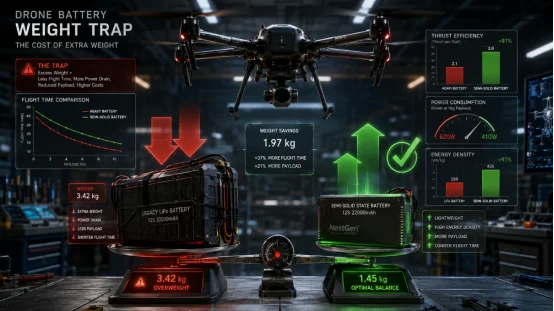
Well, the battery itself adds to the total aircraft weight.
As drone battery weight creeps up, motors pull extra current to stay airborne. Past a tipping point, that added energy gets burned merely hauling the heavy pack. If you want to increase drone flight time, relying on mAh alone can be misleading.
A more relevant question is: how much usable energy do you actually gain per kilogram added to the aircraft?
Why Does More mAh Not Always Improve Drone Battery Flight Time?
Battery capacity matters, but capacity is only one part of the flight system. Voltage, battery mass, payload, propulsion efficiency, current demand, weather, and flight profile all affect the result.
What Does Drone Battery mAh Actually Tell You?
Drone battery mAh indicates charge capacity, but it does not directly represent the total energy stored in the battery.
For example, two 20,000mAh batteries can have very different total energy if one is 6S and the other is 12S. That is why comparing drone battery capacity only by mAh can be misleading.
For cross-voltage comparisons, drone battery Wh is more useful:
Battery Energy (Wh) = Nominal Voltage (V) × Capacity (Ah)
A 22.2V, 20Ah battery stores about 444Wh. Increase voltage or capacity, and Wh rises.
Still, 600Wh packed into a very heavy battery may not give the flight-time gain you expected.
How Does Drone Battery Weight vs Flight Time Change as Packs Get Bigger?
The relationship between drone battery weight vs flight time is not linear. Early increases in capacity can add useful endurance. Keep adding cells, though, and the returns usually become smaller.
The Weight Trap Starts With Thrust
A heavier aircraft needs more thrust to hover. More thrust means the motors draw more power.
The relationship can be summarized as follows:
More capacity → more battery weight → higher takeoff weight → higher power demand → smaller endurance gain
That extra half kilogram may look minor on a workbench. In the air for 40 minutes, it is there every second.
If the propulsion system also faces high current demand during climbing or wind correction, drone battery voltage sag can become another concern. Loaded voltage matters more than the resting voltage you saw before takeoff. This is especially relevant during punch-outs, steep climbs, and heavy-load operation, as explained in this drone battery voltage sag guide.
Why Does a High Energy Density Drone Battery Matter?
If battery mass is limiting your mission, adding ever more capacity may be the wrong approach. A high energy density drone battery aims to put more usable energy into less battery mass.
Wh/kg Shows What mAh Cannot
Drone battery Wh/kg describes how much energy the battery stores per kilogram. For endurance aircraft, UAV battery energy density can be one of the most useful comparison points.
Consider a simplified example:
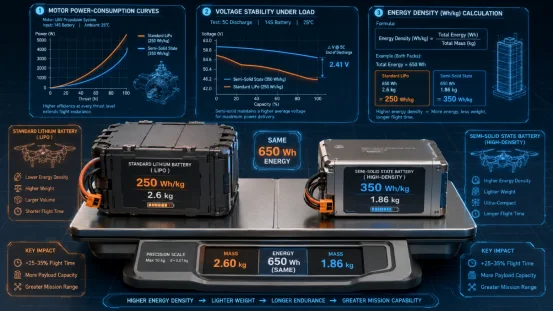
| Pack | Energy | Weight | Energy Density |
| A | 500Wh | 2.0kg | 250Wh/kg |
| B | 650Wh | 2.6kg | 250Wh/kg |
| C | 650Wh | 1.86kg | 350Wh/kg |
Pack B and Pack C both store 650Wh, but Pack C carries roughly 0.74kg less battery mass. Actual drone battery flight time will still depend on the aircraft, but this shows why a long flight time drone battery cannot be judged by mAh alone.
Current UAV battery products span energy-density classes from 275Wh/kg through 350Wh/kg, alongside high-rate and high-voltage options.
How Can You Estimate Drone Battery Flight Time?
A useful estimate starts with energy and average power consumption. It should then be checked against the added battery mass.
Start With Usable Energy
A basic drone battery flight time calculator can use:
Estimated Flight Time = Usable Battery Energy ÷ Average Power Consumption
The catch is average power consumption. It can rise after you install a heavier pack.
When comparing a new drone battery size, record your current takeoff weight, battery weight, hover power, typical payload, peak current, and real flight time. Then estimate again with the new mass. Better yet, validate the result through controlled flight tests.
This drone battery selection guide also highlights physical fit, connector, polarity, cable routing, charging setup, and loaded voltage. Those details sound mundane until one stops a field test.
How Do You Choose the Best Battery for Longer Drone Flight Time?
The best battery for longer drone flight time is not automatically the largest one available. The battery should be selected based on the actual operational requirements of the aircraft.
For Long-Range and Endurance Missions
A battery for long range drone applications usually benefits from high Wh/kg, provided its discharge performance meets the mission load.
Survey, mapping, inspection, logistics, and other long-duration work often make battery mass especially important.
For Heavy-Lift and High-Power Missions
A high discharge drone battery may make more sense than chasing maximum energy density. Heavy payloads, rapid climbs, agricultural work, and strong wind correction can create large current spikes.
For these missions, discharge capability and voltage stability deserve as much attention as Wh/kg.
For Higher-Voltage Platforms
A high voltage drone battery can suit aircraft designed around a higher-voltage propulsion architecture. The motor, ESC, wiring, charger, and battery must be considered as an integrated system.
The published product range includes a 270Wh/kg 4.35V high-voltage series and a 190Wh/kg high-rate 25C series, alongside higher-energy-density packs. So there is no single battery specification that fits every UAV mission.
When Does Battery Choice Need to Move Beyond a Catalog Pack?
Once you know your target flight time, payload, voltage, peak current, and available battery bay, battery selection becomes significantly more precise. Sometimes a standard UAV battery pack fits. Sometimes the airframe needs something more specific.
Shengya Electronic is a UAV battery manufacturer specializing in semi-solid and solid-state lithium-ion soft-pack cells and assembled UAV batteries. Its published range includes 190Wh/kg high-rate 25C products, a 270Wh/kg 4.35V high-voltage series, and high-energy-density series reaching 350Wh/kg. Available configurations across the range include 4S, 6S, 7S, 12S, 14S, and 18S.
For a custom UAV battery, the company states that voltage, capacity, size, interface, structure, and BMS options can be matched to project requirements. That matters when reducing battery mass is only useful if the resulting pack still fits the aircraft, wiring layout, current profile, and mission.
FAQ
Q1: Does a higher mAh battery always increase drone battery flight time?
A: No. More mAh adds capacity, but it usually adds weight too. If the added drone battery weight pushes power consumption up too far, the flight-time gain can become small or even negative.
Q2: What is the ideal drone battery size?
A: There is no universal drone battery size. The right choice depends on takeoff weight, payload, voltage, average power draw, peak current, battery-bay space, and target endurance.
Q3: Is Wh/kg more important than mAh for a long flight time drone battery?
A: Often, yes. Drone battery Wh/kg shows how much energy you carry per kilogram, while mAh alone does not account for voltage or battery mass.
Q4: What battery is best for a long-range drone?
A: A battery for long range drone use should combine sufficient Wh, strong UAV battery energy density, suitable discharge capability, and the correct voltage. Higher energy density is especially valuable when aircraft weight is already near its practical limit.
Q5: How can you increase drone flight time without simply adding capacity? A: To extend drone flight time, evaluate aircraft weight, Wh/kg, and propulsion efficiency alongside voltage, payload, and flight profile. Quite often, choosing a lighter high energy density drone battery works far better than mounting a much larger pack..


