
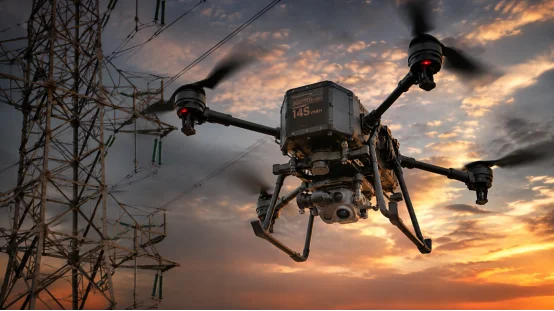
Industrial inspection drones regularly fly right next to structures, towers, and power equipment. A random wind gust or heavy camera package changes things. Rapid climbs demand a significant burst of current. If the pack fails to push that energy, the drone reacts poorly. Voltage plummets. Flight stability can quickly degrade.
A 25C high-rate discharge battery specifically tackles these demanding tasks. That rating indicates pure current delivery. However, actual field performance relies on internal cell quality. Pack wiring, cooling, and connectors matter deeply. You must evaluate the entire hardware setup, not just a printed sticker.
Why Does 25C Matter for Peak Acceleration?
The C rating links battery capacity to the current the pack can provide. A 30,000mAh pack has a nominal capacity of 30Ah. At 25C, the theoretical discharge figure is:
30Ah × 25 = 750A
That number is a reference point, not a promise that every drone can safely draw 750A. Actual limits depend on cell chemistry, temperature, internal resistance, BMS settings, cables, connectors, and motor demand.
Current Delivery During Fast Maneuvers
During inspection work, the highest current usually appears during takeoff, braking, climbing, wind correction, and rapid position changes. A high-current drone battery provides additional headroom for motors during these short-duration events. This helps the flight controller maintain the requested thrust instead of reacting to a sudden power dip.
Why Voltage Sag Deserves Attention
Voltage sag occurs when battery voltage falls under load. Excessive sag can trigger low-voltage warnings even when useful capacity remains. It may also reduce motor speed and affect camera stability. A pack with low internal resistance usually holds voltage better during acceleration, especially when the inspection payload is heavy.
How Do You Translate 25C Into Real Flight Current?
You should compare the battery rating with the drone’s measured current, not only its maximum motor specification. A six-motor platform may draw modest current while hovering but several times more during a hard climb.
Build a Simple Current Budget
Record hover current, climb current, peak current, and landing reserve. For example, if a drone draws 90A in hover and reaches 210A during a climb, a 30Ah pack operates at about 3C in hover and 7C during that climb. The 25C rating offers headroom, but repeated high-load events still create heat.
Consider Repeated Acceleration
Inspection flights rarely involve one burst. The aircraft may stop, move sideways, climb, and hold position every few seconds. Repeated peaks raise battery temperature and increase resistance. Your test plan should include the full mission pattern, with the payload and propellers installed.
What Does a 14S1P, 53.2V, 30,000mAh Pack Deliver?
The referenced configuration is a 14S1P 53.2V 30,000mAh battery. “14S” means fourteen cells connected in series, while “1P” indicates one parallel cell group. The pack stores roughly:
53.2V × 30Ah = 1,596Wh
That is about 1.6kWh of nominal energy. The usable amount will be lower because you need reserve voltage for a controlled landing and battery protection.
Higher Voltage, Lower Current for the Same Power
For a given motor power, a higher-voltage pack can reduce current in the main power path. Lower current helps limit cable losses and connector heating. It can also support a cleaner drone power system when the motors and electronic speed controllers are designed for the pack voltage.
Capacity Is Not the Same as Endurance
A 30Ah UAV battery does not guarantee a fixed flight time. Wind, payload weight, propeller pitch, motor efficiency, climb frequency, and reserve policy all matter. A camera drone flying in gusty conditions may consume energy much faster than a similar aircraft on a calm test flight.
Which Battery Details Affect Inspection Reliability?
The 25C label is only one part of the selection process. You should check the details that affect daily field use.
Cell Matching and Internal Resistance
Consistent cells help the pack share load evenly. Uneven resistance can cause one cell group to reach its voltage limit early. Ask for production test data, resistance checks, and cycle records when the mission is safety-critical.
Connectors, Cables, and Protection
A high-rate pack needs connectors and cables that match its current demand. A weak connector can heat up even when the cells are capable of more. Confirm polarity, anti-spark control, fuse strategy, temperature sensing, and charger compatibility before deployment.
Thermal Behavior
Battery thermal management matters most after repeated climbs or long hover periods. Measure pack temperature during a complete inspection route, then check the cooling period before recharge. Avoid charging a pack while it is still hot from flight.
How Can You Test Peak Acceleration Before Field Deployment?
Bench tests help, but they cannot replace a loaded flight test. Start with a controlled hover and short climb. Monitor voltage, current, cell spread, motor response, and pack temperature.
Use the Real Payload
Install the inspection camera, gimbal, lighting, and protective equipment used in service. A bare-airframe test can hide voltage sag that appears later in the field.
Set a Conservative Reserve
Do not plan to use the full nominal capacity. Set a landing threshold that leaves enough energy for wind correction and a second approach. Record battery data after every flight during the first test cycle. Small changes often reveal a connector or cooling issue before it becomes serious.

Where Can a Custom Pack Improve Mission Fit?
A standard pack may work well, but industrial inspection often needs a precise combination of voltage, current, size, connector layout, and mounting method. A custom design can match the aircraft’s center of gravity and reduce unnecessary cable length.
For teams comparing pack options, Shengya Electronic’s product range can be used as a starting point for discussing voltage, capacity, discharge demand, connector selection, and enclosure requirements. The useful conversation is specific: peak current, duty cycle, payload mass, charging time, and field temperature.
A 25C high-rate discharge design is most valuable when those figures are tied to real flight data. The pack should support quick acceleration without creating excessive heat or unstable voltage behavior.
FAQ
Q1: What does 25C discharge rate mean for a drone battery?
A: It indicates the battery’s rated discharge capability relative to its capacity. A 30Ah pack rated at 25C has a theoretical 750A discharge figure, subject to cell, wiring, temperature, and protection limits.
Q2: How much energy is stored in a 14S1P 53.2V 30000mAh battery?
A: Its nominal energy is about 1,596Wh, calculated from 53.2V multiplied by 30Ah. Actual usable energy is lower because a flight reserve is required.
Q3: Will a 25C battery always improve acceleration?
A: No. Acceleration also depends on motors, propellers, electronic speed controllers, connectors, and software limits. The battery helps only when the rest of the power system can use the available current.
Q4: How do you reduce voltage sag during inspection flights?
A: Use low-resistance cells, short and correctly sized cables, suitable connectors, balanced cell groups, and a conservative operating temperature. Avoid repeated full-throttle events without cooling time.
Q5: What should you ask before ordering a high-current drone battery?
A: Confirm voltage, capacity, continuous and burst current, dimensions, weight, connector type, charging method, temperature monitoring, cycle expectations, and compatibility with the aircraft’s power system.


