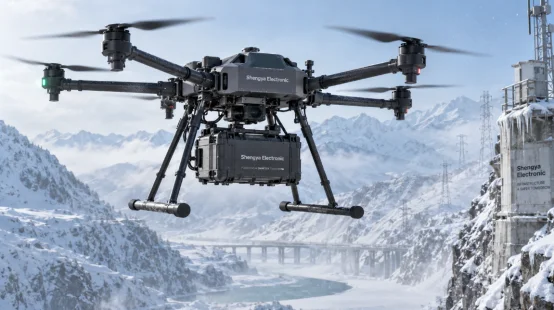
When a spray drone takes off with a full tank, its battery faces one of the highest power demands of the entire flight. Motor current rises quickly, loaded voltage falls, and the flight controller can reduce thrust when the pack crosses its low-voltage limit.
For manufacturers and large cooperatives, an agricultural drone battery must be sized from the aircraft power curve. Capacity remains one part of the specification. This article explains the load steps, shows what a 10C peak rating means, and gives a test path for selecting a heavy-lift drone battery.
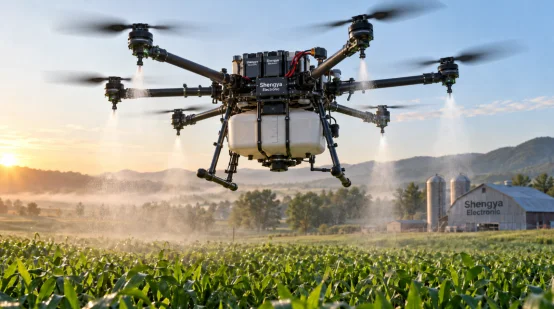
Why Does a Full Spray Tank Create a Sharp Power Peak?
The aircraft power curve changes as the mission moves from takeoff to hover, forward flight, turns, and landing. A full tank raises gross mass, so each motor produces more thrust. Low-altitude work adds frequent corrections from gusts, trees, and uneven terrain. Those short events create the current spikes that expose weak cells and high-resistance connections.
Takeoff and Climb Demand the Most Current
At launch, the motors accelerate propellers while lifting the frame, battery, and liquid. A useful measurement set records pack voltage, total current, motor RPM, and altitude at 10 to 20 samples per second. The first 2 to 5 seconds usually show the highest electrical demand. A climb after a refill can repeat that peak, even when the pack has already warmed.
Hover and Spraying Form a Moving Baseline
Hover power settles after the climb, yet the spray pump, valves, and flow controller add a steady auxiliary load. As liquid leaves the tank, thrust demand declines. Wind correction, start-stop spraying, and a sudden yaw command then appear as smaller peaks on top of the baseline. Logging these phases gives you continuous current and peak current values for the battery specification.
How Does Voltage Sag Affect Motor Thrust?
Voltage sag is the temporary difference between open-circuit voltage and loaded voltage. Loaded Voltage = Open-Circuit Voltage − (Load Current × Internal Resistance). This simplified model helps explain voltage drops during high-current operation. The same pack can look healthy on a bench and dip during a hard climb because current is much higher in flight.
Internal Resistance Sets the Drop
Cell chemistry, temperature, age, welds, busbars, connectors, and cable length all add resistance. A weak series group reaches the controller cutoff first, so cell matching matters as much as nominal pack voltage. Measure resistance at the same state of charge and temperature, then compare the lowest cell voltage during a repeatable throttle pulse.
The Flight Controller Needs a Voltage Reserve
If loaded voltage approaches the low-voltage threshold, the controller may limit throttle or trigger return-to-home. The aircraft then has less lift while it still carries spray liquid. Set a reserve from flight data, wind, payload, and the required return route. Track minimum loaded cell voltage alongside the percentage display.
What Does a 10C Peak Rating Mean for a Heavy-Lift Drone Battery?
The C-rate links current to capacity. A 20 Ah battery pack rated for 10C peak discharge has a theoretical peak current of 200 A, provided that the specified operating conditions are met. Actual performance depends on pulse duration, temperature, state of charge, and BMS current limits. The rating describes a defined pulse duration, temperature, cutoff voltage, and state of charge. Ask for those conditions before comparing a high discharge UAV battery with another pack.
Peak and Continuous Ratings Serve Different Jobs
Peak current covers takeoff, climb, gust correction, and fast maneuvering. Continuous current covers hover and the spray route. A pack needs both values, plus a pulse duration that matches your aircraft log. Repeated 10C events also create heat, so temperature rise and recovery voltage belong in the acceptance test.
Avoid “Power Starvation” in the Wiring Path
Motor power can be limited by a connector, fuse, busbar, or BMS threshold even when cells carry the advertised current. Use appropriately sized power cables, secure contacts, well-matched parallel cell groups, and a BMS with suitable current-monitoring and protection capabilities. Inspect connector temperature after a full-tank climb. A warm contact often points to resistance that a capacity test will miss.
How Should You Test an Agricultural Drone Battery Before Fleet Use?
Testing should reproduce the work cycle. A capacity number from a slow bench discharge cannot describe a loaded spray flight. Build a protocol that your engineering and operations teams can repeat across sample lots.
Capture the Complete Power Curve
Test an empty-tank and full-tank takeoff, a two-minute hover, a normal spray leg, a sharp turn, and a return climb. Record pack voltage, minimum cell voltage, current, temperature, payload mass, wind, and state of charge. Repeat the sequence at the lowest planned ambient temperature. Compare voltage recovery after throttle reduction; slow recovery indicates resistance or imbalance.
Set Pass Limits and Track Each Pack
Write limits for peak sag, continuous temperature, cell spread, cutoff behavior, usable watt-hours, and landing reserve. Mark each pack with a serial number and log charge cycles, storage state, and warnings. Cycle testing should include the depth of discharge and charge rate used in the field. Retire a pack when measured values cross the written service limit.
Which Battery Integration Details Matter in Production?
The battery, charger, aircraft firmware, and tank system form one power system. Confirm the voltage window, connector keying, enclosure dimensions, center of gravity, charging current, data protocol, and mechanical restraint before locking the airframe design. Leave room for inspection and replacement; field crews work faster when connectors and labels are easy to reach.
Match Cells, BMS, and Charger Settings
Matched cells keep series groups close during high current. The BMS should log cell voltage, pack current, and temperature, then apply warning and cutoff values verified in flight. Charger balance limits must match the cell chemistry. Test a hot-day recharge and a quick turnaround between sorties because both affect the next takeoff peak.
Plan for Farm Conditions
Spray liquid, dust, vibration, and frequent transport place stress on seals and connectors. Use an enclosure with a clear inspection path and strain relief on high-current leads. Store packs at the maker’s recommended state of charge, keep damaged packs in quarantine, and route retired lithium packs to an authorized recycler.

How Can Shengya Electronic Fit Peak-Load Requirements?
Once your power curve is measured, supplier discussions become specific. Shengya Electronic can review the aircraft voltage window, capacity, peak and continuous current, connector layout, BMS thresholds, and enclosure limits for an agricultural drone battery proposal. Its UAV battery range is listed on the product page.
For a pilot, request sample packs with cell-matching records, loaded-voltage curves, temperature data, and a stated 10C pulse condition. Compare those results with your written pass limits before a second-lot order. The company site can receive the aircraft duty cycle and test format for that technical review.
FAQ
Q1: What should an agricultural drone battery deliver during a full-tank takeoff?
A: It should meet the measured peak current with loaded cell voltage above your controller limit, while temperature and cell spread remain within the written test limits.
Q2: Is a 10C rating enough for every heavy-lift drone battery?
A: The rating must match pulse duration, pack capacity, temperature, cutoff voltage, and your aircraft’s logged peak. A 10C label alone does not define mission performance.
Q3: How can you confirm a high discharge UAV battery avoids voltage sag?
A: Run repeatable full-load climbs, log minimum loaded cell voltage and current, and compare sag and recovery with your acceptance limits.
Q4: Which battery data should a cooperative record after each flight?
A: Record serial number, payload, peak current, lowest cell voltage, pack temperature, state of charge, route time, warnings, and recharge details.
Q5: When should a spray-drone pack leave service?
A: Quarantine it for swelling, damage, abnormal heat, repeated cutoff, rising resistance, or cell spread that exceeds your written limit. Replace it after review of the logged evidence.