Do you manage an inspection, mapping, agriculture, or emergency-response fleet? If so, battery problems often become real-world headaches. Packs might swell inside warm charging areas. Connectors can smell burnt after steep climbs. Sometimes, flights just cut short when voltage drops.
A semi-solid state drone battery tackles these struggles using a unique semi-solid electrolyte structure. This guide compares semi-solid cells against standard lithium polymer packs regarding energy density, battery safety, and cycle life. Finally, we will show you how to set up a practical sample test.
Why Does Battery Chemistry Matter in Industrial UAV Work?
Industrial aircraft fly repeated routes, carry expensive sensors, and work near people, fuel, dust, and heat. The battery must deliver stable current while the pack survives transport, vibration, charging, and storage. Chemistry affects the failure modes your maintenance team sees every week, so the comparison belongs in the aircraft qualification plan.
What Traditional LiPo Packs Bring to the Airframe
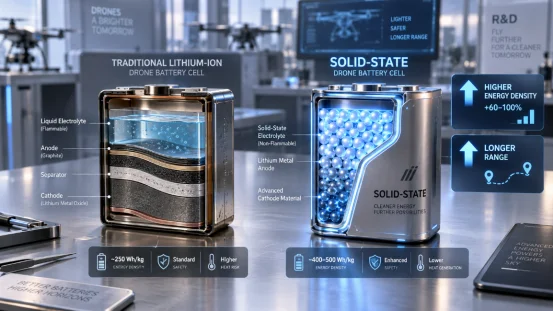
Traditional LiPo cells use a liquid polymer-based electrolyte held in a pouch. The format supports high discharge current and familiar pack designs. It also relies on pouch integrity, careful charging, and balanced cells. Overcharge, puncture, age, or high temperature can create gas, swelling, electrolyte leakage, and internal shorts. A swollen pack needs immediate isolation and a written disposal process.
How Semi-Solid Electrolytes Change the Risk Profile
Semi-solid-state cells combine solid or gel-based components with varying amounts of liquid electrolyte. The material stays in closer contact with the electrodes and limits liquid movement after impact.
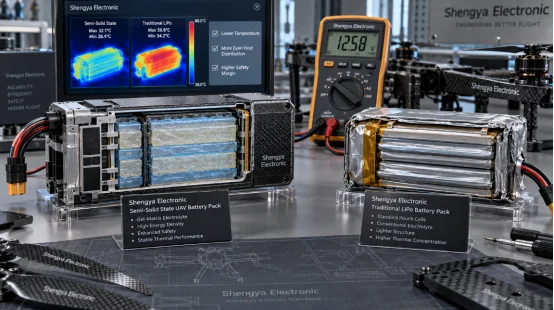
A semi-solid electrolyte can reduce combustible liquid content and slow the chain of reactions that feeds thermal runaway. The pack still needs current limits, temperature sensors, cell balancing, insulation, and a tested enclosure. Chemistry reduces one hazard pathway; system design controls the rest.
How Do Semi-Solid and LiPo Packs Compare on Energy Density?
Energy density affects your aircraft in two linked ways: stored watt-hours and the mass required to carry them. Use pack-level data at your discharge rate, temperature, and cutoff voltage. Cell headline figures alone cannot predict flight time.
Gravimetric Energy Density and Payload
A semi-solid-state drone battery may offer higher energy density, depending on its chemistry and cell design. You can assign that gain to longer inspection legs, a larger imaging payload, or a bigger return reserve. Traditional LiPo packs remain useful where a known form factor and high burst current matter more than maximum watt-hours per kilogram.
For a fair solid state vs LiPo battery test, record takeoff mass, hover power, climb current, route distance, wind, payload, landing reserve, and pack temperature. Treat open-circuit voltage as a reference and capture loaded voltage during the route. Repeat the route with packs at the same state of charge. A few extra minutes matter when they complete a scheduled task.
Power Delivery Under Real Mission Loads
Industrial UAVs pull sharp current during ascent, gust correction, and payload actuation. Capture loaded voltage during those events and use open-circuit voltage as a separate bench reference. Check the lowest cell voltage, recovery after throttle reduction, connector temperature, and BMS cutoff behavior. A pack with strong energy density still needs low resistance and reliable interconnects.
Can Semi-Solid Cells Improve Battery Safety and Cycle Life?
Safety and service life shape fleet cost. A pack that needs frequent quarantine, slow charging, or early replacement can disrupt dispatch even when its purchase price looks attractive. Set acceptance limits before you compare suppliers.
Thermal Runaway, Swelling, and Damage Response
Liquid electrolyte can vaporize and feed combustion when a damaged cell heats rapidly. Semi-solid electrolytes may reduce certain fire risks, but overall safety still depends on cell chemistry and pack design. Ask for abuse-test conditions, nail or crush results where available, overcharge response, and pack-level propagation data. Confirm how the BMS isolates a hot or imbalanced cell group.
Cycle Life in Daily Fleet Service
Cycle life depends on depth of discharge, charge rate, temperature, storage state, and peak current. Compare retained capacity after a defined number of cycles, such as 300 or 500, at your actual duty cycle. Log internal resistance and cell spread by serial number. A stable curve helps you schedule replacement before a pack fails during a route.
What Should You Check Before Ordering Industrial UAV Batteries?
Supplier data becomes useful when it matches your aircraft. Give the supplier your voltage window, continuous and peak current, payload, connector, enclosure dimensions, charger limits, and operating temperature. Request sample packs from more than one production lot when the program moves past a lab trial.
Build a Pack-Level Test Protocol
Conduct capacity, continuous and peak discharge, charging, vibration, thermal exposure, and insulation resistance tests. Include a hot-day charging test and a cold-start flight. Record usable watt-hours, voltage sag, temperature rise, cell balance, recharge time, and post-cycle capacity. Define pass or fail values in writing. Keep the same propellers, firmware, payload, and route for every comparison.
Review Traceability and Service Handling
Each sample should carry a cell lot, assembly date, test record, and serial number. Your maintenance team needs clear instructions for quarantine, transport, storage, and end-of-life recycling. Ask how replacement cells, connectors, and BMS settings stay consistent across repeat orders. Traceability turns a surprising field event into a fixable batch issue.
How Can a Semi-Solid Battery Program Move from Sample to Fleet?
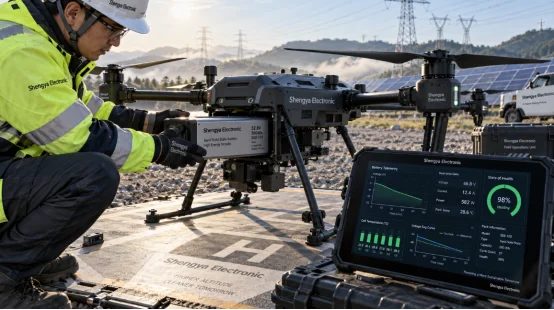
The right supplier discussion links chemistry to the aircraft, charger, and operating records. Shengya Electronic specializes in customized lithium battery packs for UAV and industrial applications.Its engineering conversation can center on pack voltage, capacity, cell matching, BMS thresholds, connector layout, and enclosure fit. Those details matter when you need stable current in a dusty field or repeated charging between sorties.
Ask for a sample configured to your duty cycle, then compare measured energy, voltage sag, temperature rise, and cycle retention against your written gates. A short pilot on a small route group gives procurement and flight operations the same evidence. If the sample meets the limits, request a second-lot confirmation before expanding the fleet. You can contact Shengya Electronic with the aircraft power profile and test conditions to start that review.
FAQ
Q1: What Is a Semi-Solid State Drone Battery?
A: It uses a gel or solid-rich electrolyte matrix that limits free liquid movement while allowing lithium-ion transport.Its energy density and safety performance depend on electrolyte formulation, cell chemistry, and overall pack design.
Q2: Does Semi-Solid Chemistry Remove Thermal Runaway Completely?
A: It can reduce the fuel and propagation paths linked to liquid electrolyte. Overcharge, short circuits, impact, and poor heat control still require BMS protection and pack-level testing.
Q3: Which Metrics Matter in a Solid State vs LiPo Battery Trial?
A: Track usable watt-hours, voltage sag, peak current, pack temperature, cell spread, recharge time, retained capacity, and mission completion rate under matched conditions.
Q4: Can a Semi-Solid Pack Extend Industrial UAV Flight Time?
A: It may provide more usable energy at a similar mass. Aircraft weight, payload, wind, propulsion efficiency, discharge rate, and reserve policy determine the flight result.
Q5: How Can You Request a Sample Test?
A: Send the aircraft voltage, current profile, payload, connector, charger limits, temperature range, and route data. Ask for a sample pack with test conditions and serial-level records, then run the written qualification protocol.