
A drone might launch fine at 20°F and climb 100 feet, only to flash a low-voltage warning within a minute. This fast drop shocks pilots. Even when fully charged, the drone acts empty. This is the biggest hurdle for cold weather drone operations.
Standard LiPo battery packs experience significant performance degradation as temperatures decrease. Internal resistance spikes, voltage sags heavily under load, and the battery management system might force an early landing.

Why Does a Standard LiPo Battery Fail at Freezing Temperatures?
Lithium polymer batteries rely on electrochemical reactions within the cells, which freezing weather actively slows down. When the drone demands a huge burst of current, the battery fails to react quickly.
It might read fully charged on the ground, but voltage crashes when motors pull hard. Pilots call this “drone battery voltage sag,” a major cause of winter trouble.
Cold Increases Internal Resistance
Low temperatures significantly increase internal resistance within the battery cells. More energy burns off as useless heat, leaving less real power for the motors. The drone feels sluggish. A pack built for high discharge won’t deliver that same punch at 32°F. Around 14°F, certain packs lose massive amounts of usable capacity and peak current.
Voltage Protection Can Trigger Early
Modern drones actively track pack voltage. If it dips below a safety line, the flight controller might cut power or auto-land. The software doesn’t know if the battery is dead or just cold. A hard climb can make a chilly battery drop below the limit briefly, triggering frustrating false alarms.
How Much Flight Time Do You Lose in Cold Weather?
Winter flight time shifts based on wind, payload, and battery age. Plan for a 20% to 40% drop compared to summer. Treat the printed capacity as a lab result rather than a guarantee. A 5,000 mAh pack gives up far less usable energy in freezing conditions, regardless of what the charger screen says.
Wind Makes the Battery Work Harder
Freezing air is only half the battle. Winter operations often involve stronger and denser airflow conditions around buildings. Motors stay at high throttle longer, draining power quickly. Basic hover tests deceive pilots. A drone hovering safely will lose voltage instantly flying into a headwind.
Older Packs Show the Problem First
Swollen or heavily used packs already suffer from high resistance. Freezing air amplifies these old weak spots. Check the internal resistance on your charger. If one cell reads unusually high, keep that pack for summer. Cold weather is not suitable for operating aged or degraded battery packs.
How Can You Keep a Drone Battery Warm Before Takeoff?
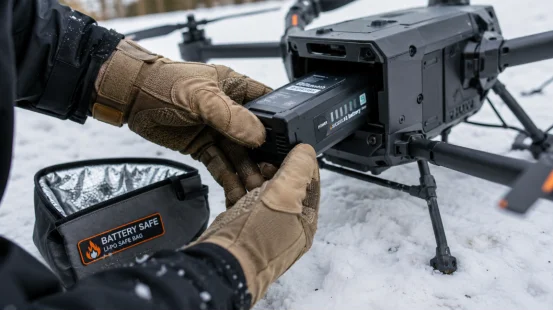
The best fix for low temperature drone battery performance is starting with a warm pack. Keep them inside an insulated case until launch. Small heaters work, but keep the heat very mild. Rapid heating damages cells. Aim for a comfortable 68°F to 86°F before flying.
Use Preheating Before the First Flight
Battery preheating for drones gives the cells a solid head start. If the battery casing feels cold to the touch, it is not yet ready for operation. Warm it up before plugging it in. Wait a minute after loading it to let the drone and battery adjust.
Insulate the Battery Compartment
Thin, closed-cell foam around the battery bay slows down the chill. Just don’t block the air vents. Avoid heavy insulation that messes with the drone’s center of gravity. A shifting battery mid-flight creates a serious crash risk.
What Should You Change in Your Winter Flight Routine?
Charge your gear indoors and ensure cells balance perfectly. Don’t launch immediately from a cold trunk. Start with a gentle hover. Watch the voltage for 30 to 60 seconds, then try a slow climb. If numbers crash, land and warm the pack back up.
Keep the First Minutes Easy
The first two minutes dictate everything. Skip full-throttle climbs while the pack wakes up. A steady load gives cells time to build internal heat safely. Plan your return trip earlier than normal. Relying on low-battery warnings provides minimal operational safety margin.
Carry More Than One Warm Pack
Keep extra packs inside an insulated bag. Swap them out individually instead of leaving them exposed. After landing, let the drained battery warm to room temperature naturally before charging. Forcing power into a frozen pack destroys it permanently.
When Should You Consider a Different Battery Design?
Standard LiPo packs handle basic flights, but heavy winter work demands a battery built for the cold. Good designs use the right chemistry, solid discharge ratings, and custom protection. A massive capacity isn’t automatically better if the voltage tanks under pressure.
Look at the Full Battery Specification
Check continuous discharge and peak current limits. Look at connector quality and real operating temps. Custom battery packs make sense for serious commercial jobs. Bolting on extra capacity that ruins the weight balance just shortens your flight time.
Reliable Battery Solutions for Cold-Weather Drone Operations
When winter flying is a daily routine, build quality matters. Shengya Electronic develops rechargeable lithium battery solutions for gear requiring steady power and specific design specs. Their lineup features customized battery pack work, focusing on cell choices, solid wiring, tough connectors, and reliable production.
This backing helps when a drone needs a battery built for tight spaces or heavy power bursts. Check out their battery solutions at the product center. Discuss your operating temps and discharge needs before buying.
FAQ
Q1: Can drones operate in below-freezing temperatures?
A: Yes. Preheat the battery before launching, fly smoothly, watch the voltage, and land early.
Q2: Why does a fully charged LiPo battery lose voltage in the cold?
A: Cold air drives up internal resistance. Voltage drops sharply when motors pull heavy current.
Q3: How do you keep a drone battery warm during winter operations?
A: Stash them in an insulated bag, use mild preheating, and never expose spares to the wind.
Q4: Is it safe to charge a cold LiPo battery?
A: No. Let the cold pack reach room temperature first, then inspect it.
Q5: Should you use a higher-capacity battery for cold weather flight?
A: Not necessarily. Check the weight, balance, and loaded voltage. A properly matched pack beats a heavy one.


