
A drone may perform reliably with a 12S battery. But it can struggle when it carries heavier things. Big cameras, delivery boxes, LiDAR tools, and long wires pull a lot of power. This makes the system work very hard. Because of this, a 24S drone power system looks like a smart idea. It gives you more voltage. It also lowers the current.
So, your wires stay cooler. However, this big change affects almost every electrical part on your drone. Don’t just buy a new battery right away. First, look at the real benefits and extra costs. Make sure your motors, ESCs, charger, and drone frame can handle this big jump.
What Changes When You Move From 12S to 24S?
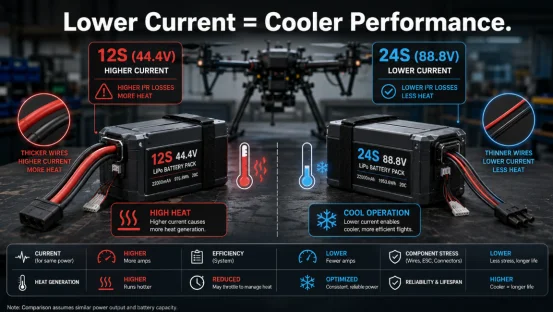
A 12S battery pack gives out 44.4 V normally. It reaches about 50.4 V when totally full. A 24S pack doubles these numbers. It sits at 88.8 V normally and hits 100.8 V when fully charged. This is a massive electrical change. It is not just swapping a normal battery.
The main point is raw power. For example, if a drone requires 8 kW of power for operation. A 12S setup pulls about 180 A. But a 24S system only needs about 90 A to do the exact same job. This lower current helps a lot. You will notice it during long upward flights or in very hot weather.
Lower Current Can Reduce Heat
Wire heat comes from high current. If you cut the current in half, the heat drops a lot. Reducing current by half can theoretically reduce resistive heat losses to approximately one-quarter.. Your plugs will stay much cooler. Also, the battery voltage won’t drop as fast when flying hard.
Still, this doesn’t mean your drone will instantly fly four times better. Other things matter too. The motors, propellers, battery health, and cooling still limit how well it flies.
Voltage Changes the Safety Margin
A fully charged 24S battery sits near 101 V. Because of this, you need thicker wire covers. You also need safer plugs, stronger fuses, and better care rules. A spark from this battery can be very dangerous. It is much worse than a 12S drone battery spark. You must treat this pack like dangerous high voltage. Always cover the metal ends. Always check it carefully before every single flight.
Does a 24S Drone Battery Increase Flight Time?
Yes, it can. But higher voltage alone doesn’t give you free energy. Battery energy is measured in watt-hours (Wh), calculated as voltage multiplied by capacity (Ah). For example, a 12S 20 Ah pack holds roughly 888 Wh. A 24S 20 Ah pack holds about 1,776 Wh. If this 24S pack doubles your energy without being too heavy, your drone will fly longer.
But real life is different. The bigger pack, thicker wires, and extra safety parts add real weight. A heavier drone needs more power to lift off. So, you lose some of that extra flight time.
Compare Watt-Hours per Kilogram
How much energy a battery packs per pound is super important. Current drone battery numbers show lithium-ion and semi-solid pouch types hold between 190 to 350 Wh/kg. Fast-power packs might hold less total energy. But they give huge power bursts for quick takeoffs.
A high-energy pack is great for slow mapping jobs. But racing or carrying heavy things is different. Flying in strong wind is tough too. For these hard jobs, fast power delivery matters much more than total stored energy.
Keep a Safe Return Reserve
Real flight time is always shorter than what the box says. Taking off, floating in place, and fighting the wind waste power. Carrying heavy things drains it too. You also need power to fly back home safely. A smart pilot always keeps about 20 to 30 percent power as a backup. This is super important when flying over roads or tall buildings.
Is Your Propulsion System Ready for 24S?
The battery is just one piece of the puzzle. Your ESC must handle the absolute maximum voltage. It must be rated for the maximum fully charged voltage, not just nominal voltage. For a 24S setup, the ESC must be rated way above 100.8 V.
It also needs good safety chips inside. You must check your motors too. A motor built for 12S might spin way too fast on 24S. You might need a lower KV rating. You might also need different propellers. Always tie the drone down for a quick test first. Watch the heat and shaking closely.
Check the ESC, Motor, and Charger Together
An old 12S charger cannot fill a 24S pack safely. You must buy a special high-voltage charger. It needs to balance every cell perfectly. The battery management system should watch the heat and voltage closely. Never mix different battery types together. Do not use random plugs either. A bad mix will blow up your ESC in just a few seconds.
Review Mechanical and Thermal Changes
A huge 24S pack might not fit in your old battery slot. You need to check the balance and the landing gear space. Make sure the cooling air can still flow through. Heat that felt okay during a quick 12S flight can get scary. It can build up super fast during a long 20-minute work job.
What Does the Upgrade Cost Beyond the Battery?
The true cost includes much more than just the battery itself. You will probably need brand new ESCs, motors, and chargers. You also need new cables and thick wire covers. Shipping these batteries is very hard. Such batteries are classified as dangerous goods.
You must follow strict UN 38.3 rules and use special warning stickers. Upkeep costs matter a lot too. Keep a written log for every single battery. Write down its charge history and any tiny faults. If a pack puffs up or gets super hot, throw it away safely.
When Is 24S Worth the Investment?
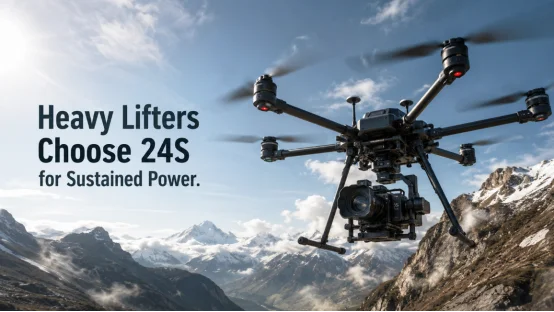
A 24S drone power system is a smart choice for heavy lifters. It is great if your drone carries heavy things or flies in very hot weather. The lower current helps keep the wires thin and cool.
But, stay with your old 12S if your drone is light. If the old setup does the job fine, don’t change it. Moving to 24S costs a lot of money. It also brings dangerous high-voltage risks. Extra voltage only helps if your drone is built to handle it safely.
How Can a Battery Partner Support a High-Voltage UAV Project?
Talk to your supplier about what your drone actually does. Tell them the weight it lifts and how long it flies. Also, share the exact battery box size. This helps the maker pick the best chemicals for your battery. Shengya Electronic makes great drone and unmanned-aircraft battery solutions. They use lithium-ion pouch technology. They offer energy numbers from 270 to 340 Wh/kg. These batteries can last for 800 to 1,000 cycles.
They sell sizes ranging from 10,000 mAh to 78,000 mAh. They usually build 4S to 18S types. If you need a big 24S project, you must ask their engineers for custom help. They can change the wire spots, the plugs, and the box shape. You can look at their drone battery list online. Then, ask them if a high-voltage design fits your specific drone.
FAQ
Q1: Is upgrading from 12S to 24S worth it for every drone?
A: No. It is best for heavy drones that need lots of power. Light drones don’t gain much because the new parts are heavy.
Q2: What is the main benefit of a 24S drone battery?
A: It gives the exact same power but uses half the current compared to a 12S. This keeps the wires cool and saves energy.
Q3: Can a 12S ESC work with a 24S battery?
A: No. Your ESC must be rated for the full 100.8 V. Using an old ESC will break it instantly.
Q4: Does a 24S pack automatically double flight time?
A: No. Flight time depends on wind, weight, and propellers. A bigger battery gives more energy, but the extra weight slows the drone down.
Q5: Can Shengya Electronic supply a custom 24S UAV battery pack?
A: Yes. They list 4S to 18S options online. But for a big 24S build, you must talk directly to their engineers to get a safe, custom design.


