
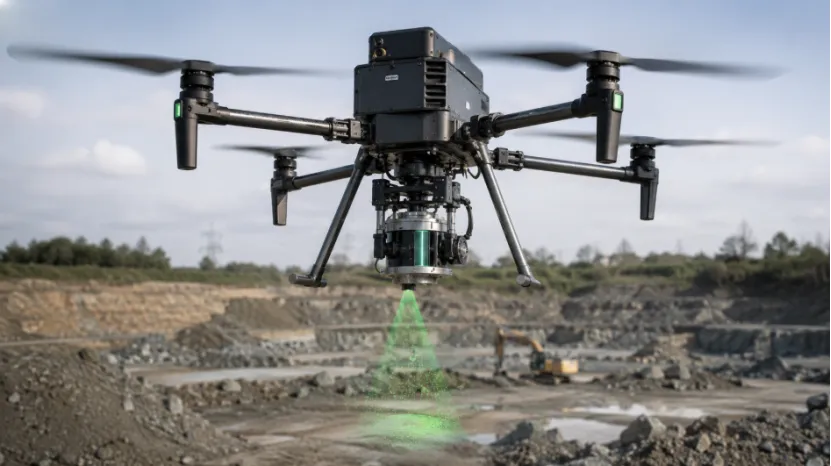
For mapping missions, a surveying drone battery affects much more than flight time. It supports the power needs of LiDAR, RTK, IMU, camera triggers, onboard storage, and communication modules. When voltage becomes unstable, sensors may restart, logs may be interrupted, and data segments may be lost in the final deliverable.The aircraft may return safely, but the dataset may not be usable. This is often where the real operational cost begins.
A professional UAV battery for LiDAR should deliver stable output under payload load, not only show a large capacity number on a datasheet. In construction mapping, stockpile measurement, corridor inspection, and terrain modeling, UAV survey data quality depends on continuous data capture. One short sensor power interruption can mean reflights, missed site windows, and extra processing work.
Why Does Power Stability Determine Surveying UAV Data Quality?
Surveying UAVs are measurement platforms first and aircraft second. They carry expensive sensors that depend on steady power while propulsion motors draw high current during takeoff, climbing, wind correction, and turning. This makes UAV power stability a direct part of data quality control.
LiDAR, RTK, IMU, and Camera Payloads Need Continuous Power
A UAV battery for LiDAR must support the LiDAR payload power supply, RTK drone battery power, IMU operation, and camera trigger timing throughout the mission. These systems work together. LiDAR records point clouds, RTK or PPK supports positioning, the IMU helps align motion data, and cameras capture images for texture or photogrammetry.
Stable power supply is critical because measurement electronics are highly sensitive to voltage fluctuations.A small interruption may not look dramatic in flight logs, but it may appear later as missing point cloud segments, broken timestamps, weak image overlap, or incomplete metadata. This creates significant post-processing challenges, because it often shows up after the crew has already left the site.
Voltage Sag Can Create Sensor Resets and Data Gaps
Voltage sag in drone batteries can happen during peak current demand, especially with heavy LiDAR payloads, low battery state of charge, strong wind, or fast flight corrections. Strong drone battery voltage stability helps reduce the risk of sensor power interruption and protects LiDAR data continuity.
For survey teams, the issue is not only whether the drone can stay in the air. The issue is whether every second of flight creates usable data.
Why Does LiDAR Surveying Place Higher Demand on UAV Batteries?
LiDAR surveying usually places heavier load on the power system than basic camera mapping. The payload is heavier, the data stream is continuous, and the aircraft must maintain planned altitude, speed, and sensor timing. A LiDAR drone battery therefore needs better stability than a general flight battery.
High-Value Payloads Increase Mission Risk
A drone mapping battery pack supports more than the aircraft body. It supports the value of the payload and the value of the mission. LiDAR scanners, RTK modules, IMUs, cameras, and onboard storage all add cost and complexity.
If power drops during a mine survey, road corridor flight, or construction progress scan, the lost work may include crew time, transport, site access, and processing hours. For large areas, one battery-related failure can turn into a full return visit. This is inefficient and often increases operational costs.
Productive Flight Time Matters More Than Advertised Flight Time
A long endurance mapping drone battery should provide usable survey time with reserve power. Endurance under no-load conditions is not sufficient for real-world operations. A surveying drone battery must perform under real payload weight, mission speed, temperature, and return-to-home margin.
For a drone battery for mapping, stable discharge behavior is often more valuable than a few extra minutes claimed under light-load test conditions.

How Does Battery Quality Support Orthomosaic Mapping and 3D Modeling?
Orthomosaic mapping and 3D modeling rely on complete coverage. The flight path may be automated, but the data chain still depends on stable power. Camera triggers, storage, GNSS records, and onboard computing need to work without interruption.
Orthomosaic Mapping Requires Continuous Image Capture
A drone battery for orthomosaic mapping and UAV battery for photogrammetry should help maintain image spacing, overlap, and metadata records. If a camera or trigger module resets during a grid flight, the final map may show holes or weak tie points. That can damage UAV survey data quality even when most of the mission looks normal.
3D Modeling Requires Consistent Coverage and Metadata
A drone battery for 3D modeling should support steady sensor operation across repeated passes. Facade scans, stockpile models, and terrain reconstruction all need consistent coverage. Missing data strips complicate processing workflows, and sometimes the only clean fix is another flight.
What Defines a Reliable Surveying Drone Battery?
A reliable surveying drone battery combines high-density cells, stable discharge behavior, low internal resistance, proper connectors, and a UAV battery BMS suited to the aircraft. The pack should match the payload and power distribution design, rather than creating integration constraints.
High-Density Cells for Payload-Carrying Endurance
A high density UAV battery can help create a long endurance mapping drone battery while leaving more useful payload capacity for LiDAR, RTK, cameras, and onboard computing. Shengya Electronic offers high energy density UAV battery products across several series, including 190Wh/kg high-rate options and higher density 275Wh/kg, 310Wh/kg, 330Wh/kg, 340Wh/kg, and 350Wh/kg ranges.
BMS Functions for Stable and Predictable Output
A professional UAV battery BMS supports drone battery voltage stability through voltage monitoring, temperature sensing, current control, cell balancing, and protection logic. Shengya Electronic product information also notes that matching BMS systems can support custom communication protocols such as CAN, RS485, and UART when required.
Where Can Shengya Electronic Fit in Surveying UAV Power Design?
Shengya Electronic focuses on semi-solid and solid-state lithium-ion battery products for UAV and industrial power use. Its product range covers 6S, 7S, 12S, 14S, and 18S platforms, with application coverage across logistics delivery, agricultural crop protection, industrial inspection, urban air mobility, firefighting, and rescue. For a surveying UAV power system, this range is valuable because different mapping platforms have varying battery requirements. Some need high discharge. Some need lower weight. Others need a custom drone mapping battery pack with specific cables, plug type, layout, and BMS communication.
If you are building a UAV battery for LiDAR or a surveying drone battery for long-area mapping, Shengya Electronic may be considered for high-density cell options, custom pack work, and payload-focused power design.
FAQ
Q1: Why Does Battery Stability Matter for Surveying UAVs?
A surveying drone battery dictates UAV survey data quality. Sudden sensor power interruptions may trigger LiDAR resets. Consequently, this causes frustrating RTK data gaps, missed image triggers, or broken point cloud records.
Q2: What Makes a Good UAV Battery for LiDAR?
A reliable UAV battery for LiDAR delivers steady voltage and ample current. Low internal resistance helps ensure a dependable LiDAR payload power supply alongside robust drone battery voltage stability.
Q3: Can Voltage Sag Affect Drone Mapping Data?
Yes. Sudden voltage sag triggers sensor power interruption. This can disrupt LiDAR data continuity. It may affect image timing and increase the risk of incomplete or unusable mapping results.
Q4: Why Is High Energy Density Important for Surveying Drone Battery Design?
A high density UAV battery creates a practical long endurance mapping drone battery. It easily carries heavy LiDAR, RTK, cameras, and onboard computing without losing precious flight minutes.
Q5: What Should OEMs Check When Selecting a Drone Mapping Battery Pack?
OEMs must evaluate the specific voltage platform, discharge curve, and internal resistance. Additionally, thoroughly review UAV battery BMS functions, connector ratings, thermal behavior, strict payload compatibility, and overall UAV power stability.


