
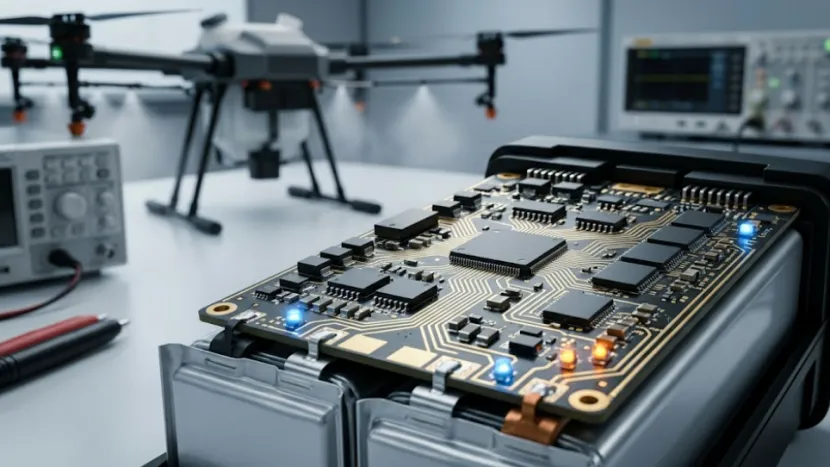
If you build or source a commercial drone battery, the battery itself is only half the story. The other half is the drone battery BMS. In crop protection, logistics delivery, industrial inspection, and emergency work, the load changes fast, the weather is rarely polite, and a bad battery readout can ruin a flight plan in seconds. That is why many OEM teams no longer treat the battery as a simple pack of cells. They look at the battery management system for drones as part of the aircraft system, right next to the motor, ESC, and flight controller. On supplier sites serving these markets, you can already see the spread of applications and battery formats, from high-rate packs to high-energy-density lines aimed at long-endurance work.
What Is a Drone Battery BMS?
A drone battery BMS is the control layer inside a drone battery pack with BMS. It watches cell voltage, current, and temperature. It also handles protection logic, charge and discharge limits, and in better systems, data output to the aircraft or ground tools.
For a hobby drone, that can be enough. For a commercial drone battery, it usually is not. A commercial drone battery BMS needs to do more than stop overcharge and overdischarge. It should support real-time battery monitoring for drones, track cell consistency, and give you cleaner battery data when the aircraft is carrying a sprayer, a camera payload, or inspection gear. That is where a smart BMS for drone battery use starts to matter. You are not just buying safety. You are buying stable behavior in the air, and that is a different thing.
Do Commercial Drones Need a Custom BMS?
In many cases, yes. But not because custom sounds fancy. It is because power demand is rarely standard once a drone enters real work.
A spraying drone pulling a heavy liquid load does not behave like a mapping platform flying a neat grid. A delivery aircraft does not see the same current spikes as a craft climbing around a power tower. This is why the question is not simply, Do commercial drones need a custom BMS? The better question is whether your airframe, payload, and operating profile can still get reliable battery data from a generic board.
A custom BMS for commercial drones becomes more useful when you need high discharge output, tighter thermal limits, better SOC and SOH in drone batteries, or direct communication with the flight controller. It also matters when your team wants fault logs, fleet service records, or a BMS for UAV battery integration through CAN, RS485, or UART. On one supplier product page, the published configuration notes are unusually direct: BMS can be matched on request, and custom communication protocols are available when needed.
Which Drone Battery BMS Features Matter Most?
If you are trying to evaluate a commercial drone battery BMS, start with the parts that affect flight decisions. This is how to evaluate drone battery BMS features without getting lost in spec-sheet noise.
First, check drone battery cell balancing. Weak balancing creates growing cell drift, and that turns into ugly voltage sag near the end of a mission. Second, look at real-time battery monitoring for drones. You want fast and stable readings, not numbers that lag when throttle changes hard. Third, ask how SOC and SOH in drone batteries are calculated. Some packs look fine on paper and still give poor remaining-power estimates in cold weather or high-load climbs.
Then check protection logic. Drone battery overcharge protection and drone battery temperature protection should be basic, but the real issue is how those limits are set and whether they fit your aircraft. A high discharge drone battery BMS for payload drones should not be tuned like a light survey aircraft. The supplier pages reviewed here also mention high-rate output up to 25C, high-voltage 4.35V options, 190 to 350 Wh/kg product ranges, cycle life of at least 800 cycles on some lines, and intrinsic safety language including puncture-test claims on some models. Those details do not replace your validation test, but they do tell you what kind of engineering conversation the supplier is prepared to have.
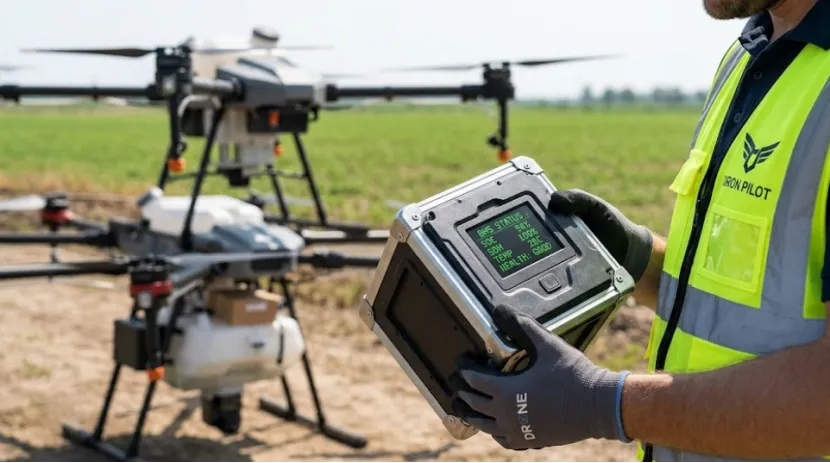
What OEM Buyers Should Ask Battery Suppliers?
This is the part many teams rush, and it shows later.
Ask whether the pack uses a standard board or a custom drone battery BMS. Ask which communication protocols are supported and whether the battery can talk cleanly to your flight controller, charger, and service tools. Ask how the supplier handles UAV battery BMS integration. Ask what happens at low temperature, at high current, and after a few hundred cycles. Ask for actual test data, not just a one-line promise.
You should also ask what OEM buyers should ask battery suppliers before sampling. The answer is simple. Ask what to ask a drone battery manufacturer about thresholds, logging, cell balancing, firmware changes, and after-sales support. A drone battery supplier that cannot explain those points in plain language will probably be hard to work with when field issues show up. And they always do, usually at the least convenient time.
Which Drone Battery Supplier Looks Ready for Real OEM Work?
If you are still sorting out how to choose a drone battery supplier, a useful sign is whether the supplier can talk about the battery pack, the BMS, and the application in one conversation. Shengya Electronic is a good example of that kind of profile. According to its published company and product information, the company was founded in 2017 in Taixing, Jiangsu, focuses on solid-state lithium-ion pouch cells and battery packs, lists product lines from 270 Wh/kg to 340 Wh/kg and beyond, and offers pack combinations such as 6S, 7S, 12S, 13S, and 14S. Its drone-facing materials also state that voltage, capacity, size, interface, structure, and BMS can be customized, with sample lead times commonly around 7 to 10 days and export documents such as UN38.3 and MSDS available for shipping support. That is the kind of published detail OEM buyers usually want to see before the first serious call.
In practical terms, an OEM drone battery program works better when the supplier can match the commercial drone battery to the mission, not just sell a catalog item. That is why custom lithium battery for drones projects often end up becoming OEM battery solutions for drones, not simple off-the-shelf purchases.
FAQ
Q1: What is a drone battery BMS?
A: It is the control system inside the battery pack that tracks voltage, current, and temperature, and manages protection, battery data, and sometimes communication with the aircraft.
Q2: Why do commercial drones need a custom BMS?
A: Because payload, discharge rate, operating temperature, and communication needs vary a lot in real jobs. A custom BMS for commercial drones can match those conditions better than a generic board.
Q3: What features should an OEM drone battery include?
A: Look for accurate monitoring, strong cell balancing, stable protection logic, useful communication protocols, and service data such as fault logs or health records.
Q4: Can a custom BMS improve drone safety?
A: Yes. It can improve protection response, thermal control, battery data quality, and warning accuracy, which helps you make safer flight and maintenance decisions.
Q5: What communication protocols should a drone battery support?
A: That depends on your aircraft, but CAN, RS485, and UART are common choices when you need cleaner integration between the battery, flight controller, charger, and service tools.


