
A drone rests on the ground, waiting to be recharged. The charger is not the only limiting factor.Heat, cell chemistry, and charger output matter. The power supply and battery management system also dictate drone battery charging time. Knowing how to fully charge a drone battery in 30 minutes means syncing the whole setup. You cannot simply increase current without considering system limitations.
Modern drone battery fast charging technology helps immensely. It makes a 30-minute turnaround doable for supported batteries. Check the specs first. Next, compare suitable drone battery products based on voltage, capacity, and S configuration.Also verify connectors and thermal limits.
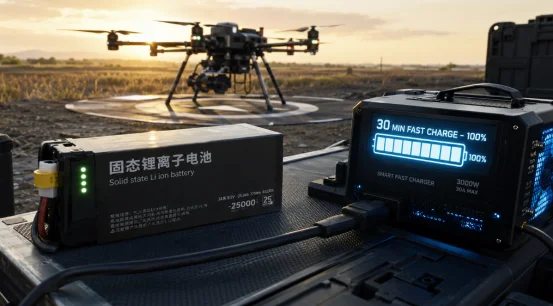
Can a Drone Battery Reach Full Charge in 30 Minutes?
A 30-minute full charge is achievable under specific conditions. However, it isn’t guaranteed everywhere. Industrial smart charging systems push compatible batteries near 100% within 15 to 30 minutes. Conversely, a standard balance charger takes 60 to 90 minutes or more. Actual results will vary depending on operating conditions. Battery capacity and starting charge alter times. Ambient weather and cooling delays change them too.
What the 30-Minute Claim Really Means
Some times are measured from 15% or 20% to 95%, not from empty to 100%. A battery that lands with a safe reserve can enter normal charging quickly. A deeply discharged battery may first enter a low-current recovery stage.
If you ask, “how long does a drone battery take to charge,” check the test conditions. Look for starting charge, final percentage, battery temperature, and charger power.
Why Charging Slows Near 100%
Lithium batteries typically use a constant current–constant voltage (CC–CV) charging method. The charger supplies higher current during the main stage, then reduces current as cell voltage approaches its limit. Drone battery cell balancing also takes place near the end.
If you ask, “why does drone battery charging slow down near 100%,” the answer is usually heat control, voltage protection, and final balancing.
What Makes 30-Minute Drone Battery Charging Possible?
Fast charging works when the battery, charger, BMS, and cooling equipment match. Any mismatch in the system can significantly slow the charging cycle. A hot pack may look ready on the tailgate while its internal temperature says otherwise.
A Compatible Battery and Charger
Use a drone fast charger approved for the pack’s voltage, chemistry, connector, and communication protocol. A high-power charger cannot safely accelerate charging if the battery has a lower charge-rate limit.
Do not confuse discharge C-rate with charge C-rate. High discharge supports strong takeoff current, but it does not automatically approve aggressive LiPo battery fast charging. Follow the stated maximum charging current.
Smart BMS Control
Smart drone battery charging depends on BMS data. The system watches cell voltage, current, temperature, and abnormal voltage differences. It may reduce current or stop charging outside safe limits.
A BMS cannot restore safety to a swollen, damaged, or internally compromised battery.
Active Battery Cooling
A drone battery cooling system may use forced air, a cooling cabinet, or a battery-compatible water-cooling setup. Cooling matters after heavy payload flights, fast climbs, or hot-weather spraying.
Check the approved drone battery charging temperature before connecting the pack. Charging a hot battery can trigger BMS protection limits and increase safety risks.
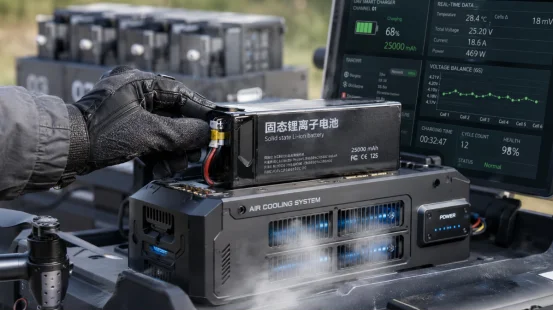
How Do You Fully Charge a Drone Battery in 30 Minutes?
The routine is simple: inspect, cool, connect, select the correct mode, and monitor the initial charging phase.
Inspect and Cool the Pack
Check the case, pouch shape, connector pins, cables, and smell. Remove any pack with swelling, leakage, impact damage, darkened contacts, or unusual heat. The swollen drone battery safety guide explains why a puffed pouch must leave service.
Let the battery cool to its approved range. Clean dirt, chemical residue, and moisture from the connector. Agricultural environments often involve dust, moisture, and chemical exposure; a small dirty contact can become a hot spot.
Connect the Correct Power System
Place the charger in a dry, ventilated area away from fuel, cardboard, dry grass, and chemicals. Confirm that the generator, inverter, or mains supply can provide stable continuous power. Insufficient input power is a common reason why fast charging fails.
Connect the pack, select the approved fast-charge mode, and confirm the displayed voltage and battery type. Never modify a cable to make an incompatible charger fit.
Monitor the Charge
Watch temperature, cell voltage difference, error codes, and progress. Stop if you notice rapid swelling, smoke, sharp odor, repeated faults, or unusual noiseEven with smart systems, charging should always be monitored by personnel.
Record actual turnaround time. Cooling may take 12 minutes and charging 20. That is still 32 minutes, even when the charger screen shows 20.
Does Fast Charging Damage a Drone Battery?
Certified fast charging does not automatically ruin a healthy compatible battery. Damage is more closely tied to excessive heat, overcurrent, deep discharge, poor cell matching, impact damage, and long storage at full charge. Charging habits and mission load both affect drone battery cycle life.
Protect Battery Life During Daily Work
To extend drone battery life, land with a sensible reserve instead of running the pack to zero. Let hot batteries cool. Use the correct drone battery storage charge when packs will sit for several days, and keep them away from hot vehicles or freezing storage areas.
These drone battery charging best practices sound basic. They prevent many expensive failures.
Stop Using Unsafe Packs
Do not recharge a swollen or badly damaged battery. Isolate it on a fire-resistant surface and follow local disposal rules. A smart charger may reject it, but relying on rejection is poor practice.
How Can You Keep a Drone Working Through the Day?
Continuous operation comes from battery rotation, not a single high-speed charging cycle. A three-pack routine is practical: Battery A flies, Battery B cools, and Battery C charges. When flight, cooling, and charge times are close, the aircraft only stops for a battery change.
Match the Pack to the Mission
Capacity alone does not choose the right battery. Voltage platform, peak current, weight, connector, dimensions, thermal behavior, and target flight time all matter. An agricultural drone battery charger also needs enough sustained input power.
Before a large purchase, use a UAV battery supplier checklist to compare cell grading, internal resistance matching, aging tests, customization, shipping papers, and after-sales support.
Why Consider Shengya Electronic for UAV Battery Projects?
Shengya Electronic develops semi-solid and solid-state lithium-ion soft-pack cells and battery packs for UAV work. Its published range covers high-rate and high-energy-density series, capacities from about 10,000mAh to 78,000mAh, and voltage layouts including 6S, 7S, 12S, 14S, and 18S. This gives you room to match endurance, payload, and aircraft voltage rather than force one standard pack into every platform.
The supplier also states that pack combinations, cable outlet positions, plugs, and labels can be customized. For a fast charging drone battery project, this matters because charge performance starts with correct cell selection, consistent matching, and a pack design that fits the aircraft and charger.
FAQ
Q1: Can every drone battery charge in 30 minutes?
A: No. How to fully charge a drone battery in 30 minutes depends on charge-rate approval, charger compatibility, input power, BMS limits, and cooling.
Q2: Does fast charging damage drone batteries?
A: It can when current or temperature exceeds the battery limit. Approved charging on a healthy pack controls the risk.
Q3: Can you charge a battery immediately after flight?
A: Not when it is hot. Cool it to the approved range first.
Q4: Why does the charger slow down near full charge?
A: The system reduces current for voltage protection and cell balancing.
Q5: What should you check before buying a fast-charge battery?
A: Check voltage, capacity, S count, maximum charge current, connector, dimensions, weight, thermal limits, BMS requirements, and test conditions.


