
A spray tank is full, the throttle rises, and a pack that felt normal on the bench grows hot before the first climb ends. This is a common pattern of drone battery overheating under load. The aircraft demands high current at the exact moment when cooling airflow is still limited. Voltage falls, internal losses become heat, and the drone may start climbing more slowly.
That heat can come from the cells, busbars, cables, or a dirty connector. Finding the source matters because each problem calls for a different fix.
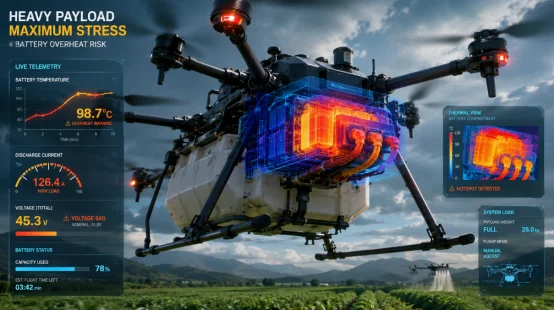
Why Does a Heavy Payload Cause Drone Battery Overheating?
Payload changes the electrical duty of the whole aircraft. More lift requires more motor power, so the battery must deliver greater current for longer periods. A short burst may be acceptable. A long climb with a full tank is much harder on the pack.
Takeoff Turns Payload into Current
Large agricultural drones can place very high discharge demands on their cells during takeoff and climbing. Some heavy-duty missions reach discharge rates between 15C and 30C. The exact figure depends on the propellers, motors, aircraft weight, and flight profile.
As voltage drops, the system may draw still more current to maintain power. This is why a weak pack often feels fine during a light test flight, then struggles with a full payload.
Resistance Turns Current into Heat
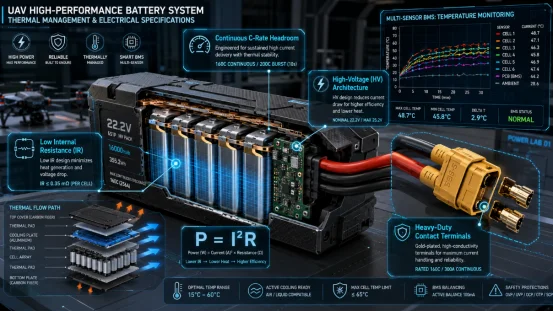
Electrical heat follows the relationship P = I²R. Doubling current produces four times the heat at the same resistance. Battery internal resistance rises with age, cell damage, poor storage, and low state of charge.
Connectors deserve attention too. At 150 A, an extra 1.5 mΩ of contact resistance creates 33.75 W of heat in a very small area. Chemical residue, loose terminals, and worn plating can make a plug hot even when the cell body remains fairly cool. Sealed housings may then trap that heat.
Which Signs Appear Before Performance Drops?
A hot casing is often a late clue. Flight logs and small changes in aircraft behavior can reveal the problem earlier, especially when you compare flights with the same payload and route.
Voltage Sag Shows Up First
Drone battery voltage sag is the difference between resting voltage and loaded voltage. A sharp dip during takeoff points to high current, rising resistance, an undersized pack, or a weak cell group. If your drone battery overheats during takeoff and one cell falls much faster than the others, stop using that pack until it has been checked.
Heat Speeds Up Aging
Repeated hot flights increase electrolyte breakdown and cell swelling. Capacity falls, resistance rises, and the next flight creates even more heat. Battery cycle life can degrade rapidly once this pattern begins.
Charging a hot pack adds another stress cycle. Do not move it directly from a demanding flight to fast charging. Follow the cell maker’s charging temperature limits and allow the core, not just the outer case, to cool.
Which Battery Specs Lower the Risk?
A heavy payload drone battery needs more than a large capacity label. You need to evaluate four interrelated parameters: continuous C-rate, resistance, voltage, and usable capacity under load.
The C-Rate Must Match Real Current
C-rate converts capacity into a current rating. A 20 Ah pack rated for 10C continuous discharge has a theoretical continuous limit of 200 A. Burst ratings do not cover a two-minute climb.
A high C-rate drone battery gives you more current headroom, but ask for test conditions and temperature derating. A printed 25C rating has little value if it only applies for a few seconds.
Battery Internal Resistance Sets the Heat Load
Request DC internal resistance data for a new pack and its individual cell groups. Compare readings at the same temperature and state of charge. A rise of roughly 30% to 50% over the original baseline calls for close inspection or retirement, subject to the maker’s limit.
Low resistance also reduces voltage sag. It can make a more noticeable difference during takeoff than adding capacity alone.
Voltage Changes Current Demand
For the same electrical power, a higher system voltage allows lower current. Lower current can reduce cable, connector, and pack heating. A high-voltage drone battery must still match the ESC, motor, charger, and BMS voltage limits. Do not treat a higher cell count as a drop-in upgrade.
Capacity Adds Headroom, with a Catch
Greater drone battery capacity lowers the effective C-rate at a given current and may extend flight time. It also adds weight. That extra weight raises thrust demand, so the largest pack is not automatically the coolest choice.
Use measured current instead. Multiply capacity in amp-hours by the continuous C-rate, then leave margin above the mission’s sustained draw.
How Can You Prevent Overheating in Daily Flights?
How to prevent drone battery overheating starts with repeatable checks. A temperature reading means little without payload, ambient temperature, peak current, and flight time beside it.
Check the Aircraft Before Launch
Inspect propellers, motors, terminals, cable joints, and cell balance. A damaged propeller or stiff motor forces the power system to work harder. Clean agricultural residue from connectors using the approved method.
Record drone battery temperature after a consistent route. A pack that runs 10°C hotter than the fleet under the same conditions deserves investigation, even if no warning has appeared.
Treat Turnaround Time as Part of the Mission
Let the pack cool in a shaded, ventilated area before charging. Do not use water, ice, or a freezer. Good battery management systems use several temperature sensors because the center cells and power electronics can stay hotter than the casing.
Once you know peak current, sustained current, voltage sag, and post-flight temperature, you can give a supplier a useful operating profile instead of asking for a battery based only on flight time.
How Can the Right Pack Supplier Reduce Thermal Risk?
That operating profile makes product selection much more precise. According to its official company information, Shengya Electronic manufactures solid-state lithium-ion pouch cells and battery packs in several energy-density ranges, including 270, 320, 330, and 340 Wh/kg. Its stated pack combinations include 6S, 7S, 12S, 13S, and 14S, with customization available for pack arrangement, cable exit, and connector type.
The product range also separates high-rate 25C packs from 4.35V high-voltage packs. That is useful because discharge capability and energy density solve different parts of the heat problem. Before ordering, confirm continuous current, resistance, temperature limits, connector rating, and cycle-test conditions for the exact model. Website figures are a starting point, not a substitute for mission-level data.
FAQ
Q1: What Is the Best Drone Battery for Heavy Payload Applications?
A: Choose a pack whose continuous current rating exceeds measured mission demand, with low resistance, compatible voltage, and enough capacity without excessive added weight.
Q2: Can a Larger Drone Battery Prevent Overheating?
A: Sometimes, but capacity alone cannot fix high resistance, poor connectors, an overloaded motor system, or inadequate cooling.
Q3: How Much Voltage Sag Is Acceptable?
A: Use the aircraft and cell maker’s limits. A growing sag trend under the same payload is more useful than one isolated reading.
Q4: Can You Recharge a Battery While It Is Still Warm?
A: Only within the maker’s charging temperature range. Fast charging a hot pack speeds up aging and may worsen cell imbalance.
Q5: Does a Hot Battery Always Mean Thermal Runaway?
A: No. Local connector heating and normal load heating can occur first. Swelling, smoke, hissing, or rapidly rising temperature requires immediate isolation under your safety procedure.


