
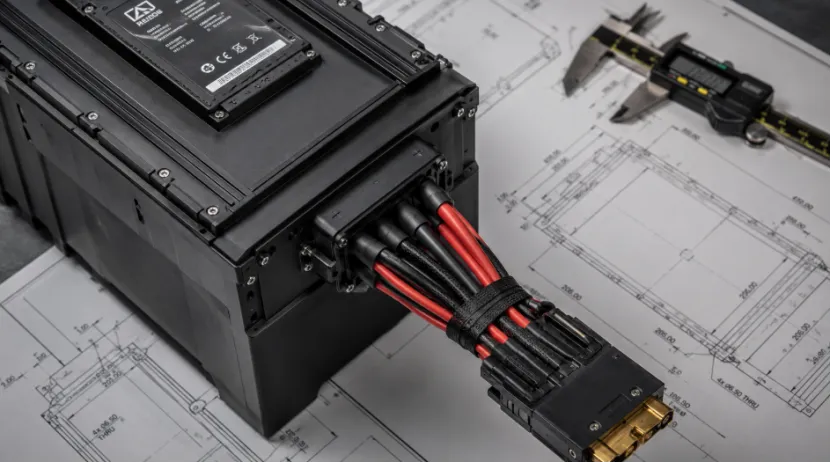
For OEM buyers, custom UAV battery packs are never just “a battery with the right capacity.” A reliable custom drone battery pack must match your aircraft voltage, flight time, payload, battery bay, plug system, charging setup, BMS data needs, label rules, and shipment documents.
In a real UAV battery OEM project, one missed detail can slow down assembly for weeks. A wire outlet placed 30 mm too far to the left is small on paper, but not small when your production team is waiting.
Why Do Custom UAV Battery Packs Need Clear Specifications Before Production?
Before custom UAV battery pack production, you should turn every need into a clear written requirement. The reference customization process covers battery cells, structure, BMS, battery integration, physical size, voltage, discharge rate, charge and discharge current, cycle life, and structure strength. It also stresses sample confirmation before mass production. That is exactly the mindset OEM buyers need.
Confirm the Real Application First
Start with the UAV type and task. A mapping drone cares about flight time and steady output. A delivery drone needs stronger current during takeoff with payload. An inspection UAV may need more reserve because it works near towers, pipelines, wind farms, or remote sites.
This first step affects drone battery customization from the start. If your drone carries a 2 kg camera payload, do not only say “need 45 minutes.” Share payload weight, hover power, peak current, flight route, temperature range, and reserve power. The battery maker cannot guess these details well. Nobody likes a second sample round just because the first brief was too thin.
What Voltage and Capacity Should Your Custom Drone Battery Pack Use?
Voltage decides whether your battery can match motors, ESCs, flight controller, charger, and power distribution board. Capacity decides energy storage, but capacity alone does not decide flight time.
Check Voltage, Wh, and Current Together
For UAV battery voltage customization, confirm nominal voltage, full-charge voltage, cell count, and voltage cut-off. Common industrial UAV platforms may use 6S, 7S, 12S, 14S, or 18S. Shengya Electronic lists UAV battery options across these voltage platforms, including high energy density 275Wh/kg, 310Wh/kg, 330Wh/kg, 340Wh/kg, and 270Wh/kg high-voltage 4.35V series.
Its products also include capacities such as 16000mAh, 22000mAh, 30000mAh, 50000mAh, 66000mAh, 70000mAh, and 78000mAh for different UAV power needs.
For drone battery capacity customization, ask for both mAh and Wh. A 30000mAh 6S pack and a 30000mAh 12S pack do not store the same energy. If you need a high capacity UAV battery pack, also check weight. A larger pack can reduce useful payload if the airframe is already near its limit.
Confirm Charge and Discharge Data
The requirement sheet should include UAV battery discharge current, peak current, UAV battery charging current, discharge rate, working temperature, and UAV battery cycle life. These numbers matter more than a nice label. For example, a delivery drone may pass a hover test, then fail when it climbs with a loaded box.
What Size, Wire Harness, and Connector Details Must Be Locked?
The mechanical side of UAV battery pack design is where many OEM projects get stuck. A battery can be electrically correct and still fail because it does not fit the tray, latch, or center of gravity target.
Confirm Size, Structure, and Heat Path
For UAV battery size customization, send the battery bay drawing with length, width, height, weight limit, fixing method, and clearance. The reference customization list includes battery thickness, width, length, shape, strength, capacity, structural strength, UAV battery heat dissipation, structural size, and UAV battery impact resistance.
Your UAV battery casing design should also match field use. A training drone may accept a simple pack, but a rescue or inspection UAV needs stronger housing, safer handling, and better protection during transport. UAV battery structure customization should cover shell material, mounting ribs, label area, cooling gap, and anti-vibration details.
Confirm Wires and Plugs Before Tooling
The UAV battery wire harness should be fixed before production drawings are approved. Confirm outlet direction, cable length, wire gauge, bend radius, strain relief, and whether power, balance, charge, heating, and signal wires are separate.
The drone battery connector type must match current rating and field replacement habits. A plug that is hard to buy locally can create service trouble later. For OEM orders, also confirm combination method, wire outlet position, plug type, logo position, and label content early.
What BMS and Communication Functions Should OEM Buyers Confirm?
A smart UAV battery pack is useful only when its BMS talks correctly with the aircraft. Do not leave BMS details as “standard” unless your team has tested that standard already.
Match BMS Functions with Flight Control Needs
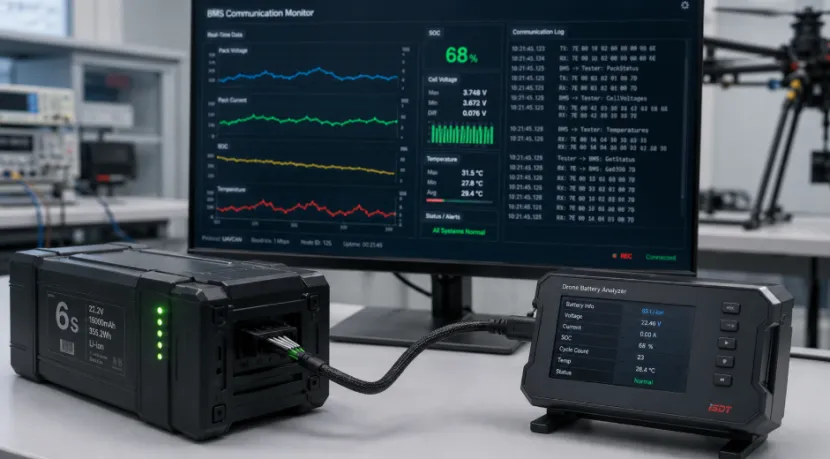
For UAV battery BMS customization, confirm UAV battery protection function such as overcharge protection, overcurrent protection, overheat alarm, low temperature alarm, over-discharge protection, short-circuit protection, balance function, reverse connection protection, self-test, voltage difference abnormality, UAV battery power display, and UAV battery abnormality record. Low-temperature work may also need UAV battery self-heating function and UAV battery low temperature protection.
Confirm the Drone Battery Communication Protocol
The drone battery communication protocol should be tested before sample approval. Confirm CAN, SMBus, UART, or project-specific protocol. Required data may include SOC, SOH, voltage, current, temperature, remaining runtime, cycle count, fault code, and alarm status. If the flight controller cannot read the battery correctly, the pack is not ready for production.
How Should Shengya Electronic Fit into an OEM Battery Project?
Shengya Electronic focuses on semi-solid and solid-state lithium-ion UAV batteries for industrial use. Its product range covers high-energy-density and high-voltage UAV battery series for logistics delivery, agricultural crop protection, industrial inspection, urban air mobility, firefighting, and rescue.
The company’s battery catalog gives OEM buyers several starting points for voltage, capacity, and energy density selection, especially when flight endurance and payload are both important.
For a practical sourcing project, Shengya Electronic is better viewed as an engineering battery partner, not just a cell supplier. You can use its product platform to discuss voltage, capacity, pack structure, connector layout, BMS requirements, sample testing, and later production planning.
What Should Be Tested Before Mass Production?
Before bulk order approval, drone battery sample testing should be done on the real UAV, not only on a bench.
Run Flight, Load, and Quality Tests
Your UAV battery flight test should check hover time, loaded takeoff, climb current, return reserve, voltage sag, temperature rise, and charging behavior. A UAV battery load test should cover continuous current and peak current. Also check plug heating, wire bending, casing fit, BMS alarm, communication stability, and charging cut-off.
For UAV battery quality control, define incoming cell checks, pack aging, capacity test, internal resistance check, insulation test, appearance inspection, and final shipment test. Request UAV battery certification documents before shipment, not after packing. Common documents include UN38.3 drone battery reports, drone battery MSDS, shipping files, and project-required compliance papers.
FAQ
Q1: What Should OEM Buyers Confirm for Custom UAV Battery Packs?
A: You should confirm voltage, capacity, Wh, size, weight, wire outlet, connector, casing, BMS, communication protocol, logo, sample test plan, and certification documents.
Q2: Why Is UAV Battery Voltage Customization Important?
A: UAV battery voltage customization affects motor output, ESC match, current draw, charger choice, and full-charge safety. Wrong voltage can damage the aircraft system.
Q3: Why Is UAV Battery BMS Customization Important?
A: UAV battery BMS customization helps the pack manage protection, power display, fault records, low-temperature work, balancing, and flight controller communication.
Q4: What Drone Battery Communication Protocol Should Be Confirmed?
A: The drone battery communication protocol may be CAN, SMBus, UART, or a custom format. It must match the flight controller and ground system.
Q5: What Should Be Included in an OEM UAV Battery Pack Checklist?
A: An OEM UAV battery pack checklist should include electrical specs, mechanical drawings, wire harness, plug type, casing, BMS data, logo, sample testing, quality control, and shipping documents from the OEM drone battery manufacturer.


