
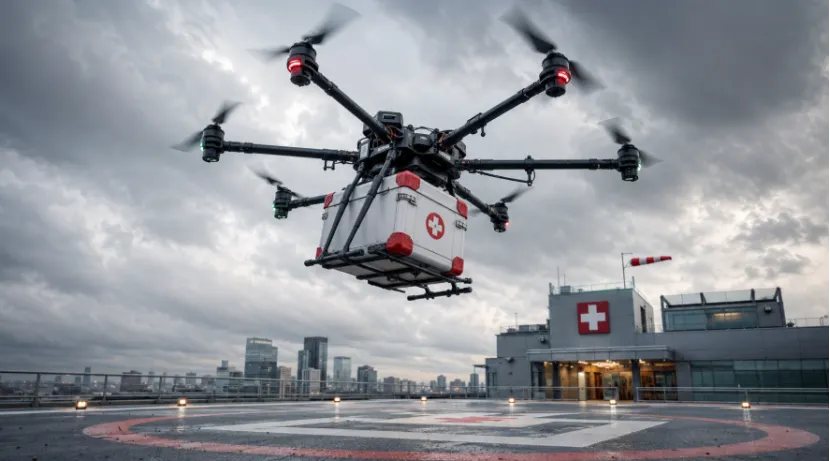
A medical drone battery is not judged only by how far it can fly on a clean test route. In real medical drone delivery, the aircraft may carry blood samples, medicines, vaccines, or diagnostic materials. It may also face wind, route changes, a delayed landing zone, or extra hover time near a clinic. That is where battery voltage sag becomes a serious issue.
Battery voltage sag refers to a temporary drop in battery voltage when the power system experiences high current demand. The battery may still show remaining capacity, but the aircraft feels less stable under load. For a drone delivery battery, that gap between “remaining power” and “usable power” can decide whether the mission finishes safely.
Why Did Battery Voltage Sag Put the Medical Drone Mission at Risk?
A medical delivery route often looks simple on paper. The distance is fixed, the cargo is packed, and the drone has a planned takeoff and landing point. Yet the hardest load usually appears early, during takeoff and climbing. The drone is heavy, the motors draw strong current, and the battery pack has to respond at once.
Takeoff and Climbing Created the First Warning
In this case, the warning came during launch. The aircraft lifted with a medical cargo box and started climbing, then the voltage dropped faster than expected. This was not a full power loss. The issue was less obvious than a complete power failure but still reduced the available safety. The system still worked, but the safe battery reserve became thinner before the drone had even reached cruise height.
That is a common problem when a medical delivery drone battery is selected mainly by rated capacity. A large mAh number can look good, but if discharge stability is weak, drone battery voltage drop under load still appears. A stable discharge drone battery must hold output during takeoff, climbing, cruising, landing, and return planning.
What Made the Battery Problem More Serious?
Medical cargo changes the standard. A retail parcel can often tolerate a delay. A lab sample or temperature-sensitive medicine is less forgiving. The aircraft does not only need to arrive. It needs enough power left for approach, cargo handoff, possible waiting, and a clean return plan.
Payload Weight Reduced the Real Flight Margin
The payload was not huge by industrial drone standards, but it was enough to change the power curve. A cold chain box, protection foam, test tubes, and landing hardware all add weight. Small items add up. Field teams know this part well, even if spec sheets sometimes hide it.
A payload drone battery must be chosen for real mission weight, not empty-frame flight time. That means route distance, cargo weight, weather, voltage platform, and safe battery reserve should be checked together. For medical drone delivery, speed matters, but battery reliability matters more when the route has no room for a failed landing.
Wind and Hover Time Increased Current Demand
The drone also met light headwind on the return side of the route. It was not dramatic weather. Still, wind correction pushed the motors harder. A short hover near the landing point added another power demand. This is where battery voltage sag during takeoff can become a full-route concern.
A reliable drone battery pack should not only perform well for the first few minutes. It should give predictable output near the end of the route too, when the pilot or control system needs clear battery data.
How Was the Appropriate Battery Configuration Selected?
The team did not solve the issue by simply adding a heavier battery. That would have increased takeoff weight and may have created another problem. The better answer was to review the whole power match: voltage platform, discharge rate, energy density, cell consistency, and battery pack layout.
High Energy Density Gave More Useful Flight Time
A high energy density UAV battery helps when the aircraft needs more usable energy without adding too much pack weight. For medical routes, this is useful because each gram saved can support cargo, reserve, or safer route planning.
Battery suppliers in the industrial UAV sector offer a range of energy-density and discharge-performance options to accommodate different mission requirements. Shengya Electronic is one example of a manufacturer providing multiple battery configurations for such applications.
Higher Discharge Capability Helped Reduce Voltage Sag
A high rate UAV battery matters during takeoff, climbing, wind correction, and urgent maneuvering. In a medical route, these moments are not rare. They are part of normal work. A battery with stronger discharge capability can reduce the risk of battery voltage sag when the drone asks for quick power.
Cell consistency also matters. If one cell group falls faster than the rest, the whole pack becomes less predictable. For repeat medical flights, UAV battery consistency is just as important as peak capacity.
Where Does Shengya Electronic Fit into Medical Drone Battery Projects?
Shengya Electronic is a specialist UAV battery manufacturer focused on high energy density drone battery solutions, solid-state lithium-ion soft-pack cells, and battery packs for industrial drone applications.
Its catalog covers multiple energy density levels and common voltage combinations such as 6S, 7S, 12S, 14S, and 18S. For buyers working on healthcare logistics, this range is useful because medical drone battery selection is rarely one-size-fits-all.
What makes Shengya Electronic practical is not only the product list. The company supports battery pack matching around combination method, wire outlet position, plug type, and project needs. For a custom UAV battery pack, these small details can affect installation, maintenance, and flight safety. That is very real work, not just a catalog choice.
What Should You Check Before Choosing a Drone Delivery Battery?
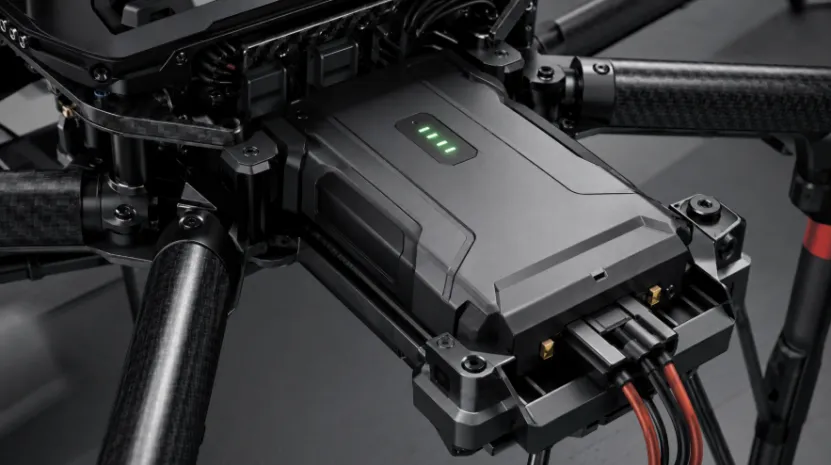
A drone delivery battery for healthcare logistics should be checked against the full mission, not only the advertised flight time. Start with payload weight, route distance, wind risk, return policy, battery compartment size, connector type, and expected discharge demand.
Battery Selection Should Be Based on Mission Requirements
For long routes, a long endurance drone battery or high energy density UAV battery may be the better direction. For heavier takeoff, fast climbing, or emergency response, a high rate UAV battery may be safer. For complex aircraft design, a custom UAV battery pack for medical drones can reduce installation trouble and improve repeat use.
Battery voltage sag is not just a technical phrase. It is the warning sign that the aircraft may not have the power margin you thought it had. A good medical drone battery keeps the aircraft stable when the route gets a little messy, because real-world operating conditions rarely remain ideal throughout an entire mission.
FAQ
Q1: What Causes Battery Voltage Sag in a Medical Delivery Drone?
A: Battery voltage sag often appears when the drone needs high current during takeoff, climbing, wind correction, or heavy payload flight. Weak discharge capability, high internal resistance, cold conditions, or poor cell consistency can make the voltage drop faster.
Q2: Is a Higher mAh Battery Always Better for Medical Drone Delivery?
A: No. A higher mAh number does not always mean better mission safety. You also need to check energy density, discharge rate, voltage platform, battery weight, and stable output under real payload conditions.
Q3: Why Does a Medical Drone Need Safe Battery Reserve?
A: Safe battery reserve gives the aircraft enough power for landing, hover time, cargo handoff, route changes, delayed reception, and return planning. Medical drone delivery cannot rely on a battery that only barely reaches the destination.
Q4: What Is the Difference Between a High Energy Density UAV Battery and a High Rate UAV Battery?
A: A high energy density UAV battery supports longer useful flight time with lower weight. A high rate UAV battery gives stronger output during high-current moments such as takeoff, climbing, and wind correction.
Q5: Can Shengya Electronic Support Custom UAV Battery Pack Projects?
A: Yes. Shengya Electronic offers multiple UAV battery series and supports project matching for voltage platform, pack structure, connector type, wire outlet position, and mission needs. This is helpful for medical drones that need a reliable battery pack rather than a general-purpose pack.


