A commercial UAV battery may cost a few hundred dollars; a high-energy semi-solid pack can exceed $1,000. One 2026 industrial UAV price guide lists semi-solid packs at roughly $500 to $1,500+ each. Treat this as a planning reference, not a quote. Capacity, voltage, energy density, discharge rate, pack design, and order size affect the solid state UAV battery price.
Check cell chemistry before comparing offers. Some products marketed as solid-state are semi-solid. Ask which electrolyte the cell uses; the label alone is not enough.
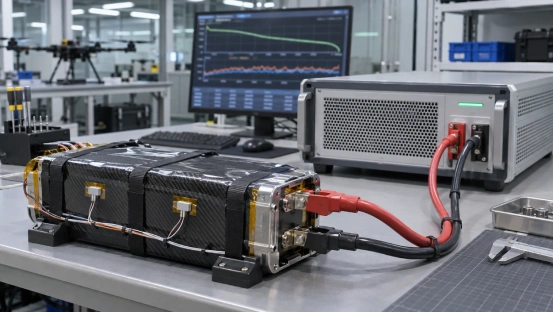
How Much Does a Solid-State UAV Battery Cost in 2026?
The solid state drone battery cost depends on the complete pack, not just the cell. A compact 6S pack and a high-capacity 12S pack store different amounts of energy.
Typical Price Range for Commercial Packs
A broad planning range for semi-solid industrial UAV batteries is about $500 to $1,500+ per pack. Higher capacity, energy density, discharge requirements, and custom electronics can raise the price. Compare the semi solid state drone battery price with rated Wh, pack weight, discharge capability, and included components.
Does a 6S or 12S Configuration Change the Price?
The 6S solid state drone battery price is not set by series count alone. Capacity, cell type, current rating, and pack construction matter too. The same applies to the 12S solid state drone battery price. Compare total energy in Wh, not mAh alone.
What Determines the Solid State Drone Battery Cost?
Two packs with the same mAh rating can have different prices and usable energy. Check the details that affect performance in your aircraft.
Capacity, Voltage, and Usable Energy
Capacity is listed in mAh or Ah; energy is measured in watt-hours. Use Energy (Wh) = Nominal Voltage (V) × Capacity (Ah). A 30,000mAh pack equals 30Ah, but total energy depends on voltage. Keep a landing reserve for wind, payload changes, and battery aging.
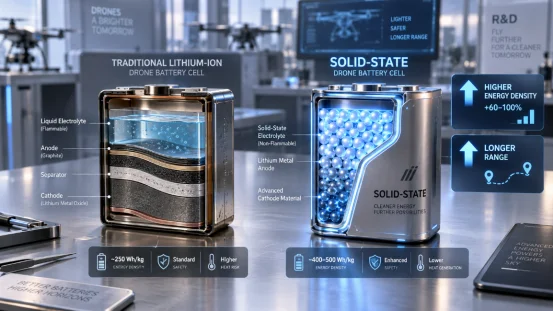
Energy Density and Cell Chemistry
A high energy density UAV battery can reduce pack weight or leave more weight for cameras, sensors, or cargo. But a higher Wh/kg figure does not guarantee better flight performance. Ask whether the figure applies to the cell or complete pack.
Discharge Rate, BMS, and Testing
Check continuous and peak discharge ratings separately. Current (A) = Capacity (Ah) × C-rate. A 20Ah pack rated at 10C has a theoretical 200A peak, but only for the stated pulse duration and test conditions. Ask for discharge curves, voltage sag, temperature records, and BMS limits. Confirm whether the BMS is included and whether CAN, RS485, or UART communication is needed.
Certification and Customization
A custom enclosure, connector, wiring layout, or BMS adds engineering and testing costs. For international shipping, ask for UN38.3, MSDS, and packing documents, then check destination requirements.
How Do Semi-Solid and Traditional LiPo Batteries Compare?
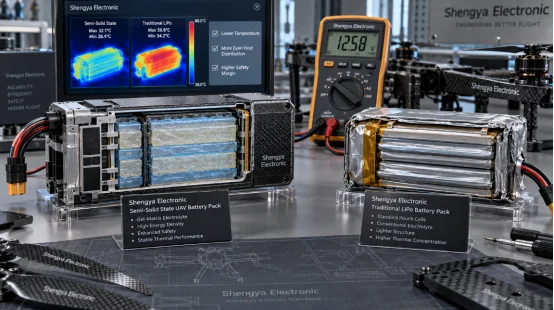
The better choice depends on aircraft power demand. Semi-solid designs can offer higher energy density for missions where flight time or payload weight matters. Traditional LiPo packs may suit aircraft that need very high discharge rates. Neither chemistry wins every mission.
What Matters Beyond Energy Density?
Check continuous discharge, peak current, internal resistance, and thermal behavior. A heavy-lift drone may need strong bursts during takeoff, not simply the highest Wh/kg figure. Compare batteries on the same aircraft, payload, route, and weather. Record flight time, current, lowest loaded voltage, pack temperature, and landing reserve.
How Do You Calculate the Solid State Drone Battery Price per Wh?
The solid state drone battery price per Wh helps compare packs with different voltage and capacity. It is a useful first check, but it does not include usable energy, cycle life, or charger costs.
Use Watt-Hours, Not mAh Alone
Divide the quoted price by nominal watt-hours:
Price per Wh = Battery Price ÷ (Nominal Voltage × Capacity in Ah)
A 7S, 25.2V, 35Ah pack stores about 882Wh before reserve. At a hypothetical $900 quote, the cost is about $1.02 per Wh. This is a calculation example, not a product quotation. See this drone battery capacity guide for more on mAh, Wh, and flight energy.
Calculate Cost per Flight Hour
For fleet planning, divide the battery price by expected usable cycles and average flight hours per cycle. Cycle life only has value when depth of discharge, charge rate, temperature, and end-of-life capacity are clear.
What Should You Include in a Solid State UAV Battery Wholesale Quote?
When sourcing solid state UAV battery wholesale quantities, request comparable quotations, not just a price per piece.
Confirm the Order Structure
Ask for sample pricing, MOQ, volume tiers, lead time, warranty, and replacement terms. Check whether the quote includes BMS, charger, connectors, cables, packaging, testing, and shipping documents.
Prepare a Complete RFQ
Include your UAV application, voltage, capacity, required Wh, maximum dimensions, weight limit, continuous and peak current, connector, BMS protocol, operating temperature, quantity, and destination. Add a drawing or photo of the battery bay.
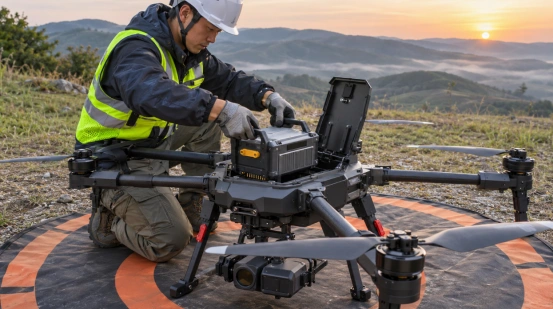
How Can You Choose a Custom UAV Battery Manufacturer?
A custom UAV battery manufacturer should discuss more than capacity and price. Ask how the supplier checks cell matching, insulation, connector temperature, voltage under load, and BMS protection. Request sample test records and agree on acceptance limits before a bulk order.
Confirm how design changes are handled. A different connector, cell lot, or BMS setting can affect aircraft integration. Keep the approved drawing and electrical specification with the purchase order.
What Makes Up the Total Industrial Drone Battery Cost?
The industrial drone battery cost includes chargers, spare packs, freight, import charges, inspection, storage, and replacement. A pack that cannot finish the route may require another landing, a battery swap, or a second aircraft.
Compare cost per completed mission. A higher-energy pack may justify a higher initial price if it removes a battery change or lets the crew finish a route in one flight. Confirm the benefit with flight logs.
Where Can You Find a UAV Battery That Fits Your Aircraft and Budget?
After comparing price per Wh and checking current demand, match your requirements with a supplier’s product range. A useful quote should state cell type, pack-level energy density, discharge limits, BMS scope, test conditions, and shipping documents.
A Practical Option for High-Energy-Density UAV Packs
Shengya Electronic lists UAV battery series from 190 to 350 Wh/kg, including a high-rate 25C range and a 4.35V high-voltage series. Its catalog covers 6S, 7S, 12S, 14S, and selected 18S configurations. One 35,000mAh semi-solid pack uses a composite solid electrolyte and high-nickel cathode, with stated energy density of 300–350 Wh/kg. The product page lists 800 or more cycles; ask for test conditions before using this figure in a cost model.
Voltage, capacity, size, interface, structure, and BMS options can be customized. The standard pack does not include a BMS, but CAN, RS485, and UART options are available by request. Samples are listed at 7–10 days depending on design. Shipping support includes UN38.3, MSDS, and packing documents. Review the 310 Series UAV battery or contact Shengya Electronic with your aircraft specifications for a quote.
FAQ
Q1: How Much Does a Solid-State UAV Battery Cost?
A: A published 2026 guide lists semi-solid industrial UAV packs at roughly $500 to $1,500+ each. Final pricing depends on capacity, voltage, energy density, discharge rate, customization, and order quantity.
Q2: Is a Semi-Solid UAV Battery the Same as a Fully Solid-State Battery?
A: No. A semi-solid battery uses a gel or composite electrolyte that may retain a liquid component. Ask for the cell chemistry and electrolyte details.
Q3: Does a 12S Battery Always Cost More Than a 6S Battery?
A: Not always. Voltage, capacity, cell type, current rating, and pack design all affect price. Compare total Wh and required performance.
Q4: How Should You Compare Solid-State UAV Battery Prices?
A: Compare price per Wh, usable energy, pack weight, discharge performance, cycle-life test conditions, BMS features, shipping documents, and warranty terms.
Q5: What Information Is Needed for a Bulk UAV Battery Quote?
A: Provide voltage, capacity, current requirements, dimensions, weight limit, connector, BMS protocol, application, quantity, and destination. Include a drawing or sample if available.