
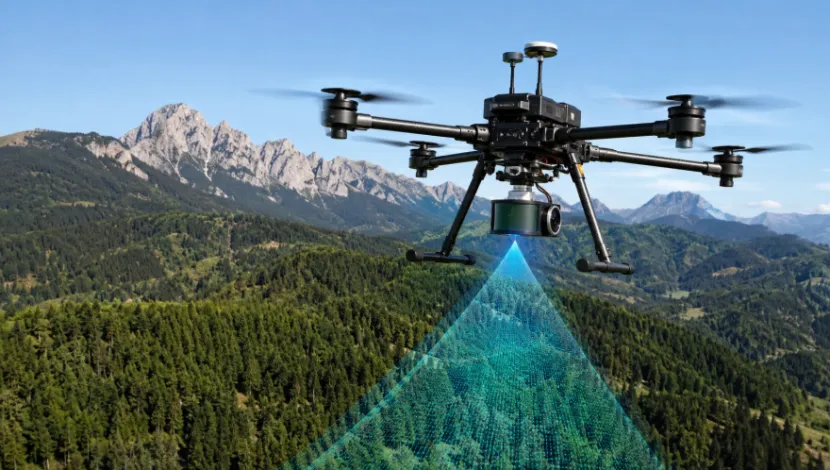
A LiDAR mapping drone can carry a lot more than a camera. A normal survey setup may include a LiDAR sensor, GNSS module, IMU, vibration mount, cables, and sometimes a small mapping camera. None of these parts are decorative. If you remove one just to save weight, the data may suffer.
This is why a LiDAR drone battery becomes such an important choice. In a real survey job, you may need to finish a long road section, a mining area, or a forest block without stopping every few minutes for a battery swap. The issue is not only flight time. It is how much useful flight time the drone can keep while carrying the full payload.
Why Did the LiDAR Mapping Drone Lose Flight Time So Quickly?
A survey team may plan the route carefully and still see shorter flight time after adding LiDAR. That is normal. Payload changes the whole power demand of the aircraft. The drone must lift more weight, hold position more steadily, and keep enough energy for return.
The Payload Was Necessary, But It Changed the Power Demand
LiDAR equipment is heavy compared with a simple camera payload. More weight means the motors need more current, especially during takeoff, climbing, and turns. This is where drone battery life vs payload weight becomes a real project issue.
A payload drone battery cannot be selected only by capacity. A bigger pack may look helpful, but if it adds too much weight, the gain becomes smaller than expected. You may see this in the field: the drone takes off fine, but the planned route still feels tight. The pilot starts watching the battery screen more than the map, which is never a good sign.
Why Couldn’t the Team Simply Reduce Payload Weight?
For LiDAR work, reducing payload is often the wrong shortcut. The sensor package affects point cloud density, position accuracy, and data consistency. A lighter setup may save a few hundred grams, but it may also create gaps that require another flight.
LiDAR Data Quality Depends on the Full Sensor Setup
A UAV battery for LiDAR mapping should support the full survey system, not force the team to remove key parts. If the GNSS, IMU, or stabilizing mount is removed or downgraded, the drone may fly longer but deliver weaker data.
For survey companies, that trade-off is risky. One repeat visit to a remote road, mine site, or mountain slope can cost more than a better battery choice. The cost of repeating a survey mission can quickly exceed the cost savings gained from reducing payload weight..
How Did a High Energy Density UAV Battery Help?
The practical answer was not to add the largest battery available. The team needed a high energy density UAV battery that gave more usable energy without pushing the aircraft weight too high. This is the key difference between more capacity and better energy-to-weight balance.
More Energy Without Unnecessary Battery Weight
A long endurance drone battery should help the drone stay in the air with its full LiDAR payload. In this type of work, useful flight time matters more than lab-style maximum flight time.
Shengya Electronic offers UAV battery options for industrial drone projects through its product range, including 190Wh/kg high rate 25C series, 270Wh/kg high voltage 4.35V series, and high energy density series such as 275Wh/kg, 310Wh/kg, 330Wh/kg, 340Wh/kg, and 350Wh/kg. These choices give drone builders and survey teams more room to match battery weight, voltage, capacity, and mission length.
Fewer Battery Swaps Improved the Mapping Workflow
After switching battery direction, the mapping workflow became smoother. The value was not only a few more minutes in the air. It was fewer breaks, fewer return trips, and more continuous route coverage.
For a road survey, that means fewer broken flight lines. For mining operations, it helps reduce downtime caused by frequent battery replacement. A long flight time drone battery for LiDAR payload can help a crew finish more area in one working window.

What Should You Check Before Choosing a LiDAR Drone Battery?
A mapping drone battery should be selected by mission data, not by a single product number. You need to look at the aircraft, payload, route, voltage platform, and battery bay together. There is no magic pack that fits every survey job.
Compare Weight, Wh/kg, Voltage, and Discharge Demand
Before choosing a drone battery for surveying, check total takeoff weight first. Then compare Wh/kg, voltage platform, C rating, connector type, cable direction, and pack size. A high energy density drone battery for long-range mapping can help, but only when it fits the aircraft properly.
For industrial drone projects, battery selection often requires balancing endurance, payload capacity, and power output. Shengya Electronic provides UAV battery solutions designed to support these requirements across different mission profiles. Its catalog includes 6S, 7S, 12S, 14S, and 18S options, which matters for different power systems. For specialized survey drones, a custom UAV battery pack can also help match the battery compartment, plug type, wire outlet position, and center-of-gravity needs.
How Does Shengya Electronic Support Long-Endurance LiDAR Drone Projects?
LiDAR mapping is not a casual flying task. It needs steady power, repeatable performance, and a battery design that fits the drone body without making field service annoying.
Battery Matching Should Start With the Mission
Shengya Electronic supports industrial UAV battery projects with semi-solid and solid-state lithium-ion battery solutions. For LiDAR mapping, this matters because your drone may need a long endurance UAV battery for route coverage, or a high rate UAV battery for stronger current during takeoff and climbing.
A good LiDAR drone battery supplier should not only sell a pack. It should help match pack structure, energy density, voltage, weight, and real working conditions. That is where Shengya Electronic fits naturally into mapping, surveying, inspection, and other industrial drone applications.
FAQ
Q1: Why Does a LiDAR Drone Need a Special Battery?
A: A LiDAR drone carries heavier sensors than a basic camera drone. A suitable LiDAR drone battery must support stable flight, long routes, and enough return reserve.
Q2: Can a Bigger Battery Always Extend LiDAR Drone Flight Time?
A: No. A bigger battery may add too much weight. You should compare drone battery life vs payload weight before choosing the pack.
Q3: Why Is High Energy Density Important for LiDAR Mapping?
A: A high energy density UAV battery gives more usable energy for its weight. This helps the drone keep the full LiDAR payload while improving flight time.
Q4: What Should Survey Teams Check Before Buying a Battery?
A: Check total takeoff weight, LiDAR payload, route length, voltage platform, battery compartment size, connector type, and safe return reserve.
Q5: Can Shengya Electronic Support Custom UAV Battery Pack Projects?
A: Yes. Shengya Electronic offers multiple UAV battery series and can support custom UAV battery pack needs for voltage platform, pack layout, connector type, wire outlet position, and mission matching.


