
A UAV battery replacement can restore lost endurance, and the right UAV battery upgrade may extend UAV flight time. However, a higher-capacity drone battery does not automatically result in longer flight time. Your result depends on usable energy, added weight, discharge current, voltage, connector, UAV battery BMS, and flight-controller settings. Battery selection should be based on the aircraft system, not just the mAh rating. A suitable option may be found in a UAV battery product range, but each option still requires a system-level check.
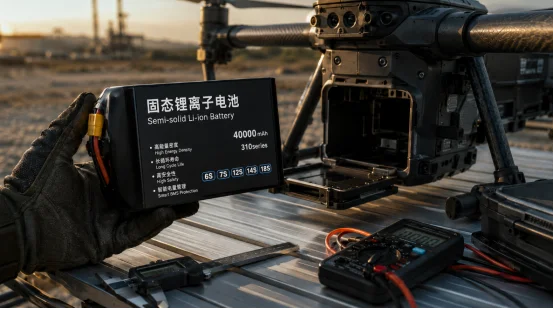
Can a UAV Battery Upgrade Extend UAV Flight Time?
Yes, when the new pack adds more usable watt-hours than the extra weight consumes. This is common in open industrial platforms, mapping aircraft, agricultural drones, and custom multirotors. A closed consumer drone may reject a third-party pack because its smart-battery protocol, housing, or firmware is proprietary.
Higher Capacity Is Only One Part
Compare watt-hours (Wh), not just mAh:
Battery energy (Wh) = nominal voltage (V) × capacity (Ah)
A 6S 16Ah pack stores about 355Wh. A 6S 22Ah pack stores about 488Wh. That looks like a 37% gain, but the aircraft will draw more power if the new pack is heavier. This is where many drone battery upgrade projects fail to deliver expected results.
Weight Changes the Whole Flight
Extra mass raises hover throttle, motor temperature, and current draw. It also reduces payload allowance. The exact penalty depends on aircraft size, propellers, motor efficiency, and flight mode. A small increase may appear insignificant during bench testing, then cost several useful minutes once the drone carries its normal payload.
Which Battery Checks Matter Before Replacement?
UAV battery compatibility is a chain. One weak link can cause early landing, power loss, hot wiring, or a damaged ESC. The connector fitting into the socket is not proof of compatibility. This is often overlooked but critically important.
Check Voltage, Cell Count, and Current
Match UAV battery voltage, cell count, full-charge voltage, and polarity. A 6S pack is not interchangeable with a 12S pack. Then check continuous and peak current:
Maximum current (theoretical) = capacity (Ah) × C-rating
A 20Ah 10C battery is rated at 200A in theory. Use verified pack data because real performance also depends on cell temperature, wiring, internal resistance, and voltage sag.
Check Size, Weight, BMS, and Charger
Measure the battery bay, cable exit, mount, and center of gravity. Confirm maximum takeoff weight. The battery management system (BMS) should support cell balancing, overvoltage, overcurrent, short-circuit, and temperature protection. Smart systems may also need CAN, UART, or another communication protocol. Your charger must match the chemistry and maximum voltage.
How Much Flight Time Can a Battery Upgrade Add?
You can estimate the result before ordering a custom UAV battery pack. The estimate will not be perfect, yet it quickly shows whether the project has room to work.
Use Usable Energy and Average Power
Estimated flight time = usable Wh ÷ average flight power × 60
Suppose the 355Wh pack uses 80% of its energy and the drone averages 700W. Estimated time is about 24 minutes. If the 488Wh pack raises average power to 800W, estimated time becomes about 29 minutes, not 33. Real testing should keep a safe return reserve and record peak current, voltage sag, pack temperature, and motor temperature.
Test in Small Steps
Begin with a ground load test. Follow with a low hover, a short unloaded route, partial payload, then the intended mission. Stop if cell imbalance grows, voltage falls sharply, the connector heats up, or the flight controller reports the wrong state of charge. A successful battery replacement requires data logging rather than guesswork.
Which Battery Chemistry Fits Your UAV?
Chemistry changes the balance among power, weight, service life, cold-weather behavior, and price. Pick for the mission. Racing-style bursts and two-hour inspection routes do not ask the same thing from a battery.
Compare LiPo, Li-ion, and Semi-Solid-State Options
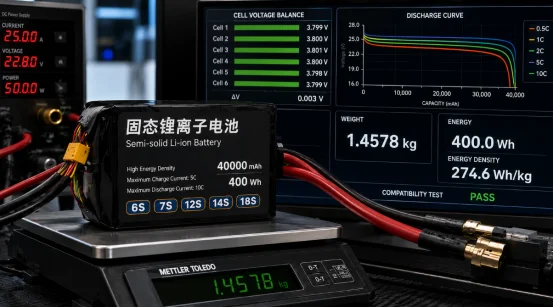
A LiPo drone battery replacement suits high-current work where power matters more than maximum energy density. A Li-ion drone battery often suits steady cruising, provided its peak output covers takeoff and climbing. A semi-solid-state UAV battery may offer higher UAV battery energy density for industrial endurance. Supplier-reported data in the referenced analysis lists 350 to 400Wh/kg and 800 to 1,000 cycles for some semi-solid designs, but those figures are not universal. Ask for pack-level test conditions.
A solid-state drone battery may sound attractive, though product labels are not always technically consistent. Request the electrolyte type, pack-level Wh/kg, discharge rate, cycle-retention condition, and safety test report. For high-current missions, a lower-energy high-rate battery series can be a better fit than a high-energy-density UAV battery with limited peak output.
When Should You Replace Rather Than Upgrade?
Not every aircraft needs more capacity. Sometimes the safest and cheapest answer is a like-for-like UAV battery replacement. This approach also simplifies certification, software compatibility, and payload calculations.
Replace an Aging Pack
Choose standard drone battery replacement when flight time has fallen, cells drift apart, internal resistance rises, or the pack swells, leaks, or heats abnormally. Remove a damaged lithium pack from service. Do not attempt to open or repair it unless handled by qualified battery technicians.
Upgrade Only with Clearly Defined Requirements
Define the payload, target time, operating temperature, peak current, voltage platform, and battery-bay limits. Then compare the UAV battery replacement cost with a power-system redesign or a new aircraft. For a working fleet, UAV battery total cost of ownership also includes cycle life, charging time, spare-pack count, downtime, and failed missions.
Why Consider Shengya Electronic for UAV Battery Replacement?
A capable UAV battery manufacturer should offer more than a large capacity number. Shengya Electronic supplies soft-pack lithium-ion cells and battery packs across high-rate and high-energy product families. Its official catalog covers 190Wh/kg high-rate 25C packs and several energy-density series reaching 350Wh/kg, with configurations that include 6S, 7S, 12S, 14S, and 18S on selected models.
The company also describes customization of pack combinations, wire position, plug type, and labeling. That range is useful when an industrial UAV battery replacement needs a specific voltage, enclosure fit, or discharge profile rather than an off-the-shelf pack. You can review Shengya Electronic when comparing an industrial UAV battery supplier for logistics, agriculture, inspection, rescue, or other long-endurance UAV battery projects.
FAQ
Q1: Can I use a higher-capacity battery in my drone?
A: Yes, if voltage, current, dimensions, weight, connector, BMS, charger, and flight-control communication all match.
Q2: Will a bigger battery increase drone flight time?
A: It can, but added weight increases power consumption.Compare usable Wh and estimated average power before buying.
Q3: Can I replace a LiPo drone battery with Li-ion?
A: Sometimes. Check peak current, voltage sag, charger settings, weight, and low-voltage limits first.
Q4: What C-rating does my UAV battery need?
A: It must cover continuous flight current and short peak loads with a practical safety margin supported by test data.
Q5: How often should a UAV battery be replaced?
A: Replace it when capacity, cell balance, internal resistance, temperature, swelling, or BMS warnings cross your fleet’s retirement limits.


