
A drone battery connector is the electrical and mechanical interface between the battery pack and the aircraft power system. It carries continuous current during cruise, peak current during takeoff, and sometimes BMS or temperature signals.
A UAV battery connector therefore affects voltage stability, heat, maintenance, and flight safety. Selecting a high-current drone connector requires more than matching two plug shapes. Your review should cover electrical ratings, contact construction, locking strength, cable size, and operating environment. Available UAV battery products show the range of capacity and series configurations.
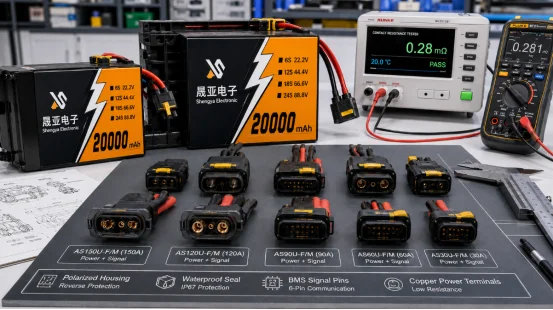
What Is a Drone Battery Connector?
The connector forms a removable path between stored energy and the electronic speed controllers, motors, flight controller, and auxiliary equipment. A drone power connector mainly carries current, while an integrated interface may include signal pins. Drone battery plug usually refers to the removable plug body, whereas connector refers to the complete mating system.
Power and Signal Paths
A basic lithium battery connector contains positive and negative terminals. A smart battery may add communication, identification, balancing, or temperature contacts. This explains how a drone battery connector works: spring pressure holds conductive surfaces together, current passes through the main terminals, and smaller pins exchange data.
Housing, Contacts, and Locking
The main parts are the insulating housing, conductive pins, cable termination, and drone battery connector locking mechanism. The housing controls polarity and insulation. Copper-alloy contacts carry current. A latch prevents separation during vibration and landing impact.
Why Is the Connector Critical to Flight Safety?
A UAV power connector sits at a critical point in the power chain. A small defect can affect the entire propulsion system. A loose terminal may pass a bench check, then heat rapidly when all motors draw current during a loaded climb.
Current Transfer and Heat
Connector power loss follows the formula P = I²R. As current rises, a small increase in drone battery connector contact resistance produces much more heat. Oxidation, weak contact pressure, poor soldering, or wear can cause drone battery connector overheating, voltage drop, softened housing, and burned connector contacts.
Vibration and Polarity Control
A polarized shell reduces reverse connection risk. Secure retention protects against brief disconnection, which can reset electronic equipment or stop propulsion even when the battery still holds energy.
Which Specifications Matter Most?
Connector ratings depend on test conditions. Ambient temperature, wire size, airflow, terminal condition, and test duration can change the result. Specifications should therefore be read as a system.
Current, Voltage, and Thermal Margin
The drone battery connector current rating should exceed the continuous load with suitable margin. Peak demand during takeoff, gust response, or heavy-payload operation must remain within the short-duration limit. The drone battery connector voltage rating should exceed the pack’s full-charge voltage.
Drone battery connector temperature rise is a practical indicator. A high-current battery connector that stays within an acceptable range under realistic load is more useful than a part rated under favorable laboratory conditions.
Wire Size and Service Life
The drone battery connector wire gauge must match the terminal range and cable capacity. An oversized cable forced into a small terminal can produce a poor joint; an undersized cable becomes the thermal weak point. Drone battery connector mating cycles also matter in fleets that replace packs many times each day.
What Drone Connector Types Are Available?
Different drone connector types serve different voltage, current, packaging, and environmental needs. Selection should follow the aircraft duty cycle.
High-Current and Anti-Spark Designs
Two-pole connectors suit straightforward power transfer. Integrated designs combine power and signal contacts. An anti-spark drone connector includes a pre-charge path that limits inrush current before the main terminals engage. This feature becomes more relevant as battery voltage and capacitance rise.
Sealed and Smart Designs
A waterproof drone connector may use seals, protected terminals, and positive locking for agricultural, maritime, or high-humidity work. Smart interfaces can combine main contacts with BMS communication. Their value depends on pin alignment, protocol compatibility, and mechanical guidance.
How Should a Drone Battery Connector Be Selected?
A reliable drone battery connector selection process starts with a full analysis of aircraft load and ends with validated testing. The best connector for high-power drones is not defined by size alone. It must fit the electrical, mechanical, and environmental limits of your platform.
Electrical Matching
Your calculation should include motor current, controller limits, avionics load, continuous demand, peak demand, battery series count, and full-charge voltage. Current derating becomes important in hot weather or closed battery bays. These factors form the electrical basis of UAV battery connector selection.
Mechanical and Environmental Matching
How to choose a drone battery connector also depends on space, cable outlet direction, polarity, latch access, insertion force, vibration, moisture, dust, and chemical exposure. Your plug should mate without side loading. Cable strain relief should keep wire force away from the terminal.
Supplier and Test Verification
Useful evidence includes contact-resistance measurements, loaded temperature-rise results, pull tests, vibration tests, and insertion-cycle data. For larger orders, a battery supplier checklist connects plug requirements with S count, discharge rate, dimensions, outlet position, and quality records.
What Causes Connector Failure?
Most connector failures result from heat, contamination, or mechanical wear. A loose contact can oxidize, causing resistance to rise, and repeated high-current use accelerates the damage.
Heat, Arcing, and Contamination
Arcing can pit terminal surfaces, especially when a high-voltage pack is connected under load. Dust, farm spray, moisture, and sand can obstruct contact or promote corrosion. Guidance on how to prevent drone connector overheating includes suitable current margin, clean contacts, correct wire sizing, secure joints, and temperature checks.
Visible Warning Signs
Black marks, green corrosion, bent pins, melted insulation, weak retention, or abnormal heat indicate a connector problem. Charging faults may also result from damaged contacts, BMS protection, or temperature limits, as described in this drone battery charging guide.
When Should a Connector Be Replaced?
Drone battery connector replacement becomes necessary when the housing deforms, contacts burn, retention weakens, cables crack near the terminal, or resistance exceeds the accepted limit. Intermittent continuity rules out a return to flight service. Both mating halves need assessment after heat or arcing damage.
Inspection Before Return to Service
The repaired assembly should pass polarity, continuity, pull, resistance, and loaded temperature checks. Visual inspection alone is insufficient.
Why Does Battery-Pack Integration Matter as Much as Connector Choice?
Connector performance depends on the pack behind it. Voltage platform, discharge rate, cable size, outlet position, and thermal behavior should be specified together. This makes battery customization and production control directly relevant.
Shengya Electronic develops semi-solid and solid-state lithium-ion soft-pack cells and UAV battery packs. Its published range covers high-rate 25C options, energy-density series from 270 to 350Wh/kg, capacities from 10,000mAh to 78,000mAh, and configurations including 6S, 7S, 12S, 14S, and 18S.
The company states that pack combinations, cable outlet positions, plug types, shapes, and labels can be customized. This allows the battery, wire, plug, and aircraft bay to be treated as one assembly. Its official materials also identify cell grading, internal-resistance matching, aging tests, and outgoing inspection as relevant procurement checks.
FAQ
Q1: What connector is used for drone batteries?
A: The choice depends on current, full-charge voltage, space, locking needs, and environmental exposure.
Q2: Why does a drone battery connector become hot?
A: High current, increased contact resistance, loose terminals, poor joints, contamination, or undersized wire can create excessive heat.
Q3: Is an anti-spark drone connector necessary?
A: It is useful for higher-voltage and high-capacity systems where inrush current can damage the main contacts.
Q4: How often should connector condition be checked?
A: Inspection frequency should reflect mating cycles, environment, vibration, and load.
Q5: Can only one half of a burned connector be replaced?
A: Both mating surfaces should be assessed. Heat and arcing often damage the paired contact, even when one side appears less affected.


