
You prepare a dawn shot and lift off. Next, you frame the ridge. Suddenly, the low battery warning appears. That tiny alert can ruin a great session ten minutes too early. The best drones with camera and long battery life grant you extra time. You can tweak exposure or wait for drifting clouds. This allows for additional shooting passes without time pressure.
Battery numbers still require context. An aircraft rated for 40 minutes rarely achieves 40 minutes of effective filming. Takeoff, positioning, heavy gusts, freezing weather, and the trip back constantly drain power. For secure aerial photography, aim to land with 20 to 30 percent remaining.Avoid operating the battery to complete depletion. Also, browse drone power solutions. This shows exactly how energy density, pack layout, and specific application needs link together.
What Makes a Long Flight Camera Drone Worth Buying?
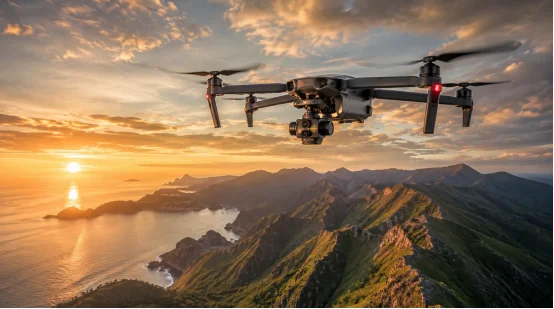
A long flight time drone with camera should balance usable endurance, camera quality, stable control, and safe recovery. A big battery alone can add weight, which makes the motors work harder. That is the awkward little tradeoff behind many impressive specification sheets.
Real World Flight Time
When comparing advertised vs real-world flight time, check how reviewers flew the aircraft. Calm hovering uses less energy than tracking a cyclist into a headwind. Cold weather can also cut drone battery life because lithium cells deliver power less freely at low temperatures.
A practical target is 30 to 40 minutes of advertised flight time for travel, property photography, and short landscape sessions. A longest flight time camera drone may claim more than 40 minutes, but the useful gain depends on payload, wind resistance, route length, and the battery reserve needed for return to home.
Camera and Flight Hardware
The best drone for aerial photography needs more than extended flight duration. Look for a larger camera sensor, RAW photo support, strong dynamic range, and a three-axis gimbal. A 4K drone with long battery life can suit most online video work, while higher resolutions provide greater flexibility for post-processing and cropping.
Obstacle avoidance matters near trees, roofs, and rock faces. Reliable transmission range also keeps the live view clear, though maximum range never replaces local visual line of sight rules. Intelligent flight modes can make repeatable paths easier, but subject tracking and fast flight usually draw more power.
Which Drone Type Fits Your Photography?
There is no useful winner for every pilot. The right choice changes with the job, the places you fly, and how much equipment you are happy to carry through an airport.
Travel and Beginner Use
The best travel drone with long battery life should fold small, handle normal coastal wind, and leave room in your bag for two batteries. Aircraft below common registration weight thresholds can be simpler to travel with, though rules differ by country.
For a first purchase, the best camera drone for beginners should have GPS, automatic return to home, simple controls, and obstacle avoidance. A flashy speed mode is less helpful when you are learning to judge distance. An affordable drone with long battery life may be a better buy if replacement props and extra drone batteries are easy to find. Looking through a broad battery product range also shows why capacity, voltage, and pack format need to be considered together.
Professional and Long Range Work
A professional photography drone needs better low light performance, color control, and steady power delivery. For mapping, large properties, or extended landscape work, a camera drone with the longest flight time can reduce battery swaps. Still, a best long-range camera drone must maintain a clean video feed and predictable return behavior. Range printed on a box is tested under controlled conditions, not beside office towers full of radio interference.
The best professional drone for aerial photography should also support a sensible battery system. Check charging time, cycle life, cold weather guidance, and the price of a second pack. Two healthy batteries often give you more working time than one oversized pack.
How Can You Extend Drone Battery Life?
Small habits make a visible difference. If you want to know how to extend drone battery life, start before takeoff. Charge the pack correctly, inspect it for swelling, and let a cold battery warm to its approved operating range.
Fly the outbound leg into the wind when possible, so the return trip gets help rather than resistance. Keep turns smooth, remove gear you do not need, and set a return threshold that suits the route. Landing at 25 percent can feel early when the light is perfect. It is still cheaper than searching a field for an aircraft that tried to stretch one last minute.
Store unused packs at the maker’s recommended charge level. Avoid leaving them full or empty for long periods. Battery aging matters too. A pack can show 100 percent on the screen while holding less energy than it did after its first few cycles.
Choosing a Better Power Match for Longer Flights
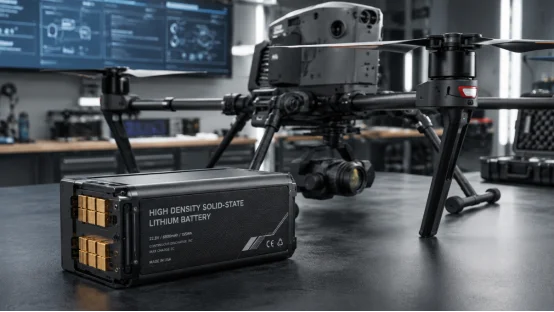
Camera performance depends on the power system carrying it. More energy per kilogram can extend endurance without forcing the aircraft to lift the same increase in battery mass. Pack voltage, discharge capability, connector choice, cable position, thermal behavior, and the aircraft’s current demand all need to match.
Shengya Electronic focuses on semi solid and solid state lithium ion pouch cells and battery packs for drones, unmanned aircraft, robotics, and specialist uses. Its official information lists energy density options from 270 to 340 Wh/kg in the company profile, along with a cycle life of 800 to 1,000 charge and discharge cycles. Its product portfolio includes listed series from 190 to 350 Wh/kg, capacities from 10,000 mAh to 78,000 mAh, and configurations such as 6S, 7S, 12S, 14S, and 18S.
Custom options cover pack configuration, cable exit position, plugs, and labeling. These capabilities are relevant when an aircraft designer needs a pack matched to payload, flight current, available space, and target endurance rather than a generic battery picked by capacity alone.
FAQ
Q1: Which drone has the longest battery life with a camera?
A: The drone with longest battery life is typically a bulkier camera aircraft. These models claim above 40 minutes. However, compare useful flight time, payload, and wind resistance. Always check the return reserve before buying.
Q2: How long do camera drone batteries last?
A: Numerous consumer camera drones advertise 25 to 45 minutes per pack. Yet, actual real world flight time is noticeably shorter. You must factor in takeoff, positioning, and wind. Filming and safe landings drain energy too.
Q3: Is a 30 minute flight enough for aerial photography?
A: Absolutely. Thirty minutes easily covers travel clips, property images, and planned landscape shots. Still, packing extra batteries helps immensely. They become essential when hitting multiple locations or attempting repeated takes.
Q4: What is the best budget drone with camera and long battery life?
A: The best budget drone with camera and long battery life delivers stable 4K footage and a mechanical gimbal. Look for GPS return, accessible spare parts, and honest battery support.Flight time should not be the only evaluation criterion.
Q5: How do you choose the best camera drones with long battery life?
A: Compare real endurance, sensor size, and gimbal quality. Evaluate obstacle sensing, transmission stability, battery cost, and local flight rules. Ultimately, the best drones with camera and long battery life keep enough power reserve. This safely returns both the aircraft and your footage.


