
A drone battery may seem simple until the drone is in operation. Then every choice starts to matter. A few hundred grams too much, a C-rate too low, a voltage configuration that does not match the power system, and the mission becomes shorter, hotter, or riskier than planned.
Good optimal drone battery selections start with the job, not the catalog page. A mapping drone, a spraying drone, a heavy-lift platform, and an FPV racing drone all ask different things from the pack. That is why a practical drone battery for different UAV applications should be evaluated based on flight time, payload, current draw, safety margin, and service life together.
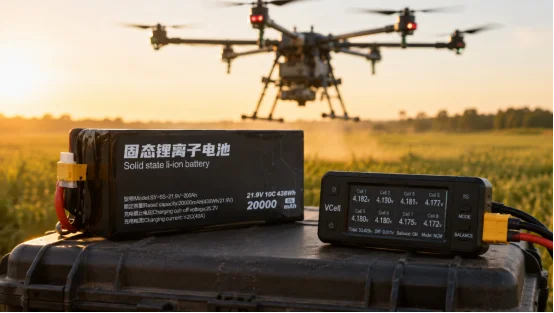
What Makes a Drone Battery Match Its Mission?
The right UAV battery is rarely the one with the biggest mAh number. That part trips up many buyers. More drone battery capacity can help, yes, but it also adds weight. Once the drone spends extra power lifting the battery itself, the gain may shrink fast.
Voltage, Capacity, and Real Current
Start with voltage configuration. A 6S drone battery, 12S drone battery, or 14S drone battery must fit the aircraft’s motor, ESC, and power distribution design. Wrong voltage is not a small mismatch. It can damage electronics or leave the drone underpowered.
Then look at watt-hours, not mAh alone. A 30000mAh pack at higher voltage stores more energy than the same capacity at lower voltage. For field teams comparing industrial drone battery options, Wh gives a cleaner picture of usable energy.
Current draw is the next check. If your drone pulls high current during climb, wind correction, spraying pump start-up, or payload lift, the pack must feed that demand without heavy voltage sag. A battery that looks fine on paper can feel weak in a real takeoff. This can lead to performance issues and increased operational costs.
C-rate and Energy Density
C-rate defines the maximum safe discharge rate of the battery. For example, a 30Ah pack rated at 10C can theoretically deliver 300A under rated conditions. A high-rate drone battery matters when you need sharp throttle response, fast climb, or stable power under load.
Energy density represents a different performance characteristic. A high energy density drone battery stores more energy per kilogram, usually shown as Wh/kg. This is valuable for long-endurance drones, mapping work, inspection routes, and any flight where battery weight quietly steals minutes from the mission.
Which Battery Fits Mapping, Spraying, Heavy-Lift, and FPV?
A battery choice should sound like the work it supports. Calm surveying flights need endurance. Spraying drones need stable discharge while pumps and payloads change. Heavy-lift drones need strong current with a wide safety margin. FPV racing cares about burst power and low weight more than gentle long cruising.
Mapping and Survey Flights
A mapping drone battery should favor energy density, stable voltage, and predictable discharge. These flights often cover large areas at steady speed. The priority is not high burst power output. It is stable and predictable flight endurance so the drone finishes the route without a rushed return.
For mapping and inspection, check how the battery behaves near the later part of discharge. Some packs drop voltage faster after the midpoint. That can shorten planned flight time, especially in cold or windy conditions.
Agricultural Spraying and Heavy-Lift Work
An agricultural spraying drone battery operates under more demanding conditions.It may carry liquid payload, run a pump, fight field wind, and repeat short cycles. Here, capacity alone is not enough. You need discharge strength, heat control, and a pack that tolerates repeated high-load use.
A heavy-lift drone battery follows the same logic, just with more pressure on current delivery. Look for a rated C-rate that covers takeoff and climb, not only cruising. Also check size and mounting. A pack that shifts during flight is bad news. This is a critical safety consideration.
FPV Racing and Fast Response
An FPV racing drone battery represents a distinct use case in engineering terms. Low internal resistance, high discharge ability, and low weight matter more than maximum flight minutes. If the battery cannot give quick power, the drone will exhibit reduced responsiveness out of corners and underperform during rapid throttle bursts.
For FPV, do not overbuy capacity just because it sounds safer. Extra grams can dull handling. A smaller high-rate pack often feels better than a larger pack with slow response.
How Should You Check Safety, Life, and Cost Before Buying?
The lowest price per pack can become the highest operating cost. If batteries swell early, charge slowly, run hot, or lose capacity after a short season, the fleet pays for it in downtime. Battery selection is part technical check, part procurement discipline.
Weight, Fit, and Connectors
Before ordering in bulk, confirm dimensions, connector type, cable position, and mounting method. A few millimeters can matter inside a compact bay. For larger UAVs, connector quality also affects heat and reliability.
Weight should be checked against the drone’s real payload plan. If the mission includes camera gear, spray liquid, sensors, or cargo, count everything. Small components are often overlooked but can significantly affect total payload weight.
Cycle Life, Smart BMS, and Field Testing
Drone battery safety depends on cell quality, pack design, charging practice, and protection systems. A smart BMS can help track voltage, current, temperature, balance status, and fault history. For fleet operators, that data is useful because weak packs can be removed before they cause trouble.
Cycle life also deserves attention. Some semi-solid state lithium-ion battery designs are built for longer service life and better safety behavior than older packs. Still, test before scaling. Run sample packs through your normal flight pattern, charging setup, storage routine, and weather conditions.
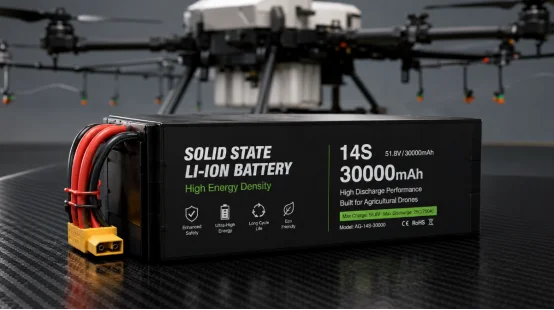
A Better Fit Between Battery Design and Real UAV Work
Once you know the mission profile, supplier capability becomes easier to judge. You are not just buying cells. You are buying the fit between chemistry, pack structure, discharge behavior, voltage range, and application support.
Shengya Electronic focuses on high-energy-density, high-rate, high-voltage, and high-safety solid-state lithium-ion batteries for industrial drones. Its UAV battery series covers 190Wh/kg high-rate 25C options, 270Wh/kg high-voltage 4.35V options, and high energy density ranges from 275Wh/kg up to 350Wh/kg.
Available configurations include 6S, 7S, 12S, 14S, and 18S across different capacity levels, which helps match batteries to mapping, spraying, heavy-lift, and long-range aircraft. Some product information also notes long cycle life, ultra-high capacity, and safety designs with needle puncture test performance on selected models.
FAQ
Q1: What Is the Most Important Spec When Choosing a UAV Battery?
A: Match the voltage first. Next, check the Wh, weight, C-rate, size, and connector. No single parameter can fully define battery performance.
Q2: Does Higher Drone Battery Capacity Always Mean Longer Flight Time?
A: Not every time. Extra capacity brings extra weight. This increases load on the propulsion system. Your actual flight time might only go up slightly.
Q3: When Should You Choose a High-Rate Drone Battery?
A: Pick it for heavy-lift setups, spraying, FPV racing, or quick climbs. Use it whenever your flight pulls massive power spikes.
Q4: Is a High Energy Density Drone Battery Better for Mapping?
A: Usually, yes. Mapping needs stable, long-duration power output. More Wh/kg lets your drone fly over wider areas without carrying a super heavy pack.
Q5: How Can You Improve Drone Battery Safety in Daily Use?
A: Always use the right charger. Try not to drain the cells dry. Watch the heat carefully. Finally, toss out any puffy or broken packs quickly.


