
Buying 100 or more batteries changes the decision completely. A consumer RC battery may work well for a hobby flight, yet the same pack can create serious trouble when your fleet flies every day, carries a payload, or operates across several teams.
For enterprise buyers, the real question is not only capacity or price. You need stable performance, repeatable production, clear test records, and a supplier that can adjust the pack to your airframe.
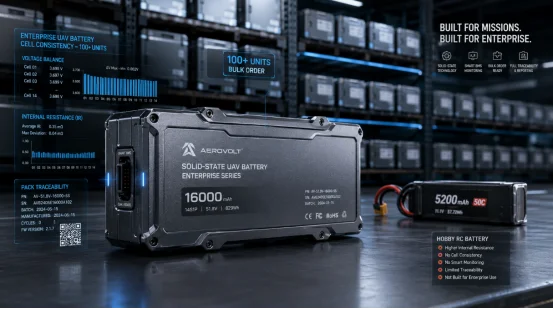
Why Does a Consumer RC Battery Fall Short for Enterprise UAV Work?
A consumer RC battery usually targets low upfront cost, light weight, and short operating cycles. An industrial UAV battery operates under significantly more demanding conditions. It must handle repeated high-current takeoff, vibration, temperature changes, and quick turnaround between missions.
The performance gap typically becomes evident after several weeks of operation rather than during initial test flights.
Discharge Behavior Under Load
During takeoff or heavy hovering, motors can pull a large current surge. If the pack has high internal resistance, the voltage falls sharply. This voltage sag can trigger an ESC alarm, reduce thrust, or cause an unexpected landing.
A pack that looks fine on a workbench may behave very differently in the air. Ask for discharge curves at the current your aircraft really uses, not only a headline C-rate.
Battery Cell Matching and Cycle Stability
Battery cell matching affects every pack in a batch. Cells with different voltage or internal resistance heat and age at different speeds. One weak cell can limit the usable capacity of the full series pack.
For an enterprise program, compare the supplier’s matching limits, incoming inspection method, and end-of-line test process. A consistent 12S pack is worth more than a cheaper pack with uneven results.
What Should You Compare in a UAV Battery Supplier?
A serious UAV battery supplier should help you define the power system before quoting. You should be able to discuss flight time, peak current, payload, connector, charging method, and operating temperature in one technical conversation.
A supplier that only asks for voltage and capacity has probably missed part of the job.
Energy Density and Chemistry
Energy density affects payload and endurance, but higher Wh/kg does not automatically mean a better pack. A sprayer, inspection drone, and fixed-wing aircraft may need different discharge behavior.
Public product information from Shengya Electronic, a UAV battery supplier, includes high energy density soft-pack lithium battery cells and packs in 270, 320, 330, and 340 Wh/kg classes. Its product range also includes 275 and 310 series UAV packs, with listed capacities from 16,000mAh to 33,000mAh. You can review the UAV battery product range before preparing a request.
BMS Telemetry and Protection Logic
Ask how the BMS reports cell voltage, temperature, current, and state of charge. BMS telemetry should warn the flight controller before a problem becomes a power interruption.
A consumer protection board may simply disconnect the pack during an over-current event. That can protect the battery on the ground, but a sudden main-power cut is dangerous in flight. The supplier should explain its alarm logic, current limits, data interface, and fault records.
Customization and Repeatability
A custom UAV battery pack may need a specific series count, cable exit position, plug type, housing shape, label, or communication interface. These details affect installation time and field service.
More important, the same specification must be repeated across every production batch. Ask whether the supplier keeps a locked bill of materials, cell grade, welding method, firmware version, and test limits. “Custom” should mean controlled variation, not a new design every time.
How to Evaluate a UAV Battery Supplier Before a Bulk Drone Battery Order?
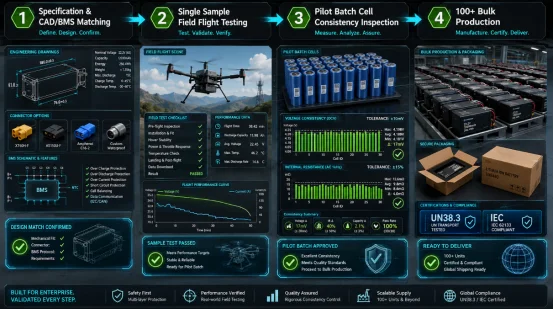
The safest path is staged purchasing. A sample proves whether the pack fits your aircraft. A pilot batch shows whether the supplier can repeat the result. Only then should you place a bulk drone battery order.
This process may appear slower initially. It is usually faster than replacing a fleet after inconsistent packs begin to appear.
Start With a Written Specification
Include nominal voltage, full-charge voltage, capacity, continuous current, peak current, target weight, dimensions, connector, cable length, charger type, and storage conditions.
Add acceptance limits for voltage sag, temperature rise, capacity, and internal resistance. If the pack needs CAN, UART, or another data connection, list the required messages and alarm behavior.
Run a UAV Battery Sample and Pilot Batch
Use a UAV battery sample in the real aircraft, with the real payload. Record takeoff current, minimum voltage, flight time, pack temperature, recharge time, and remaining capacity.
Then order a small pilot batch. Compare pack weight, open-circuit voltage, internal resistance, connector fit, and discharge results. Five identical packs tell you more about production control than one impressive prototype.
Check Records and Shipping Documents
A reliable drone battery manufacturer should provide batch identification and test records that you can trace later. Ask how rejected cells are handled and how production changes are approved.
For international shipments, request current UN38.3 documentation and SDS files.For projects targeting industrial markets in Europe, verify whether IEC 62619 compliance applies to the battery system and its intended application.
What Does a Practical Supplier Evaluation Look Like?
Shengya Electronic is a manufacturer of solid-state lithium-ion soft-pack cells and battery packs for UAVs, robots, and other special applications. Its public company information states a cycle-life range of about 800 to 1,000 charge and discharge cycles, depending on the product and use conditions.
The company also lists support for 6S, 7S, 12S, 13S, and 14S combinations. Its stated battery customization covers the pack combination, cable exit position, plug type, and logo. Those points matter when you are trying to keep 100 or more packs consistent across one aircraft platform. More technical background is available on the Shengya Electronic company profile.
The useful next step is simple. Send the supplier your electrical limits, mechanical drawing, connector details, and mission profile. Review the sample data before discussing the final price.
FAQ
Q1: Is a consumer RC battery suitable for a commercial UAV?
A: It may work for early bench tests, but enterprise fleets usually need tighter cell matching, stronger production control, traceability, and application-specific protection logic.
Q2: What should you request from a UAV battery supplier first?
A: Request a datasheet, cell specifications, discharge curves, dimensions, connector details, BMS information, sample test results, and shipping documents.
Q3: Why does voltage sag matter during drone takeoff?
A: High current passing through internal resistance causes a voltage drop. Excessive voltage sag can reduce thrust or trigger a low-voltage protection response.
Q4: How many packs should you test before ordering 100 or more?
A: Start with one UAV battery sample, then run a pilot batch that represents the intended production design. Compare the results before placing the full order.
Q5: Can a drone battery manufacturer customize the battery pack?
A: A capable supplier may adjust series configuration, cable position, connector, housing details, labels, and communication functions, while keeping the approved design consistent across batches.


