
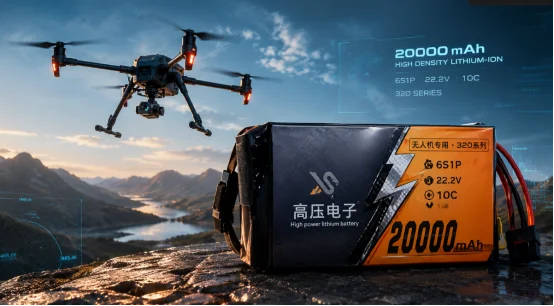
Drone lithium-ion batteries provide extra flight time. They offer higher energy density with reduced weight. They also deliver smooth, consistent power. Still, finding the best battery for your drone takes more than selecting the highest mAh rating. You must match the exact voltage, power output characteristics, overall weight, and plug. Solid safety features matter too.
A lithium-ion drone battery performs well in mapping and surveying applications. But on a speedy racing drone? it may not meet the required discharge performance. This performance gap often creates uncertainty for buyers.
Are Drone Lithium-Ion Batteries the Best Choice?
The answer depends on your specific application. A rechargeable lithium battery for drones packs massive energy into a compact space. That helps immensely for distant, smooth trips. Yet, storing energy differs completely from delivering high discharge current rapidly. Huge capacity simply keeps a drone airborne. Meanwhile, rapid power output manages sharp speed shifts. It also tackles heavy payloads and sudden motor spikes.
Advantages of Lithium-Ion Batteries for Drones
The key advantages of lithium-ion drone batteries are their high energy, good run time, and longer life. A high-energy-density drone battery packs more power without adding heavy weight. This makes a lithium-ion battery for long-range drones perfect for mapping, inspection, monitoring, and logistics delivery applications.
A long-range drone battery also shines when power use stays steady. You will fly much longer when cruising smooth than when zooming straight up. That is completely normal.
Disadvantages of Lithium-Ion Batteries for Drones
Limitations become evident under high-load operating conditions.Some cells cannot push out power fast enough. If the motors ask for too much, the power drops. The battery gets hot. Then, the drone might have to land early.
Lithium-ion battery dangers also happen if you crash, charge them wrong, or get a short circuit. So, are lithium-ion batteries good for drones? Yes, as long as the battery matches the drone and the job.
Which Battery Fits Your Flight Style?
Your battery needs to fit the drone well. You should never force your aircraft to use a bad power source. Check your motors, weight, flight time, and real power needs first. Then pick the battery.
Li-Ion vs LiPo Drone Battery
A Li-ion vs LiPo drone battery choice comes down to flying long versus flying fast. Li-ion is good for steady, long trips. LiPo is much better for racing, quick climbs, and big power bursts.
Ask yourself: what does your drone do during its hardest 30 seconds? Can I use a Li-ion battery instead of LiPo? Yes, but only if the voltage, power flow, plug, size, and balance are right. The same plug does not mean it acts the same.
Where Li-Ion Works Best
A lithium-ion battery for mapping drones covers huge areas easily. A lithium-ion battery for inspection drones saves time on battery swaps near tall power lines. A lithium-ion battery for FPV drones is fine for smooth flying, but it is bad for aggressive aerobatic maneuvers. Big heavy drones need careful power checks, because lifting takes huge power.
What Are the Hidden Safety Risks?
Good safety starts on the ground. Check your battery after moving it, hard landings, or charging. A battery might look fine outside, but internal damage can lead to serious safety risks.
Drone Battery Thermal Runaway
Drone battery thermal runaway happens when a hot battery keeps getting hotter by itself. One bad cell heats the next one. It releases gas and can lead to complete battery failure. Pokes, smashes, overcharging, and hot days make this worse.
What causes a drone battery to catch fire? Bad damage, wrong chargers, bad wires, or pulling too much power. If you crash hard, place the battery in a fire-safe and isolated area. Do not charge it right away.
Voltage Sag and Heat
Voltage sag means you lose power before the battery is fully empty. Fast flying, cold days, old batteries, and heavy loads make this worse. Watch each cell’s voltage, not just the whole pack. Check for abnormal temperature rise after landing. Excessive heat requires immediate inspection.
How Do You Choose a Drone Battery?
How to choose a drone battery becomes straightforward when evaluating the complete aircraft system. The pack must fit in the space, balance the weight, and give enough power.
Check Drone Battery Voltage and Capacity
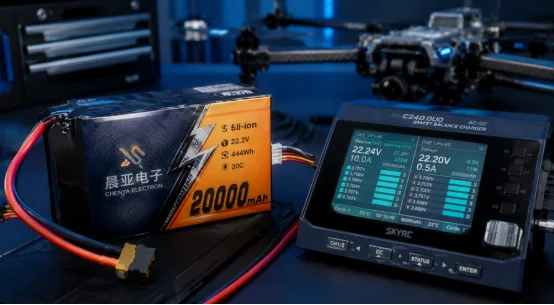
Drone battery voltage and capacity must match your motors and charger. Look at watt-hours, not just mAh:
Watt-hours = Nominal Voltage × Capacity in Amp-hours
This is how to calculate drone battery watt-hours. For example, a 22.2 V, 20 Ah pack stores 444 Wh. A bigger pack might be too heavy. So, more capacity does not always mean longer flights.
Review Current, Weight, and Pack Design
Check the normal power, max power, wire size, and plug. A custom UAV battery pack helps when standard ones do not fit your space or weight limits. Checking these early saves money. Poor connector placement can lead to long-term reliability issues.
How Should You Charge and Store the Battery?
Drone battery charging and storage heavily impact overall safety. They also affect battery life. These routines remain quite simple. Please do not skip them.
How to Charge a Lithium-Ion Drone Battery Safely
Always use the correct charger. Pick a secure, fire-resistant spot. Stay nearby during the process. Allow a hot battery to cool down first. Then, begin charging. Stop charging immediately if the battery shows swelling Stop if it smells strange, emits smoke, or becomes extremely hot. Never attempt to operate or test a damaged battery.
How to Store Drone Lithium-Ion Batteries
Proper storage relies on the manufacturer’s exact guidelines. Never leave packs completely full for several weeks. Also, avoid leaving them totally empty. Keep the units dry and cool. Place them away from loose metal. Store them far from broken batteries. Check your packs regularly.
How Long Do Lithium-Ion Drone Batteries Last?
A single simple answer does not exist. Actual flight time fluctuates constantly. Wind, payload weight, and local weather cause these shifts. Overall life span relies on your discharge depth. Heat levels and daily storage habits play huge roles too.
Throw it out if the power drops fast, cells get out of balance, or it gets way too hot. Puffy, dented, or leaky batteries are trash. A scratched case is okay. A puffy cell is not.
Where Shengya Electronic Fits into UAV Battery Selection
When you know what you need, the maker matters. Shengya Electronic specializes in semi-solid and solid-state lithium-ion soft-pack cells and UAV battery packs. They offer a 190 Wh/kg high-rate 25C series. They also have energy-density series rated at 270, 275, 310, 330, 340, and 350 Wh/kg. You can get 6S, 7S, 12S, 14S, and 18S setups.
The company provides customizable battery solutions for your exact job. This helps with delivery, farming, urban inspection, and rescue tasks. The company says you get 800 to 1,000 charge-discharge cycles for their high-energy models, depending on how you use them.
FAQ
Q1: Are lithium-ion drone batteries safe?
Yes. But you must build, charge, and handle them properly. Crashing hard hurts them. excessive discharge demand or picking cheap chargers brings huge dangers.
Q2: What is the best battery for drone flight?
Simply find what fits your exact power, room, and weight limits. Doing long trips? Pick Li-ion. Flying super fast? You definitely need higher-rate packs.
Q3: How long do lithium-ion drone batteries last?
Flight times change based on wind and payload. Their actual lifespan? That comes down to heat, your charging routine, and everyday storage habits.
Q4: Can I use a Li-ion battery instead of LiPo?
Sure. However, the power output, plug style, physical dimensions, and total mass must match up exactly.
Q5: What should you provide for a custom UAV battery pack?
Tell the builder your available room and target weight. Also, share motor specs, energy demands, and plug type. Add local weather details and your exact charger setup.


