
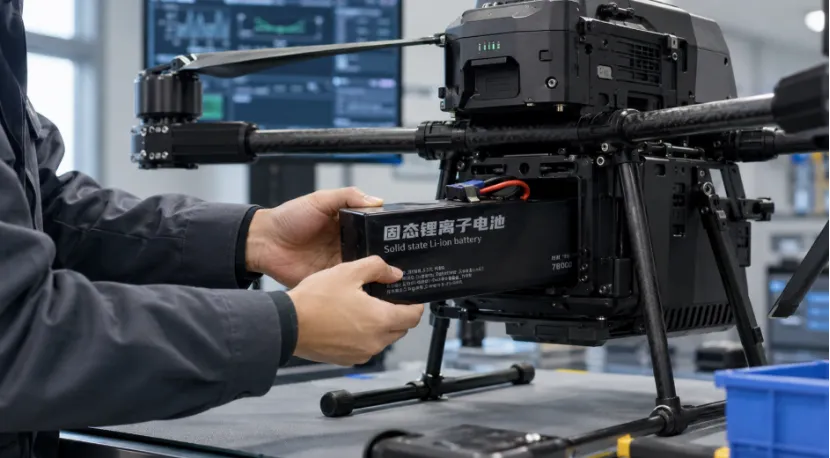
Are drone batteries replaceable? In most cases, yes. Consumer camera drones, FPV aircraft, agricultural platforms, and industrial multirotors often use a removable drone battery. Small integrated aircraft may contain a built-in drone battery that requires enclosure disassembly or technical service.
Drone battery replacement is not simply about finding a battery that fits physically. Voltage, capacity, discharge current, dimensions, weight, connector polarity, and communication protocol must all match the aircraft. For industrial projects, the available UAV battery products also show why batteries are divided by energy density, series configuration, and discharge performance rather than capacity alone.
Are Drone Batteries Replaceable in Different Drone Types?
Battery design decides your swap time. It could take seconds, or it might need workshop tools. First, check how the pack mounts. Also, find its electrical plugs before removal.
Removable and Strap-Mounted Drone Batteries
A removable drone battery often uses a rail, latch, or strap. Smart models include a drone battery management system. This tracks charge, heat, cycle count, cell voltage, and errors.
Strap-mounted packs often appear on FPV and custom UAV builds. Their main power connector stays exposed. Swapping them is fast. But, the pilot must carefully manage polarity, cable routing, and secure strapping.
Built-In and Dual-Battery Drone Systems
A built-in drone battery hooks up via plugs, soldered wires, or an internal board. Opening the shell is risky. You might damage weak antenna cables, sensors, or seals. Always seek professional service if no clear repair guide exists.
Dual-battery industrial systems also need care. Packs may operate as a matched pair, so mixing batteries with very different capacity, internal resistance, or drone battery cycle life can create unequal loading.
When Should You Replace a Drone Battery?
Replacement should follow battery condition rather than age alone. Reference guidance often treats 200 to 300 cycles as a review point for some high-performance lithium packs, but temperature, charge rate, depth of discharge, storage state, and mission load can shorten or extend service life.
Performance Warning Signs
Reduced flight time is often the first sign of declining drone battery health. Compare flights with similar payload, wind, route, and ambient temperature. A sudden drop during takeoff or climb may indicate drone battery voltage sag rather than low nominal capacity.
A healthy pack should also maintain reasonable cell consistency. Persistent drone battery cell imbalance, early low-voltage warnings, unusual percentage jumps, or repeated automatic landing events require further inspection.
Physical and Thermal Warning Signs
A swollen drone battery must not return to service. Other retirement indicators include:
- Cracked or deformed housing
- Burned or loose terminals
- Damaged insulation
- Leakage or unusual odor
- Drone battery overheating
- Impact or water exposure
A damaged drone battery may hold a normal resting voltage yet fail under load. Physical condition therefore carries equal weight with software data.
How Do You Choose a Replacement Drone Battery?
A replacement drone battery must match the electrical system, mounting structure, and intended mission. Connector similarity alone does not prove drone battery compatibility.
Voltage, Capacity, and Discharge Rate
Drone battery voltage is the first parameter to confirm. The series count and maximum charge voltage must suit the electronic speed controllers, motors, power board, and charger.
Battery energy is calculated as:
Watt-hours = Nominal Voltage × Capacity in Ampere-Hours
For example, a 22.2 V, 16 Ah pack stores 355.2 Wh. Drone battery mAh describes charge quantity, while drone battery watt-hours allow a better energy comparison across different voltages.
The drone battery C rating indicates current capability. A 16 Ah pack rated at 10C has a theoretical 160 A current rating, subject to the manufacturer’s continuous-load limits and thermal conditions. Heavy-lift takeoff, rapid climbing, and agricultural spraying may require a higher discharge rate than steady mapping cruise.
Dimensions, Weight, and Communication
Drone battery dimensions must fit the tray without compression. Cable exits should avoid propellers, hinges, hot components, and sharp carbon-fiber edges. The battery weight must remain within the approved takeoff limit and center-of-gravity range.
An intelligent flight battery may also use identification, temperature, or smart battery communication signals. A physically compatible pack may still be rejected by the aircraft if the digital interface differs.
Can a Larger Drone Battery Increase Flight Time?
A higher capacity drone battery stores more energy, but added mass raises the thrust required for hovering. Larger dimensions may also move the center of gravity or obstruct cooling.
Drone Battery Capacity vs Added Weight
The useful comparison is not mAh alone. Energy density, expressed in Wh/kg, indicates how much energy is stored for each kilogram of battery. Long-endurance mapping may favor higher energy density, while heavy-payload aircraft may place greater value on current output and low voltage sag.
The result must be verified through ground testing, low-altitude hovering, motor-temperature checks, and loaded flight trials. A bigger pack can sometimes produce only a small endurance gain. In a poor installation, it can reduce control margin.
How to Replace a Drone Battery Safely
Safe drone battery replacement follows a controlled process. The aircraft should be powered down in a clean, dry area, with propellers stopped and payload systems inactive.
Removal and Installation
The normal sequence is:
- Confirm voltage, capacity, connector, dimensions, and polarity.
- Inspect the new pack for swelling, damage, or loose wiring.
- Release the old pack without pulling on its cables.
- Inspect contacts, locking parts, trays, and straps.
- Install the new pack in the correct orientation.
- Engage every latch or restraint.
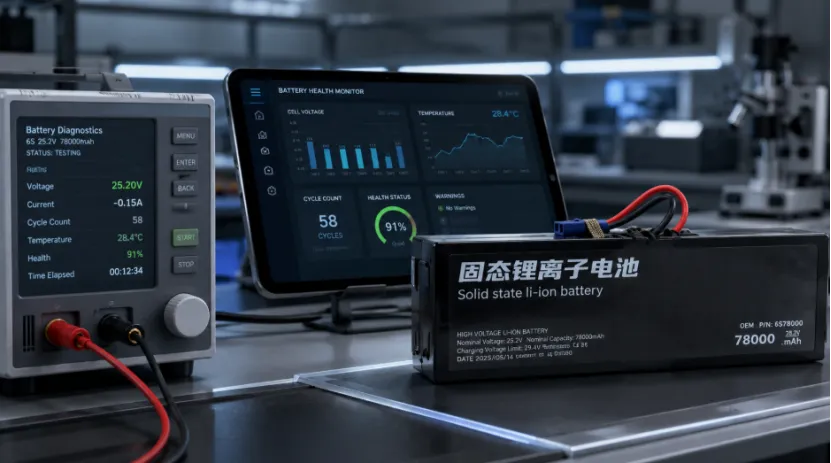
- Check displayed voltage, temperature, and cell status.
Post-Replacement Verification
The first flight should use a low-risk location and conservative altitude. Monitor voltage behavior during takeoff, hover, acceleration, and landing. After the flight, inspect connector temperature, pack movement, cell deviation, and consumed capacity. Industrial fleets should record the battery ID, production date, cycle count, measured capacity, and fault history.
How to Store and Recycle Drone Batteries Safely?
Correct drone battery storage slows calendar aging and reduces fire risk. Long-term charge level should follow the pack manufacturer’s specified storage setting rather than remaining fully charged or deeply discharged.
Storage and Transport
Store extra packs in dry, cool spots. Keep them away from metal items. Always shield the terminals when traveling.
Current airline regulations (such as U.S. FAA guidance) typically limit standard rechargeable lithium batteries at 100 Wh. You can carry up to two spare batteries between 101 and 160 Wh. However, you need airline approval first. Also, they must stay inside your carry-on bags.
End-of-Life Handling
Never throw lithium batteries into regular trash or standard recycling bins. Tape the terminals using nonconductive tape. Alternatively, put each pack inside its own bag. Finally, drop them at a proper hazardous-waste collection point.
Where Does Shengya Electronic Fit into Replacement Projects?
A standard pack may be unsuitable when an aircraft has a restricted battery bay, nonstandard voltage, long cable route, or high peak-current requirement. This is where cell selection and mechanical integration need to be considered together.
Battery Engineering for Different UAV Loads
Founded in 2017, Shengya Electronic produces semi-solid and solid-state lithium-ion soft-pack cells and assembled UAV packs. Its published portfolio includes a 190 Wh/kg high-rate 25C series and high-energy-density ranges from 275 to 350 Wh/kg. Listed capacities extend from 10,000 to 78,000 mAh, with configurations including 4S, 6S, 7S, 12S, 14S, and 18S.
The practical distinction is integration flexibility. Pack combination, cable outlet position, connector type, and external layout can be matched to the airframe. Shengya Electronic also supports UAV duties such as logistics delivery, crop protection, industrial inspection, and emergency response, where replacement packs must balance endurance, peak current, payload mass, and installation space.
FAQ
Q1: Can You Use a Higher-Capacity Drone Battery?
A: Yes, but only when voltage, discharge current, dimensions, weight, connector, center of gravity, and aircraft limits remain compatible.
Q2: Does a New Intelligent Flight Battery Need Firmware Matching?
A: Some smart systems require firmware or communication compatibility. This should be confirmed before operational flight.
Q3: Can Two Batteries With Different Cycle Counts Be Used Together?
A: Dual-pack systems should follow the aircraft manufacturer’s pairing rules. Capacity and internal-resistance differences can cause unequal loading.
Q4: Can a Swollen Drone Battery Be Repaired?
A: No. Swelling indicates internal degradation or gas generation. The battery should be isolated immediately and sent to an approved recycling facility.
Q5: What Data Should Be Sent to a Custom UAV Battery Supplier?
A: Provide nominal voltage, maximum charge voltage, required Wh, continuous and peak current, target weight, installation dimensions, connector, cable length, operating temperature, payload, and expected mission profile.


