
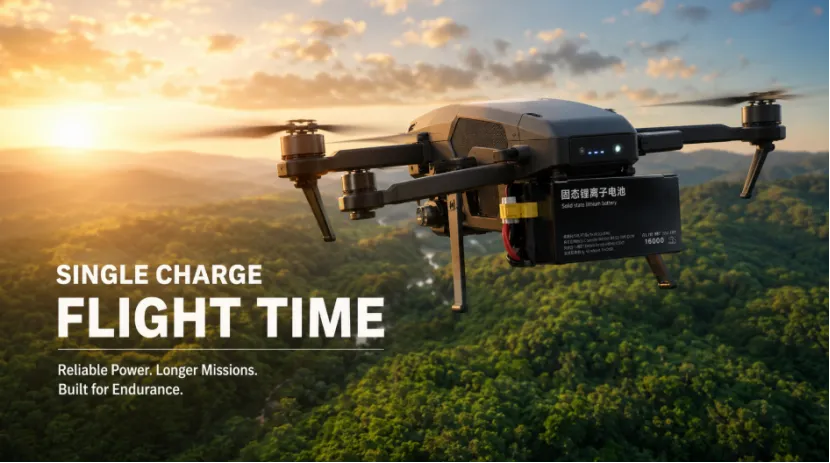
How long can a drone fly? The real answer is rarely the highest number on a data sheet. You need to calculate the actual usable flight time for photography, mapping, inspection, or delivery missions. You calculate this after counting takeoff, transit, return, and landing reserves. Battery design is key here. Shengya Electronic develops UAV battery solutions tailored to different endurance requirements and payload demands.
How Long Can a Drone Fly on a Single Battery Charge?
Drone flight time per charge changes by aircraft class. Recreational entry-level aircraft usually give roughly 6 to 15 minutes. Meanwhile, small camera models hit 20 to 35 minutes. Bigger professional systems might stay up longer. However, payload configuration matters far more as mass goes up.
Consumer and Camera Drone Flight Time
Consumer drone flight time typically supports training, travel photography, real estate imaging, and short video production.A 25-minute rating may suit a small site, but it does not provide 25 minutes of uninterrupted filming. Several extra minutes can remove one battery change from a roof survey.
Camera operation also consumes power. The imaging sensor, processor, mechanical gimbal, obstacle sensors, and transmission system remain active during flight. For this reason, camera drone flight time should be checked with normal recording settings rather than with the payload disabled.
Industrial and VTOL Drone Flight Time
Industrial drone flight time should be evaluated as part of the complete UAV system. Airframe design, payload compatibility, navigation, communications, and mission software all affect the result. VTOL fixed-wing aircraft combine vertical takeoff with efficient cruise, while multirotor platforms suit close inspection and stable hovering.
Why Is Real-World Drone Flight Time Shorter Than Advertised Flight Time?
Advertised drone flight time is usually measured with low payload, stable speed, mild temperature, and little wind. Real-world drone flight time includes climb, maneuvering, sensor operation, and safe return. The difference is normal and does not necessarily indicate a defective battery.
Maximum Time Versus Usable Mission Time
Usable Mission Time = Total Flight Time − Takeoff and Climb − Transit − Return − Landing − Safety Reserve
A 40-minute rating may leave about 22 productive minutes after 5 minutes outbound, 6 minutes for return, and a 7-minute reserve. On-station flight time is therefore more useful than the headline figure.
A distant transmission link does not increase endurance either. Drone flight range and battery life are separate specifications. The aircraft still needs enough stored energy to fly back against the wind and complete a controlled landing.
What Factors Affect Drone Battery Life?
The main factors affecting drone battery life are stored energy, aircraft weight, propulsion efficiency, payload current, weather, altitude, and battery condition. You should compare the complete power system, not capacity alone.
Drone Battery mAh vs Wh
mAh indicates charge capacity, while Wh measures actual stored energy and allows a more accurate comparison across different voltages:
Battery Energy (Wh) = Nominal Voltage (V) × Capacity (Ah)
A 22.2 V, 20 Ah pack stores 444 Wh. Higher mAh does not mean longer endurance if voltage is lower or mass is excessive. Shengya Electronic offers UAV battery solutions including a 190 Wh/kg high-discharge series and energy-density classes from 270 to 350 Wh/kg.
Drone battery energy density, expressed in Wh/kg, shows how much energy the pack stores relative to its mass. Discharge rate serves a different purpose. A high discharge drone battery must deliver the peak current required during takeoff, rapid climbing, heavy-payload operation, or strong-wind correction.
Payload, Wind, and Battery Health
Drone flight time with payload falls because motors must produce more thrust, while cameras, LiDAR, pumps, and communication modules draw power. Headwind raises return demand. Low temperature can increase drone battery voltage sag and trigger an earlier warning.
Internal resistance, cell imbalance, swelling, abnormal heating, and capacity fade indicate declining drone battery state of health. Cycle count helps with maintenance planning, but physical condition and measured capacity remain more important than the number alone.
How Do You Calculate Drone Flight Time?
A practical estimate starts with battery energy and average aircraft power. Maximum motor ratings do not represent normal cruise or hover demand.
A Simple Drone Flight Time Calculation Method
For a 444 Wh pack and an average draw of 900 W:
Theoretical Flight Time = 444 ÷ 900 × 60 = 29.6 minutes
At 80% usable capacity, the result becomes 23.7 minutes before return and landing reserve. Flight-log power data provides a better estimate than catalogue motor data. The test should use the intended propellers, payload, takeoff mass, and normal operating speed.
Which Drone Flight Time Fits Your Application?
Your mission defines the endurance target. A mission-ready UAV should be selected as an operational system because imaging, thermal, LiDAR, or communication payloads change task value and power demand.
Photography, Mapping, and Inspection
Photography needs stable gimbal operation and framing reserve. Mapping requires route coverage, image overlap, positioning accuracy, and predictable cruise power. Inspection often requires hover with zoom or thermal payloads.
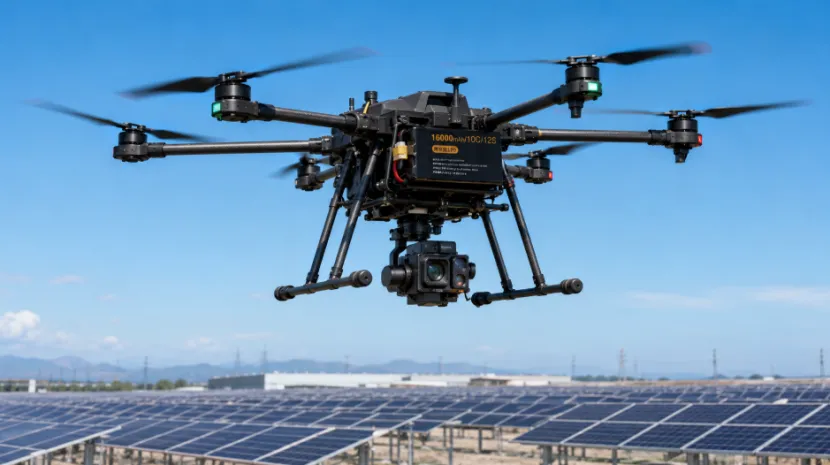
Shengya Electronic’s UAV application portfolio covers logistics delivery, crop protection, industrial inspection, urban air mobility, and emergency response. Each application creates a different balance between energy density, peak current, payload mass, and usable drone mission time.
How Can You Extend Drone Flight Time?
How to extend drone flight time safely comes down to reducing avoidable loss. Suitable propellers, clean motor bearings, sound connectors, and correct cable gauge reduce wasted energy. Route planning should account for wind and return distance.
Battery temperature, cell voltage spread, and cycle history should be checked before critical work. Unused parts may be removed only when the approved aircraft configuration allows it. A larger pack should not be installed without checking voltage, current capability, center of gravity, structural load, and motor temperature.
Where Does Shengya Electronic Fit into Long-Endurance UAV Development?
Long endurance UAV battery selection becomes difficult when a standard pack does not match the airframe, current profile, or installation space. Shengya Electronic was founded in 2017 and manufactures solid-state lithium-ion soft-pack cells and assembled packs. We offer UAV battery energy density classes of 270, 320, 330, and 340 Wh/kg, with stated cycle-life ranges of 800 to 1,000 charge-discharge cycles for relevant products. We also customize cell combinations, cable exit positions, connector types, and branding.
The 310 Wh/kg UAV battery series lists capacities from 20,000 to 70,000 mAh and configurations from 4S to 18S across available models. This allows selection by voltage, payload, peak current, and compartment geometry rather than capacity alone.
FAQ
Q1: How Long Does a Drone Battery Last on One Charge?
A: Entry-level drones typically fly for 6 to 15 minutes, while compact camera aircraft often provide 20 to 35 minutes. Payload and reserve policy reduce usable time.
Q2: Does a Higher-mAh Battery Always Fly Longer?
A: No. Compare Wh, mass, discharge capability, voltage compatibility, and aircraft power demand.
Q3: Does Hovering Use More Battery Than Forward Flight?
A: It normally does for multirotor aircraft. This occurs because rotors provide all lift constantly. Actual power drain depends on airframe efficiency and flight speed.
Q4: When Is a Custom UAV Battery Needed?
A: It is helpful when regular packs fail. This happens if voltage, peak current, weight, or dimensions fall short. It also applies to cable routing, connector, or weather limits.
Q5: When Should a Drone Battery Be Removed from Service?
A: Retire a pack showing swelling or damaged wiring. Stop using it if you spot strange heating or bad cell imbalance. Fast capacity loss or constant voltage warnings also mean it is done.


