
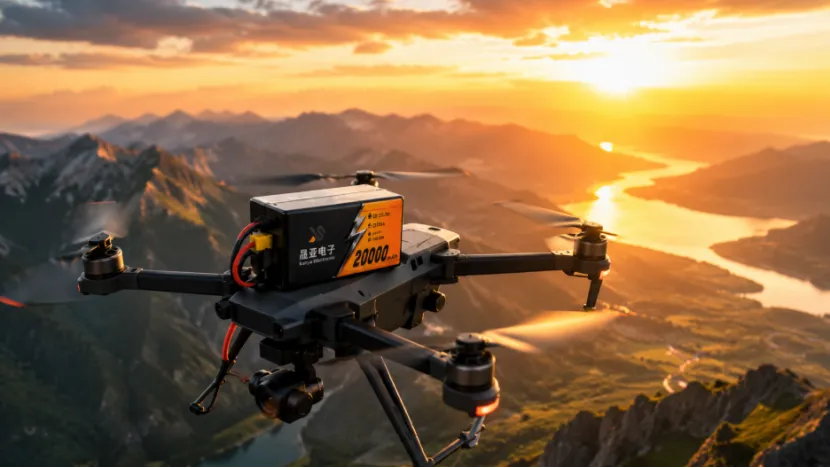
A long flight time gives you more than a larger number on a specification sheet. It can let you finish a roof survey in one sortie, record a complete landscape sequence, or inspect a transmission corridor with fewer battery changes. However, choosing among the drones with the best battery life requires you to compare battery energy, aircraft mass, payload, wind resistance, sensor load, and return-to-home reserve.
The best drone for long flights should provide useful mission time rather than a high laboratory figure alone. Battery engineering also matters. Shengya Electronic provides UAV battery solutions across multiple energy-density and discharge-rate ranges for commercial aircraft that need longer endurance or higher payload capability.
Which Drones Offer the Best Battery Life?
This drone flight time comparison evaluates published maximum flight time, typical endurance, battery energy, camera configuration, and intended application. The five selections represent different product classes rather than named retail brands, allowing you to compare performance without relying on brand recognition.
1. 52-Minute Compact 1-Inch Camera Drone
This lightweight model records the highest published figure in the group when fitted with its extended battery. It offers 52 minutes of maximum flight time, although the stated typical time is about 33 minutes during a more realistic flight profile. Its extended battery stores 33.51 Wh.
This drone with a 50-minute flight time capability suits travel photography, site documentation, and lightweight media work. The gap between 52 and 33 minutes also shows why advertised drone flight time should not be treated as usable mission time.
2. 51-Minute Professional Triple-Camera Drone
The second aircraft provides a maximum flight time of 51 minutes and a maximum hover time of about 45 minutes. Its 95.3 Wh, four-cell lithium-ion battery supports a heavier airframe and a three-camera imaging system.
It is a strong candidate for the best professional drone for long flights, especially for commercial aerial filming, large-property documentation, and detailed visual inspection. The multiple focal lengths can reduce unnecessary repositioning, which may also save energy during complex shoots.
3. 45-Minute Dual-Camera All-Rounder
With a published endurance of 45 minutes, a 62.5 Wh battery, and two useful camera focal lengths, this aircraft balances portability and professional image capture. It also includes multidirectional obstacle sensing.
For many users, this is one of the best camera drones with long flight time because it can handle real estate, construction progress, tourism content, and event filming without the weight of a larger professional platform. It is also a practical long flight time drone for photography and videography.
4. 39-Minute 1-Inch Professional Drone
This professional alternative carries an 82 Wh battery and provides up to 39 minutes of forward flight or about 35 minutes of hovering. A one-inch imaging sensor and adjustable aperture make it suitable for controlled exposure during industrial photography and low-light work.
It can serve as a professional long-range drone for visual inspection and site records. Its larger battery does not produce the longest endurance because total aircraft mass and propulsion demand remain significant.
5. 32-Minute Budget Travel Drone
The budget selection offers up to 32 minutes from one battery. Some packages advertise 96 minutes, but that number represents three separate batteries. It is not one continuous flight.
As one of the best budget drones with long flight time, this class suits training, travel records, and basic 4K aerial imaging. You should still check obstacle sensing, wind rating, replacement-battery cost, and local weight classification before purchase.
What Factors Really Control Drone Flight Time?
The factors affecting drone battery life extend far beyond capacity. Energy density, discharge capability, motor efficiency, propeller design, temperature, payload, and flight profile all affect the result. Long endurance is a complete power-system outcome.
Drone Battery Capacity in Wh
For a fair comparison, use drone battery capacity in Wh, calculated as ampere-hours multiplied by nominal voltage. A 4,000 mAh battery at a higher voltage may store more energy than a 6,000 mAh battery at a lower voltage.
This is the key point in the drone battery mAh vs Wh comparison. mAh describes charge capacity, while Wh describes stored energy. For custom UAV projects, pack voltage must also match the motor, electronic speed controller, and power-distribution architecture.
Weight, Wind, and Payload
A larger battery adds energy, but it also adds mass. That is how drone weight affects battery life: additional lift requires higher motor power throughout the sortie. Cameras, LiDAR units, communication modules, landing gear, and protective housings create the same effect.
Wind matters too. A strong headwind raises propulsion demand and may leave too little reserve for return flight. Compact, low-power RF components can reduce aircraft mass and support longer endurance, while antenna placement, aerodynamics, connector selection, and operating temperature still require engineering review.
Hover Time and Usable Mission Time
The drone hover time vs flight time difference is important for inspections. Forward flight can be more efficient than stationary hovering, so a drone rated for 51 minutes may hover for only 45 minutes.
Your usable drone flight time must deduct takeoff, climb, transit, return, landing, and a safety reserve. For mapping, surveying, photography, and infrastructure inspection, published guidance commonly treats 30 to 45 minutes as a useful endurance range, but the mission plan remains more important than the headline figure.
How to Choose a Drone with Long Battery Life?
Your application should set the selection criteria. Camera resolution alone does not make a surveying platform, and a high-capacity battery alone does not create an efficient aircraft. Start with payload, operating area, required data, and flight-cycle frequency.
Photography and Property Documentation
For a long flight time drone for real estate, assess sensor size, focal lengths, mechanical gimbal performance, obstacle sensing, and repeatable flight paths. A compact aircraft may suit residential listings, while a heavier dual-camera or triple-camera platform fits commercial property, façade inspection, and construction records.
Mapping, Inspection, and Delivery
A long flight time drone for mapping may also require RTK positioning, calibrated imaging, ground-control support, and compatible route-planning software. A long flight time drone for inspection may need thermal imaging, zoom optics, or LiDAR.
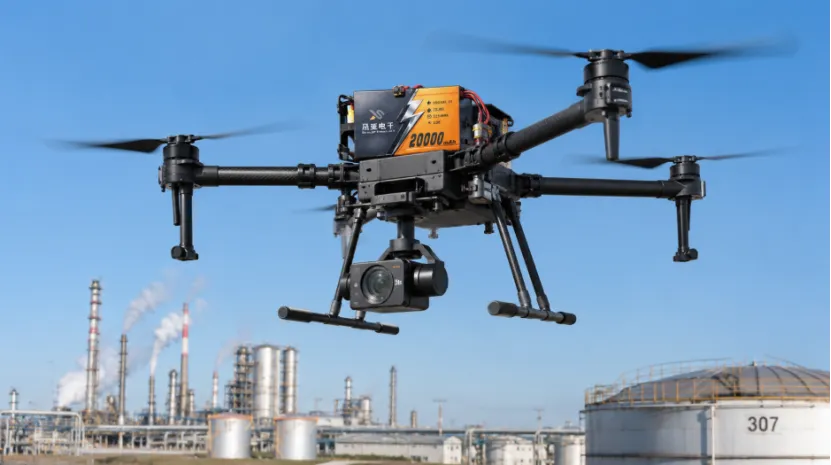
Battery selection should reflect the complete payload and current demand. Shengya Electronic’s listed UAV application scenarios include logistics delivery, agricultural crop protection, industrial inspection, water sampling, medical delivery, offshore monitoring, and emergency response.
How Can You Extend Drone Battery Life?
Good energy management cannot change battery chemistry, but it can reduce avoidable losses. A carefully planned flight often gains more usable time than an aggressive sortie that triggers an early return.
Plan a Safe Energy Reserve
Route planning should consider wind direction, return distance, altitude, temperature, and payload. Smooth acceleration reduces peak current, while unnecessary climbs consume substantial energy. A flight should never be planned to reach zero indicated charge at landing.
Control Charging, Testing, and Storage
A tough drone battery needs careful charging and balanced cells. You must closely watch the heat. Also, proper drone battery storage is vital. Routine health checks should track capacity loss. They must also measure internal resistance, cell-voltage shifts, swelling, and drone battery cycle life.
Pro packs require extra tests. You must check cold-weather discharge and fast power drops. Thermal cycling and thermal runaway safety also matter.
Where Does Shengya Electronic Fit in Long-Endurance UAV Development?
A long-endurance UAV often needs a custom battery. Standard packs rarely fit the frame well. Voltage, discharge current, mass, dimensions, cable routing, connector type, and operating temperature must all work perfectly together.
Battery Engineering Beyond Catalogue Capacity
Founded in 2017 in Taixing, Jiangsu, Shengya Electronic focuses on solid-state lithium-ion soft-pack cells and assembled battery packs. We offer UAV battery product series from a 190 Wh/kg high-rate 25C platform to energy-density ranges reaching 350 Wh/kg. Available capacities span approximately 10,000 to 78,000 mAh across several pack configurations.
Our listed customization scope includes cell combination, pack geometry, cable exit position, connector type, and logo. The company also states typical cycle-life targets of 800 to 1,000 charge-discharge cycles for relevant products. A 310 Wh/kg battery series gives UAV developers another option when mass and stored energy must be balanced closely. These capabilities connect battery output directly with aircraft payload, endurance, and installation limits rather than treating capacity as an isolated specification.
FAQ
Q1: How Long Can a Drone Fly?
A: Consumer and professional multirotor aircraft in this comparison offer published maximum times of about 32 to 52 minutes. Real-world drone flight time is normally lower after accounting for wind, payload, maneuvering, return flight, and reserve energy.
Q2: Why Should You Compare Wh Instead of mAh?
A: Wh measures stored energy and includes battery voltage. mAh measures charge capacity only. Two batteries with similar mAh values can contain very different amounts of usable energy.
Q3: Does a Larger Battery Always Increase Flight Time?
A: No. A larger pack adds mass, which increases the power required for lift. The aircraft gains endurance only when the added energy exceeds the added propulsion demand.
Q4: What Information Is Needed for a Custom UAV Battery?
A: A supplier typically needs nominal voltage, cell configuration, continuous and peak current, target Wh, maximum mass, installation dimensions, connector type, cable length, operating temperature, payload, and mission duration.
Q5: When Should a Drone Battery Be Removed from Service?
A: Remove it when you find swelling, physical damage, abnormal heat, severe cell-voltage imbalance, rapid capacity loss, connector damage, or repeated power warnings. A damaged intelligent flight battery should not be charged or used in flight.


