
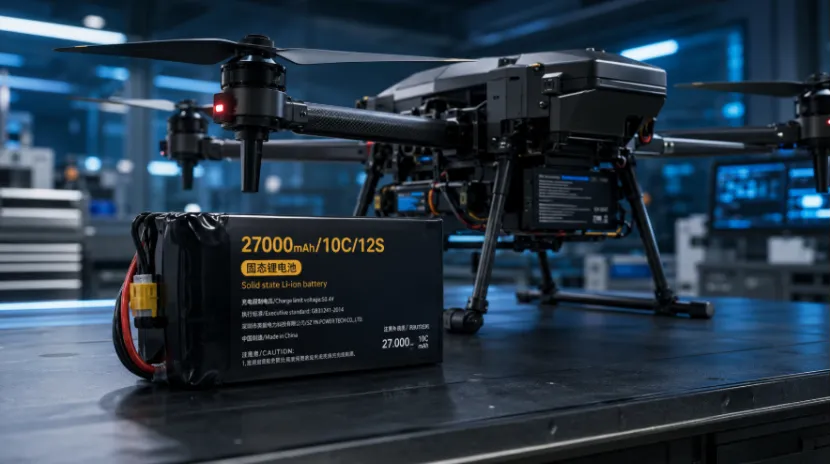
Choosing a drone battery requires more than checking capacity alone. The main drone battery parameters control power, flight time, payload, handling, and safety. A wrong value can cause poor fit, lost thrust, or hot wiring. This drone battery selection guide explains how to interpret drone battery specifications and choose a practical pack.
What Are the Main Drone Battery Parameters?
Start with electrical compatibility, then check physical limits. A strong-looking battery can still fail the job if its weight shifts the center of gravity or its connector cannot carry peak current. Available drone battery products show why voltage, capacity, energy density, and cell configuration must be reviewed together.
Voltage and Cell Count
Drone battery voltage comes from the drone battery cell count. A standard 6S battery pack consists of six cells in series with a nominal voltage of 22.2 V. Your motor, ESC, power module, and charger must accept the full voltage range. Higher voltage can deliver the same power at lower current, but it is not a direct upgrade without system compatibility checks. Too much voltage can damage electronics.
Capacity, Energy, and Flight Time
Drone battery capacity is typically specified in mAh or Ah.More capacity usually supports longer drone battery flight time, but it also adds mass. Compare energy in watt-hours: Wh = nominal voltage × capacity in Ah. For example, a 22.2 V, 20 Ah battery pack stores approximately 444 Wh of energy.
A larger pack may add less flight time than expected because the drone must carry it every second. If 16 Ah is usable and average current is 40 A, rough flight time is 24 minutes. Wind, payload, cold weather, reserve level, and battery age will reduce that figure.
C-Rating and Current Output
Drone battery C-rating describes current capability relative to capacity. The maximum theoretical current equals capacity (Ah) × C-rating. A 20 Ah, 10C pack is rated at 200 A in theory. Your required drone battery discharge rate should cover measured continuous current plus short takeoff or climb peaks.
A very high C-rating is not always better. High-rate cells can be heavier, so the extra current capability may cut endurance when the aircraft rarely needs it.
Size, Weight, and Connectors
Drone battery size and weight affect mounting, center of gravity, payload, and motor load. Measure the tray, strap position, cable clearance, and nearby cooling space. Also check drone battery connector types, wire gauge, polarity, and current rating. An undersized connector in a high-current UAV battery pack can become a critical failure point, even when the cells are suitable.
Chemistry and Energy Density
The LiPo vs Li-ion drone battery choice depends on your mission. High-power multirotors value fast discharge and firm voltage response. Long-range aircraft often value energy per kilogram. Energy density is important, but it does not replace discharge performance data.A light pack that suffers severe voltage sag under load will not give good field performance.
How Do These Parameters Affect Your Flight?
Battery selection affects the entire propulsion system, not one isolated part. The best battery for a drone should meet thrust demand without taking too much payload or producing excess heat. Small differences become significant in real-world operations, such as a mapping aircraft fighting a headwind on the return leg.
Power and Voltage Sag
When current rises, battery voltage falls. High internal resistance makes that drop worse and creates heat. If voltage sag reaches the low-voltage limit during takeoff, the aircraft may reduce power even though the display still shows remaining capacity. Check loaded voltage, not only resting voltage.
Weight and Endurance
More watt-hours can extend range, while extra weight raises hover current. This is why UAV battery selection should compare test flights at the same payload, route, reserve setting, and weather range. A bench figure alone does not tell the whole story.
How to Choose a Drone Battery Step by Step?
A sound process starts with aircraft limits and ends with a controlled flight test. Avoid selecting a battery pack based on a single headline specification. Review the full drone battery specifications, including voltage, continuous current, dimensions, cable, connector, charge rate, and operating temperature.
1. Define the Mission
List payload, target flight time, speed, altitude, temperature range, and wind conditions. A delivery multirotor, survey aircraft, and racing platform ask for different current and energy profiles. Application examples can help you compare real operating priorities through these UAV application cases.
2. Match Voltage and Current
Use the approved voltage range from the motor and ESC data. Add the maximum current of all motors plus avionics and payload equipment. Select a pack whose continuous output covers that demand with a sensible margin. Check burst current separately.
3. Balance Capacity against Weight
Estimate watt-hours from average current and target time, then check total takeoff mass. If a larger pack pushes the aircraft outside its efficient thrust range, step back. Sometimes two shorter flights are safer and faster than one overloaded flight. Not glamorous, but often true.
4. Check Physical and Charging Compatibility
Confirm pack dimensions, mounting method, center of gravity, connector, polarity, balance lead, and charger power. For custom platforms, cable exit position matters too. Improper cable routing that causes bending or stress against the frame can lead to premature failure.
5. Test before Full Operation
Inspect cell voltage and internal resistance, then run a low-risk hover and a normal mission profile. Record peak current, lowest loaded voltage, landing temperature, used capacity, and actual flight time. Repeat in the cold or under full payload if those conditions matter.
What Should You Look for in a Battery Supplier?
The supplier should help turn aircraft data into a workable pack specification, not just offer a large catalog. You need clear cell data, pack-level current limits, consistent assembly, usable test information, and the ability to match voltage, capacity, wiring, and connectors.
Shengya Electronic and UAV Battery Configuration
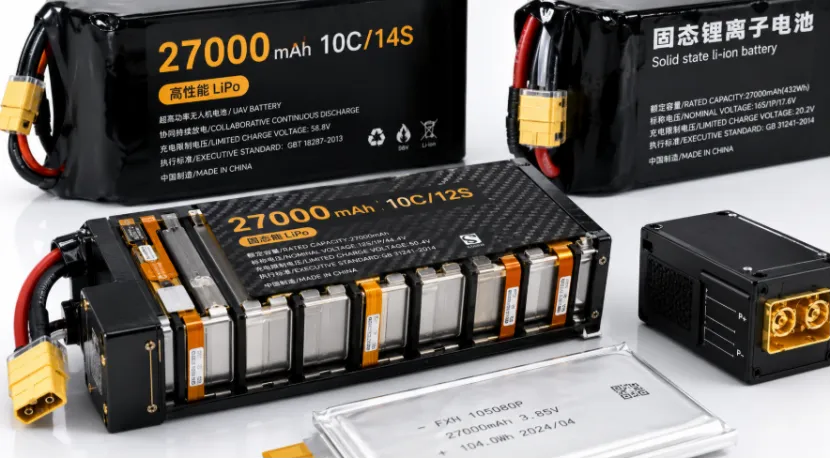
Shengya Electronic specializes in semi-solid and solid-state lithium-ion pouch cells and battery packs for drones, UAVs, robots, and related equipment. Its official product range includes energy-density series from 190 Wh/kg high-rate packs to 270, 275, 310, 330, 340, and 350 Wh/kg options. Listed configurations cover 4S to 18S and capacities from 10,000 mAh to 78,000 mAh across different series.
The company also offers customization for battery pack configurations, cable exit positions, plug types, and labels. For buyers comparing an industrial UAV battery pack, this range supports a practical discussion of discharge power, weight, voltage, and endurance rather than applying a one-size-fits-all battery solution.
FAQ
Q1: What Are the Most Important Drone Battery Parameters?
A: The key values are chemistry, voltage, cell count, capacity, watt-hours, C-rating, continuous current, size, weight, connector, charge rate, internal resistance, and temperature range.
Q2: How to Choose a Drone Battery for Longer Flight Time?
A: Compare usable watt-hours and total battery weight. Then test average current at the real payload. More mAh helps only when the added mass does not raise power demand too much.
Q3: What Drone Battery C-Rating Do You Need?
A: Calculate maximum current from all motors and onboard equipment. Choose a continuous rating above measured demand, with extra room for takeoff and climb peaks.
Q4: Can You Use a Higher Drone Battery Voltage?
A: Only when the motor, ESC, flight controller, power module, and charger support the full-charge voltage. Do not judge compatibility from nominal voltage alone.
Q5: When Should You Replace a UAV Battery Pack?
A: Replace it when cells become swollen, damaged, badly unbalanced, unusually hot, or show rising internal resistance and sharp voltage sag. A battery pack may charge normally yet still be unsafe for flight operations.


